



Viral desai
Artificial Intelligence is rapidly becoming one of the most transformative technologies of our time. From healthcare and education to manufacturing, scientific research, communication and climate modelling, AI is beginning to influence almost every sphere of human activity. Yet behind this extraordinary digital revolution lies a physical reality that receives far less attention. Artificial Intelligence may appear to live in the cloud, but the infrastructure that powers it exists firmly on the ground and eventually, so does its waste.
Every question asked to an AI system, every image generated and every complex model trained depends upon data centres filled with servers, specialised processors, GPUs, storage systems, cooling equipment, cables and other electronic infrastructure. As global competition accelerates to build faster and more powerful AI systems, the demand for this hardware is expanding rapidly. At the same time, successive generations of more efficient and powerful chips can shorten the economically useful life of existing equipment.
This raises an important environmental question: what happens to today's AI hardware when tomorrow's technology replaces it?
Electronic waste is already one of the world's fastest-growing waste streams. According to the Global E-waste Monitor 2024, the world generated approximately 62 million tonnes of e-waste in 2022. Only 22.3 per cent was documented as formally collected and recycled. The report projects global e-waste generation could reach 82 million tonnes by 2030 if current trends continue.
Artificial Intelligence could add another dimension to this challenge.
A 2024 study published in Nature Computational Science examined the potential e-waste implications of generative AI and estimated that, depending upon different growth scenarios, generative AI could cumulatively contribute between 1.2 million and 5 million tonnes of e-waste between 2020 and 2030.
More recent estimates have produced considerably different numbers, demonstrating how difficult it remains to forecast the environmental footprint of a technology evolving at extraordinary speed. Assumptions about computing demand, improvements in chip efficiency, equipment lifespan, reuse and future AI architectures can dramatically change projections.This uncertainty should not be ignored. Nor should the highest available estimate simply be selected because it creates the most dramatic headline.
The more important message emerging from these studies is much simpler: Artificial Intelligence has a physical environmental footprint, and that footprint must become part of the AI conversation before it becomes another environmental problem that we attempt to solve retrospectively.
There is an interesting contradiction at the centre of this challenge. We are creating machines capable of extraordinary intelligence while potentially continuing to operate them through one of humanity's least intelligent economic models: extract, manufacture, consume, discard and replace.
AI requires highly specialised electronic equipment containing valuable metals, minerals, plastics and complex components. When this equipment reaches the end of its useful life, it does not disappear simply because the services it provided were digital.
Electronic waste contains valuable resources including copper, aluminium, iron, gold and other critical materials. Recovering these resources scientifically can reduce pressure on virgin mining and strengthen resource security. But when e-waste enters poorly regulated or informal recycling systems, the environmental and human-health consequences can be serious. Unsafe dismantling, burning and chemical processing can release hazardous substances into air, soil and water.
AI e-waste, therefore, should not be viewed merely as another waste-management problem. It is simultaneously a pollution issue, a resource-security issue, a circular-economy issue and increasingly a question of how responsibly we want to build the digital economy.
For India, this conversation assumes particular significance.
India has ambitious aspirations in Artificial Intelligence, semiconductor manufacturing, data centres, digital infrastructure and advanced electronics. These ambitions can create enormous economic opportunities, generate employment, improve productivity and strengthen India's position in the global technology ecosystem. The choice cannot be between technological progress and environmental protection.
The real question is: what kind of technological progress should India pursue?
India already has an important regulatory foundation through the E-Waste (Management) Rules, 2022 and its Extended Producer Responsibility framework. But the extraordinary expansion of AI infrastructure presents an opportunity to think beyond conventional e-waste management.
Can servers be designed and operated for longer useful lives? Can older AI hardware be redeployed for less computationally demanding applications rather than immediately discarded? Can processors, storage systems and other components be refurbished? Can data centres maintain transparent inventories of equipment and materials? Can critical minerals from obsolete electronics be recovered within India? Can procurement policies encourage durability, repairability, modularity and recyclability?
Most importantly, can circularity be designed into India's AI ecosystem before the waste is generated?
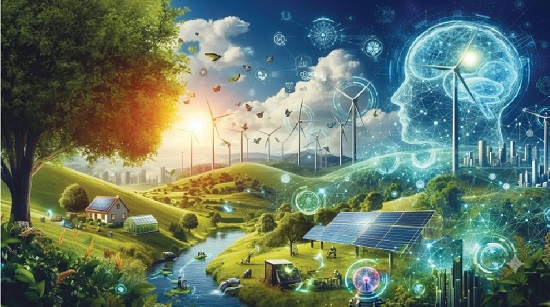
This leads to what I believe should become an important principle for the next phase of technological development: Artificial Intelligence must also become Environmentally Intelligent.
For decades, technological progress has largely been measured through parameters such as speed, computing capacity, efficiency, affordability and commercial value. In an era of climate change, biodiversity loss, pollution and increasing pressure on natural resources, these measurements are no longer sufficient.
Environmentally Intelligent AI would examine the entire lifecycle of Artificial Intelligence—from the minerals extracted to manufacture its chips and the resources required to construct its data centres, to the electricity and water consumed during operation and ultimately what happens to the hardware when it becomes obsolete.
This does not mean slowing technological innovation. Nor should environmental concerns become an argument against Artificial Intelligence.
The objective should be to make AI smarter in the fullest meaning of the word.
Encouragingly, scientific research suggests that intervention can make a significant difference. The Nature Computational Science study estimated that circular-economy strategies could reduce projected generative-AI-related e-waste substantially, with reductions ranging from approximately 16 per cent to 86 per cent under different interventions and scenarios.
This tells us something extremely important: the future environmental footprint of Artificial Intelligence is not predetermined.
We can influence it.
A practical framework could begin with five principles: Reduce, Reuse, Refurbish, Recover and Recycle.
Reduce unnecessary hardware replacement. Extend the useful life of equipment wherever technically feasible. Reuse older computing systems for applications that require less processing power. Refurbish components rather than automatically replacing complete systems. Recover valuable and critical materials when equipment genuinely reaches the end of its life. And finally, ensure that remaining electronic waste enters scientifically managed recycling systems rather than unsafe disposal channels.
But there is another dimension to this debate that should not be overlooked. Artificial Intelligence itself could become an extraordinarily powerful environmental tool.
AI can help optimise electricity grids, improve industrial energy efficiency, strengthen climate and weather modelling, monitor forests, detect pollution, map biodiversity, improve agricultural resource efficiency, identify illegal deforestation and potentially make waste sorting and recycling more effective. The irony would be profound if a technology capable of helping humanity address environmental problems simultaneously created environmental problems that humanity failed to anticipate.
The objective, therefore, cannot be AI versus the environment. It must be AI for the environment without AI itself becoming an unnecessary burden on the environment.
India has an opportunity to provide leadership in this transition. Our ambition should not merely be to participate in the global AI race or expand our computing capacity. We can aspire to develop an Indian model of Green AI in which technological advancement and environmental responsibility evolve together. Imagine an AI ecosystem where data centres increasingly operate on cleaner energy, water is managed responsibly, electronic equipment is designed for longevity, refurbishment becomes economically attractive, valuable minerals circulate back into manufacturing and producers remain responsible for the environmental lifecycle of their technologies.
Such an approach would demonstrate that sustainability is not an obstacle to technological progress. It can become an important measure of technological progress itself.
The larger lesson extends beyond Artificial Intelligence. For generations, humanity has often celebrated innovation first and confronted its unintended environmental consequences later. We developed plastics before understanding microplastic pollution. We built fossil-fuel-dependent economies before fully confronting their climatic consequences. We embraced disposable electronics before developing adequate systems to recover their materials.
Artificial Intelligence gives us an opportunity to do something different.
This time, we can anticipate the environmental consequences while the technological revolution is still unfolding.
Artificial Intelligence may eventually become one of humanity's most consequential inventions. But perhaps its true intelligence should not be measured only by how rapidly it processes information, how convincingly it communicates or how effectively it solves our problems. It should also be measured by how responsibly it uses the resources of the planet that made its existence possible.
The future does not need less Artificial Intelligence. It needs Artificial Intelligence accompanied by greater environmental intelligence.
Because ultimately, the smartest technology cannot truly be called intelligent if the planet becomes poorer in creating it.
(The author is a known Environmentalist and the pioneer of Satyagraha Against Pollution movement, viraludayindia@gmail.com )
(The content of this article reflects the views of writer and contributor, not necessarily those of the publisher and editor. All disputes are subject to the exclusive jurisdiction of competent courts and forums in Delhi/New Delhi only)






















Leave Your Comment