


Pakistan's internal political fault lines are once again coming into sharp focus, with thousands of people taking to the streets in Sindh to oppose a proposal to divide the country's existing provinces. What began as resistance to an administrative restructuring has rapidly developed into a wider confrontation involving ethnic identity, control over natural resources and the authority of Pakistan's military establishment. The protests have also revived the demand for an independent Sindhudesh, bringing fresh attention to the growing resentment against the military-backed power structure led by Army chief Field Marshal Asim Munir.
Thousands of people have poured onto the streets across Pakistan's Sindh province, sending a strong political message against a proposal to carve out smaller provinces from the country's existing administrative boundaries. The demonstrations, which have spread from Karachi to Hyderabad, Larkana, Nawabshah and other towns, reflect growing apprehensions among Sindhi nationalists that the proposed restructuring could undermine the province's historical identity, political influence and control over its resources. Protesters allege that the initiative is not simply an administrative exercise but part of a larger design by Pakistan's military-backed establishment to weaken Sindh and strengthen central control over its territory and wealth.
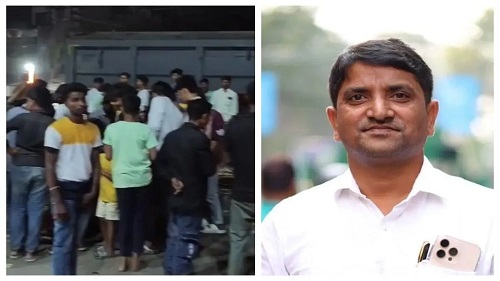
The largest demonstration took place in Karachi on November 22, when thousands of protesters carrying red flags assembled under the banner of the Jeay Sindh Rahbar Committee (JSRC), a coalition of four Sindhi nationalist organisations. The rally was led by Jeay Sindh Mahaz chairman Riaz Ali Chandio, along with Niaz Kalani and other prominent nationalist figures. Lawyers and civil society representatives also joined the agitation, disrupting traffic and forcing the temporary closure of several roads. The organisers made it clear that their opposition was directed against the proposed division of Sindh rather than any particular ethnic or linguistic community, including Urdu-speaking residents. They also rejected the suggestion of holding a referendum on creating smaller provinces, arguing that such a process could become a convenient instrument to legitimise a decision already favoured by the authorities. The Karachi demonstration followed similar protests in Hyderabad, Nawabshah and Larkana, while residents of Mehar in Dadu district also organised a rally on November 21.
Beyond the question of provincial boundaries, the agitation has increasingly become a confrontation over Pakistan's political power structure. Sindhi nationalist leaders have accused the military establishment, which they describe as dominated by Punjab, of attempting to consolidate its influence over Sindh's agricultural land, coastal territories and mineral wealth. Their allegations include the appropriation of extensive agricultural areas and strategic coastal islands, besides growing control over resources such as oil, natural gas and coal. Field Marshal Asim Munir has consequently become a prominent target of criticism, with protest leaders accusing the military leadership of interfering in provincial affairs and threatening Sindh's territorial integrity. These allegations have added an explosive dimension to an already sensitive debate over federalism and provincial autonomy.
The controversy has also created political complications for Prime Minister Shehbaz Sharif's government. The Pakistan Peoples Party (PPP), an important ally of the federal administration and a powerful political force in Sindh, has opposed the proposed division of the province. This puts Islamabad in an uncomfortable position, as any attempt to push ahead with the restructuring risks intensifying tensions with a coalition partner that commands considerable political influence in the region. The resistance also highlights the longstanding friction between Pakistan's centralised political system and provinces demanding greater control over their administrative, economic and natural resources.
Meanwhile, the protests have given fresh momentum to the separatist movement seeking an independent Sindhudesh. The Jeay Sindh Muttahida Mahaz (JSMM), whose activists participated in the Karachi demonstration despite not being part of the organising coalition, has announced plans to expand its agitation. The organisation has threatened an economic blockade targeting Punjab and indicated that its campaign against the proposed division of Sindh would be transformed into a broader struggle for independence. Its Germany-based chairman, Shafi Muhammad Burfat, has appealed to the United Nations and the international community to support the creation of an independent Sindhudesh. In a statement on X, he rejected Pakistan's existing political and territorial framework and described the proposed division as an attempt by the military establishment to undermine the Sindhi nation.


















Leave Your Comment