


Union Agriculture and Farmers Welfare Minister Shivraj Singh Chouhan's visit to Punjab's Tarn Taran district carried a message that went beyond a routine interaction with farmers. Sitting among farmers in the fields of Booh Haveliyaan village, listening to their problems and discussing practical solutions, Chouhan sought to underline the importance of farmer welfare, sustainable agriculture and cooperation between the Centre and the state. His appeal was particularly significant at a time when Punjab's agricultural sector is grappling with soil degradation, stubble management and the need to diversify traditional farming practices.
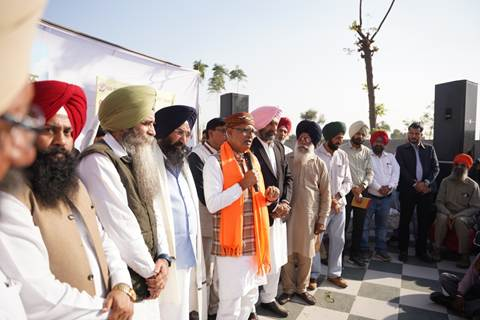
Addressing the Kisan Chaupal at Booh Haveliyaan, Chouhan made it clear that his purpose was not to organise a major political gathering or deliver a conventional political speech. Instead, he wanted to sit among farmers, understand their difficulties and listen to their suggestions. Describing himself as a servant of farmers rather than a leader, he said that public office was an opportunity to serve people and not a source of personal ego or authority.
Invoking the teachings of Guru Nanak Dev Ji, Chouhan emphasised the values of humility, service and freedom from jealousy, arrogance and ill will. He observed that farmers work tirelessly to ensure that the country has enough food, and serving those who feed the nation is, for him, equivalent to worshipping Satguru.
He also acknowledged Punjab's historic contribution to India's food security. Recalling the period when the country depended on imported wheat to meet its food requirements, he said Punjab's farmers transformed the agricultural landscape through the Green Revolution and helped India become self-sufficient in foodgrain production. Their contribution, he stressed, would always remain central to the country's development.
However, the minister cautioned that the agricultural achievements of the past should not come at the cost of future generations. Excessive use of chemical fertilisers and pesticides, along with the practice of burning crop residue, is damaging soil health and affecting beneficial organisms such as earthworms and friendly insects. Protecting soil fertility, therefore, must become a priority for farmers and policymakers alike.
Appreciating the farmers and panchayats of Booh Haveliyaan and neighbouring areas for avoiding stubble burning for the past six years, he highlighted their adoption of Happy Seeder and Direct Seeding technologies. He described their efforts as an inspiring example of the Khet Bachao Abhiyan, demonstrating that agricultural productivity and environmental protection can go hand in hand.
An important aspect of the Kisan Chaupal was the discussion on the practical difficulties farmers encounter while managing crop residue. Progressive farmers Sukhwinder Singh of Kirtowal, Jatinder Singh of Munda Pind and former sarpanch Gurnam Singh shared their experiences and raised concerns regarding the availability of effective agricultural machinery and subsidies for baler machines.
Chouhan gave serious consideration to their suggestions and assured them that they would be invited to Delhi for a detailed discussion so that their concerns could be examined and appropriate solutions explored.
Responding to complaints about the quality of machinery supplied under government subsidy programmes, he clarified the respective responsibilities of the Centre and the state. The Union Government is providing approximately Rs 286 crore to Punjab this year under the Crop Residue Management (CRM) programme. However, the responsibility for procuring machinery, ensuring quality standards and making arrangements for repairs rests with the state government.
He urged the Punjab government to ensure that farmers receive reliable equipment rather than machinery that becomes unusable after a short period. Proper maintenance and repair facilities are equally important because farmers cannot be expected to adopt environmentally friendly practices without dependable technological support.
The larger message was that stubble management cannot be treated merely as a seasonal exercise or an administrative campaign. It requires affordable machinery, timely subsidies, technical assistance and sustained cooperation among farmers, village panchayats and government agencies. Punjab's experience also demonstrates that encouraging successful local models can be more effective than relying exclusively on punitive measures.
Chouhan also stressed that making agriculture economically sustainable requires more than increasing crop production. Farmers must be able to reduce cultivation costs, diversify their sources of income and adopt integrated farming practices. He advocated combining traditional crop cultivation with animal husbandry, fisheries and poultry farming to reduce dependence on a limited number of crops and create additional income opportunities.
A major concern raised by the minister was Punjab's continued absence from the Pradhan Mantri Fasal Bima Yojana. Expressing disappointment over the scheme's non-implementation in the state, he said crop insurance could provide essential protection to farmers against losses caused by floods and other natural disasters. He recalled writing to the Punjab Chief Minister during the floods, urging the state government to implement the scheme so that affected farmers could receive financial compensation.
The issue is particularly important for a state where agricultural livelihoods are vulnerable to extreme weather conditions and other uncertainties. Crop insurance, he indicated, should be viewed as a necessary safeguard rather than an optional welfare measure.
Speaking to the media after the interaction, Chouhan reiterated the Centre's commitment to procuring farmers' produce at the Minimum Support Price. He said the government was procuring the entire quantity of paddy and wheat offered under the procurement system. He also highlighted the Centre's commitment to 100 per cent procurement of tur, masoor and urad pulses, along with cotton, at MSP.
Contrasting the procurement record of the present government with that of the previous UPA regime, he maintained that the Modi government had procured substantially larger quantities of agricultural produce and would continue supporting farmers through assured procurement.
The Tarn Taran interaction thus brought several interconnected challenges into focus: protecting soil fertility, eliminating stubble burning through technology, improving agricultural machinery, expanding crop insurance and ensuring remunerative prices. Chouhan's emphasis on listening directly to farmers suggested that agricultural policymaking must be guided by ground realities rather than administrative assumptions. Ultimately, Punjab's next agricultural transformation will depend not only on preserving its legacy as the country's food bowl but also on building a farming system that is environmentally responsible, economically rewarding and secure for future generations.

















Leave Your Comment