


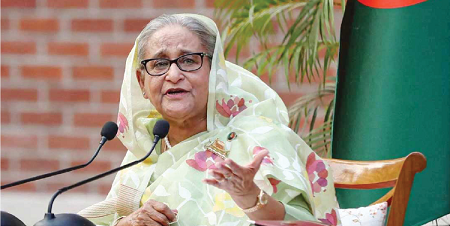
Former Bangladesh Prime Minister Sheikh Hasina’s declaration that she intends to return to Bangladesh in December 2026 is far more than a personal political announcement. It has the potential to become a defining moment for Bangladesh’s democracy, its political institutions and the future direction of India-Bangladesh relations. After nearly two years in exile in India, Hasina has made it clear that neither arrest, imprisonment nor even the possibility of death will deter her from returning to her country. In July, she told Reuters that she and senior Awami League leaders planned to return and surrender to the courts.
Her latest public intervention has added a new dimension to an already complicated political situation. Hasina was ousted in August 2024 following a mass student-led uprising and subsequently remained in India. Bangladesh’s International Crimes Tribunal later sentenced her to death in absentia, while activities of the Awami League have been banned. Her proposed return therefore presents Bangladesh with an extraordinary constitutional and political challenge: can the country deal with its most powerful former leader through a credible judicial and democratic process, rather than allowing political rivalry to turn into political retribution?
That question will have consequences far beyond Sheikh Hasina herself.
A return that could reshape Bangladesh’s politics
Hasina’s decision has already injected fresh energy into Bangladesh’s political discourse. Her message that she is prepared to face arrest or even death on returning home is likely to resonate strongly among Awami League supporters, many of whom have faced political and legal pressure since the fall of her government. At the same time, her return would pose a formidable challenge to the political forces that have emerged after her removal.
The issue is particularly sensitive because Bangladesh’s political competition has historically been dominated by rivalry between the Awami League and the Bangladesh Nationalist Party (BNP). With BNP leader Tarique Rahman now serving as prime minister after the 2026 elections, the political contest has entered a new phase. India has already invited Rahman to attend the BRICS Summit in New Delhi as a special guest, offering an opportunity for direct engagement between the new Bangladeshi leadership and New Delhi.
Hasina’s return could therefore transform the political landscape once again. It could revive the Awami League as a political force, deepen the contest between the two principal political camps and bring millions of voters back into an intensely polarised political debate.
The central issue, however, should not be whether Hasina is politically popular or unpopular. In a democracy, the ultimate decision belongs to the electorate. The more important question is whether every political force is allowed a fair opportunity to participate in the political process, subject to the law.
If an entire political party is permanently excluded from democratic competition because of the actions of its former government, Bangladesh risks weakening the very democratic institutions it seeks to strengthen.
Justice must not become political revenge
There is no question that allegations surrounding the violent suppression of protests during Hasina’s final days in power require credible investigation and accountability. Justice for victims is an essential component of democracy. But justice must be transparent, independent and consistent with internationally recognised principles of due process.
The danger arises when accountability is perceived as collective punishment.
The post-2024 political environment has already witnessed intense pressure on former Awami League figures and supporters. The recent attack on the home of former Bangladesh cricketer and former Awami League lawmaker Shakib Al Hasan, following his participation in a virtual appearance involving Hasina, has further raised concerns about the atmosphere surrounding political dissent. Reuters reported that Shakib, who has been living abroad, has said he is ready to return if the government guarantees his security.
Such incidents matter because political violence rarely remains confined to politicians. Once political disagreement begins to spill into attacks on individuals, families, businesses or public figures, it weakens social cohesion and creates an atmosphere of fear.
Bangladesh therefore faces a critical test. If Hasina returns, the state must demonstrate that she will be treated according to law and that her supporters will not be subjected to extra-legal retaliation. Equally, Hasina and her supporters must accept legitimate judicial processes and accountability where evidence establishes wrongdoing.
Democracy cannot mean immunity for those in power. But neither can it mean punishment without due process for those who lose power.
The deeper battle over Bangladesh’s identity
The Hasina controversy is also connected to a much larger struggle over Bangladesh’s historical and ideological identity.
The Awami League has traditionally presented itself as the principal political inheritor of the 1971 Liberation War and the secular-nationalist foundations of Bangladesh. The BNP, meanwhile, has its own interpretation of the country’s national identity and political history. The competition between these narratives has increasingly become intertwined with contemporary political rivalry.
Consequently, Hasina’s return would not simply be a contest between an individual politician and the government of Tarique Rahman. It could reopen fundamental debates about the Liberation War, secularism, nationalism, the role of religion in public life and the nature of Bangladesh’s relationship with its neighbours.
Will Hasina’s return unite Bangladesh—or divide it further?
This is perhaps the biggest question.
Hasina’s return could energise democratic competition. Her presence could force the BNP government to demonstrate its commitment to political pluralism and compel the Awami League to reconnect with voters and confront allegations concerning its past rule.
But there is another possibility.
If her return triggers mass protests, arrests, violence or counter-mobilisation, Bangladesh could enter another cycle of political instability. Instead of creating healthier competition, her return could deepen the divide between supporters and opponents.
The difference between these two outcomes will depend less on Hasina herself than on the institutions surrounding her.
If the judiciary acts independently, if law enforcement remains politically neutral, if the government protects peaceful political activity and if all parties reject violence, her return could actually become an opportunity for democratic renewal.
If, however, political rivalry continues to be settled through arrests, intimidation and street violence, Bangladesh risks entering another dangerous phase of polarisation.
For India, the challenge is to demonstrate that its neighbourhood policy can rise above personalities and partisan preferences. New Delhi must maintain relations with the government of Bangladesh while protecting its own strategic interests and continuing to advocate stability, dialogue and democratic institutions.
If Sheikh Hasina actually returns in December, it will be one of the most consequential political events in South Asia in 2026. Her return could sharpen political competition and give Bangladesh’s democracy a chance to prove its resilience. But if handled through vengeance and confrontation, it could deepen an already dangerous political divide.
The real victory, therefore, should not belong to Sheikh Hasina, Tarique Rahman, the Awami League or the BNP. It should belong to Bangladesh’s democratic institutions.
The country must prove that political power can change hands without turning politics into a cycle of revenge. India, meanwhile, must show that a mature neighbourhood policy is based not on individuals but on institutions, mutual respect and long-term national interests.
The question is no longer simply whether Sheikh Hasina will return to Bangladesh. The larger question is what kind of Bangladesh she will return to—and whether that Bangladesh will be prepared to accommodate political disagreement without allowing it to become another source of national division.




















Leave Your Comment