


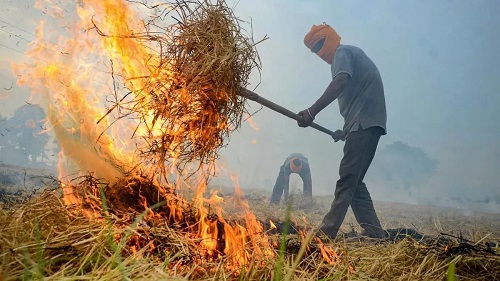
Punjab has witnessed a worrying spike in stubble burning incidents, with 283 new cases reported on Wednesday alone, pushing the total for this harvesting season to 1,216. The state’s fields, where paddy is being cleared for the next wheat crop, have once again turned into smoke zones, raising alarms over worsening air quality in the region.
According to official data, 71 per cent of this season’s total cases have been reported in just the past nine days. Until October 20, only 353 cases had been registered; however, the number jumped by 863 between October 21 and October 29. Officials warn that the situation could worsen further, as 30–40 per cent of the paddy crop is still standing and farmers rush to prepare fields for wheat sowing.
In compliance with recent Supreme Court directives, the Punjab government has stepped up enforcement measures against stubble burning. So far, 376 FIRs have been lodged against farmers, though no arrests have been made yet. Authorities have also made 432 “red entries”—penal notations in land records—and imposed fines amounting to ₹24.25 lakh.
Tarn Taran has emerged as the worst-affected district with 296 cases, followed by Amritsar (173) and Sangrur (170), the home district of Chief Minister Bhagwant Mann.
Despite the alarming surge in recent days, the Punjab government has maintained that stubble burning cases are down by 49 per cent compared to the same period last year. Official figures show that by October 29, 2,356 cases had been recorded in 2024, 5,254 in 2023, and 12,112 in 2022.
Officials attribute the improvement to better awareness, increased use of crop residue management machinery, and subsidies for in-situ management. However, environmental experts caution that even a “smaller number” of fires can have a devastating impact on air quality when concentrated over a short period.
Meanwhile, the Delhi-NCR region continues to bear the brunt of north India’s pollution season. Data from the Central Pollution Control Board (CPCB) shows the Air Quality Index (AQI) at Akshardham touching 409, placing it firmly in the ‘Severe’ category.
Residents across the capital have reported eye and throat irritation, breathing difficulties, and poor visibility, as smog blankets the city. In response, authorities have begun deploying truck-mounted water sprinklers across key areas to suppress dust and improve air quality.
With meteorological conditions unlikely to improve immediately, experts warn that the combination of stubble burning, vehicular emissions, and stagnant winds could keep Delhi’s air quality in the “severe to very poor” range in the coming days.
As the paddy harvesting season progresses, all eyes are now on whether Punjab can rein in the fires — and whether north India can breathe a little easier.





















Leave Your Comment