



Viral Desai
Imagine driving a car whose dashboard suddenly begins flashing warning lights. One light indicates that the engine is overheating. Another warns that the oil pressure is falling. A third says the brakes need attention. You might continue driving for a while, and the car may even appear perfectly normal. But would you keep accelerating if seven warning lights were glowing at the same time?
Something remarkably similar is happening to our planet.
For thousands of years, Earth provided humanity with relatively stable environmental conditions. The climate, forests, oceans, freshwater systems and countless living species interacted in ways that created the conditions in which agriculture developed, cities emerged and civilizations flourished. Scientists refer to much of this unusually stable period as the Holocene, which began around 11,700 years ago.
But industrial civilization has begun pushing some of Earth's most important systems beyond the conditions under which human societies developed. Scientists have developed a powerful way of understanding just how far we have travelled from that relative stability. It is called the Planetary Boundaries framework.
Earth's Nine Guardrails
Think of planetary boundaries as guardrails for civilization. They do not tell us that crossing a particular line will cause the world to collapse the following morning. Instead, they indicate where human interference with the Earth system becomes increasingly dangerous and where the possibility of large, potentially irreversible changes begins to rise.
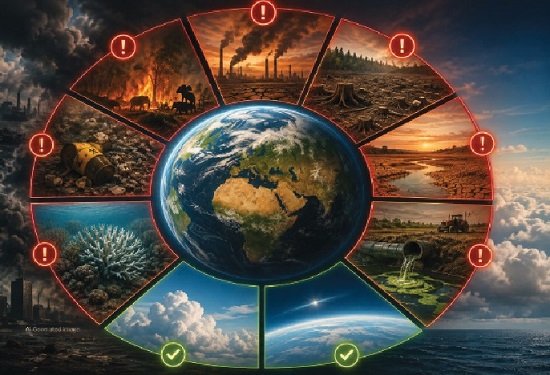
Scientists identify nine such boundaries: climate change, biosphere integrity, land-system change, freshwater change, biogeochemical flows, novel entities, ocean acidification, atmospheric aerosol loading and stratospheric ozone depletion.
And here comes the disturbing part.
According to the 2025 Planetary Health Check, humanity has now transgressed seven of these nine planetary boundaries. Only stratospheric ozone depletion and atmospheric aerosol loading remain within the globally defined safe operating space.
Seven out of nine.
This does not mean that the planet is about to become uninhabitable. Nor should the finding be turned into another sensational prediction of environmental apocalypse. What it tells us is more scientifically precise and perhaps more consequential. Humanity is increasing the pressure on several of Earth's fundamental life-support systems simultaneously.
The Seventh Warning Light
Until recently, six planetary boundaries were considered transgressed. In 2025, scientists assessed ocean acidification as the seventh.
The ocean has quietly protected humanity from some of the consequences of our carbon emissions by absorbing enormous quantities of carbon dioxide. But that service comes at a price. When carbon dioxide dissolves in seawater, it alters ocean chemistry and makes the water more acidic.
Since the beginning of the industrial era, the pH of the ocean's surface has declined by around 0.1 units, corresponding to roughly a 30–40 percent increase in acidity.
For humans, a change of 0.1 may sound insignificant. For marine ecosystems, it is anything but.
Increasing acidity makes it more difficult for organisms such as corals, shellfish and tiny marine creatures called pteropods to build and maintain their calcium-carbonate structures. These organisms may appear distant from our everyday lives, but they form parts of extraordinarily complex marine food webs. Damage at their level can travel upwards through entire ecosystems, eventually affecting fisheries, coastal livelihoods and food security.
The ocean is therefore not merely another victim of climate change. It is one of Earth's great stabilizing systems and we are weakening its ability to perform that role.
Everything Is Connected
Perhaps the most important lesson of planetary boundaries is that environmental problems cannot be neatly separated into different boxes.
Climate change is connected with forests. Forests are connected with rainfall. Rainfall is connected with freshwater. Agriculture affects nitrogen and phosphorus cycles. Chemical pollution enters soil and rivers before eventually reaching the ocean. Biodiversity loss reduces the resilience of ecosystems already struggling with a changing climate.
Nature does not recognize the departmental boundaries through which governments and institutions often manage it.
Consider a forest. When a large forest is destroyed, we do not merely lose trees. We lose a carbon sink. We disturb local and regional rainfall patterns. We destroy habitat. We alter soil moisture. We affect rivers and groundwater. We increase temperatures and, in many landscapes, the probability of fire.
One environmental action can therefore create consequences across several planetary systems.
The reverse is also true.
Protecting and restoring forests can support biodiversity, absorb carbon, regulate water cycles, moderate local temperatures and strengthen ecological resilience. This interconnectedness is precisely why environmental conservation must move beyond isolated campaigns and become part of the way we design cities, industries, agriculture and economies.
When Change Stops Being Gradual
There is another reason scientists are concerned.
We instinctively imagine environmental deterioration as a straight line. If we damage Nature a little more, we expect conditions to become a little worse. But complex natural systems do not always behave that way.
Sometimes pressure accumulates gradually until a threshold is reached. Beyond that point, change can become much faster and harder to reverse. Scientists describe such changes through the idea of tipping points.
A forest repeatedly exposed to deforestation, drought and fire, for example, may gradually lose its ability to regenerate. Ice loss can reduce the amount of sunlight reflected back into space, contributing to further warming and additional melting. Changes in one part of the Earth system can therefore amplify changes elsewhere.
This is why planetary boundaries matter. They are not predictions of the exact moment disaster will occur. They are warnings that as we move farther from the safe operating space, we are taking progressively greater risks with systems whose behaviour cannot always be predicted with certainty.
But We Have Crossed Back Before
There is one part of this story that gives me enormous hope.
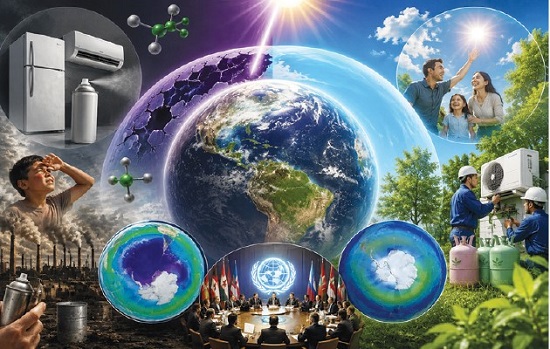
One of the two planetary boundaries currently within the safe operating space is stratospheric ozone depletion. Yet ozone depletion was once one of humanity's most frightening environmental crises.
Scientists discovered that chemicals widely used in refrigerators, air conditioners and aerosol products were damaging the ozone layer that protects life from harmful ultraviolet radiation. The world responded through the Montreal Protocol. Governments acted, industries changed technologies and the use of major ozone-depleting substances was progressively phased out.
The ozone layer began its long journey towards recovery.
That achievement carries a message far greater than ozone itself: planetary damage is not necessarily a one-way street.
When science identifies a danger, governments cooperate, industries innovate and citizens support change, humanity can alter its trajectory.
We have done it before.
India's Place in the Planetary Story
For India, planetary boundaries are not an abstract scientific concept discussed only in international conferences. Their consequences are already intertwined with our development.
Our farmers depend on predictable rainfall and healthy soils. Our cities depend on secure freshwater. Our coastal communities depend on productive oceans. Our economy depends on energy, materials and functioning ecosystems. And our young population will live through decades in which many of these planetary pressures will intensify.
This creates a special responsibility but also an extraordinary opportunity.
India does not have to repeat every environmentally destructive stage through which today's wealthy economies developed. Renewable energy, circular manufacturing, sustainable agriculture, water conservation, urban forests, cleaner mobility and resource-efficient infrastructure give us the possibility of creating prosperity differently.
Development and environmental protection should therefore not be presented to India's youth as opposing choices. The real challenge of this century is to achieve development that can endure because the ecological foundations supporting it endure as well.
Our Generation's Boundary
The Planetary Boundaries framework ultimately asks us a surprisingly personal question:
How much pressure are we willing to place on the only planet capable of supporting our civilization?
There is no second Earth waiting for us if this experiment goes wrong. Yet that realization should not lead us towards fear or helplessness. It should lead us towards responsibility.
Every forest restored, every river protected, every unnecessary emission avoided, every resource reused and every ecosystem allowed to regenerate helps move our relationship with Nature in the right direction. Individual actions alone cannot return humanity within all nine planetary boundaries; governments, businesses, industries and international institutions must make structural changes as well. But institutions ultimately change when societies change what they expect from them.
Seven warning lights are already glowing on Earth's dashboard.
The question before us is not whether we should panic.
The question is whether we are wise enough to read the warnings and courageous enough to change direction while we still can.
(The author is a known Environmentalist and the pioneer of Satyagraha Against Pollution movement, viraludayindia@gmail.com )
(The content of this article reflects the views of writer and contributor, not necessarily those of the publisher and editor. All disputes are subject to the exclusive jurisdiction of competent courts and forums in Delhi/New Delhi only)





















Leave Your Comment