


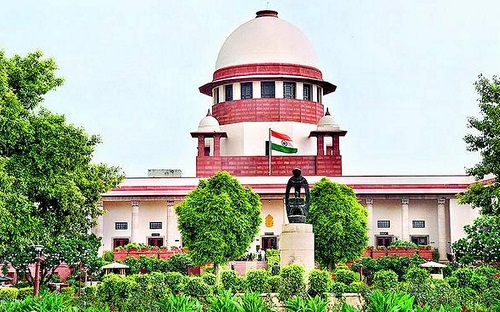
In an extraordinary intervention, the Supreme Court of India on Friday moved to resolve a high-stakes standoff between the Election Commission of India (ECI) and the West Bengal government over the ongoing revision of electoral rolls in the state.
A bench led by the Chief Justice of India acknowledged the "exceptional situation" and the "nearly impossible" task of determining the specific rank of officers to be deployed by either side for the Special Intensive Revision (SIR) of voter lists. Instead of wading into the bureaucratic tussle over deputation and rank, the Court devised a unique judicial mechanism to ensure the integrity of the process.
Judicial Officers to Adjudicate Voter Claims
The apex court requested the Chief Justice of the Calcutta High Court to appoint serving and former judicial officers, specifically those with the rank of District Judge or Additional District Judge, to adjudicate pending claims and objections regarding inclusions and exclusions from the voter list.
The focus, the Court specified, would be on cases involving “logical discrepancies”—those sensitive disputes where the accuracy and fairness of the electoral roll are most critical. By appointing experienced judicial officers, the Supreme Court sought to inject a layer of legal neutrality and credibility into a process that had become mired in a conflict between the state administration and the constitutional election body.
Expediting the Process
In a bid to bring the exercise to a swift and logical conclusion, the Supreme Court directed the Chief Secretary and the Director General of Police (DGP) of West Bengal, along with the State Election Commissioner, to meet with the Chief Justice of the Calcutta High Court. The meeting, to be held in the presence of the Advocate General and the Solicitor General, is aimed at evolving practical modalities to complete the SIR exercise as expeditiously as possible.
The Court set a tight deadline, expressing its hope that the exercise be wrapped up preferably by February 28.
Draft List Not Conclusive
Furthermore, the Court provided crucial clarity on the publication timeline. It ruled that the publication of the draft or final list on February 21 would not be considered conclusive. The ECI retains the authority to issue a supplementary list subsequently to reflect any adjustments or findings arising from the ongoing adjudication by the judicial officers. This ensures that the final voter list remains accurate and up-to-date, incorporating the outcomes of the legal scrutiny ordered by the Court.
Context and Implications
The Supreme Court’s intervention underscores the deep impasse between the ECI and the West Bengal government over the mechanics of the voter roll revision. By bypassing the dispute over which state officers should be deputed, and instead appointing district-level judges, the Court has signaled that the integrity of the electoral process is paramount.
This extraordinary step reflects the judiciary’s willingness to forge innovative solutions to protect electoral integrity, particularly in a politically sensitive state like West Bengal. The emphasis on a time-bound resolution by February 28 and the possibility of a supplementary list demonstrates the Court's commitment to a fair, transparent, and legally grounded revision process, ensuring that no eligible voter is left out and no discrepancies are left unaddressed in the final electoral roll.




















Leave Your Comment