


The right to protest is an essential feature of a democratic society, but its exercise must also take into account the rights and responsibilities of others. This delicate balance came under judicial scrutiny on Tuesday when the Supreme Court questioned the prolonged occupation of designated protest sites in Delhi, observing that no location could be occupied indefinitely in the name of demonstrations. Hearing petitions concerning protests against Chief Election Commissioner Gyanesh Kumar, the court sought responses from the Centre and other concerned parties, including political organisations associated with the demonstrations.
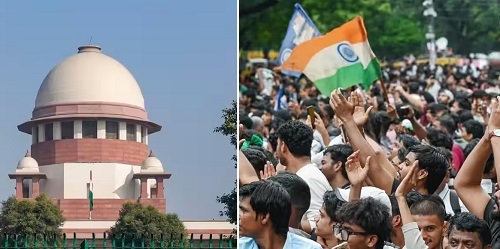
The Supreme Court on Tuesday raised important questions about the regulation and duration of public demonstrations, making it clear that the right to protest cannot translate into an unrestricted right to occupy a particular location indefinitely. A Bench comprising Chief Justice Surya Kant and Justices Joymalya Bagchi and V Mohana was hearing a batch of petitions concerning demonstrations against Chief Election Commissioner Gyanesh Kumar, including a plea filed by the Kirana Committee Delhi seeking relief from the disruption allegedly caused by political protests in the capital.
During the hearing, Chief Justice Surya Kant observed that public spaces must remain accessible to different groups and cannot be permanently appropriated by one organisation or section of society. Pointing out that farmers, journalists and other groups also require designated places to raise their concerns, the CJI remarked that nobody could occupy a protest site for all times to come. He stressed that demonstrations should be permitted for designated periods, allowing the democratic right to protest to coexist with the interests of the wider public.
The observation reflected the larger constitutional challenge of balancing freedom of expression and peaceful assembly with public convenience, commercial activity and the rights of other citizens. The court did not question the legitimacy of peaceful demonstrations but indicated that their duration, location and administrative arrangements must be regulated through a reasonable framework.
Senior advocate Mukul Rohatgi, appearing for the traders' organisations, informed the Bench that nearly 50 lakh people lived in areas surrounding the protest locations. He argued that demonstrations had adversely affected commercial establishments and claimed that shops remained closed while Connaught Place presented a deserted appearance on Tuesday.
The Bench, however, pointed out that an effective judicial examination of the traders' grievances would require the inclusion of all political parties and organisations responsible for organising the demonstrations. It accordingly asked the petitioners to implead the concerned political parties as respondents in their case. Without bringing the protesting organisations before the court, it would be difficult to adjudicate the competing claims and pass an appropriate order.
The petitions before the Bench encompass several contentious issues associated with the demonstrations, including allegations of mass detention, police excesses, the closure of Metro stations and internet shutdowns. These matters have brought the management of political protests in the national capital under renewed judicial scrutiny.
The proceedings also come against the backdrop of earlier litigation concerning electoral issues. On October 15, the same Bench had sought responses from the Election Commission and other parties on a petition filed by Congress leader Rahul Gandhi and 12 other Opposition leaders. Their plea alleged large-scale deletions and irregularities in the Special Intensive Revision (SIR) of electoral rolls. The electoral controversy and subsequent demonstrations have become part of a wider political confrontation between the Opposition and the Election Commission.
The immediate trigger for the traders' petition is the alleged economic impact of the INDIA bloc's November 1 rally at Ramlila Maidan. The demonstration, organised by Opposition parties against the Chief Election Commissioner, took place just days before Diwali, when Delhi's wholesale and retail markets traditionally witness a substantial increase in customer activity.
According to the Chamber of Trade and Industry (CTI), approximately 2.5 lakh out of nearly three lakh shops across 25 major commercial markets were either closed or severely affected by the rally and the resulting disruptions. The organisation identified Chandni Chowk, Sadar Bazar, Connaught Place, Karol Bagh and Kashmiri Gate among the markets that experienced significant difficulties.




















Leave Your Comment