


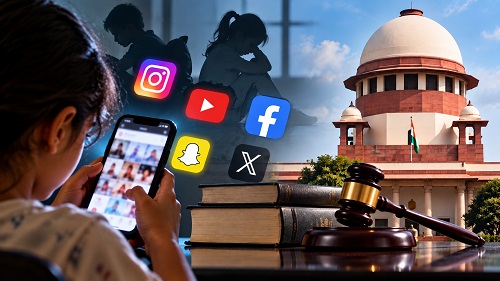
As children increasingly become users of social media, gaming platforms and other digital services, the question of how far existing Indian laws can protect them in the online world is gaining urgency. The Supreme Court has now asked the Centre to examine whether a statutory framework can be created to ensure that digital platforms comply with laws governing minors, including the legal restriction on children below 18 independently entering into contracts.
The Supreme Court's intervention brings into focus a legal gap created by the rapid expansion of the digital economy: while Indian law recognises that minors require special protection in contractual and other legal relationships, digital platforms often operate through standardised terms and conditions that users accept electronically. The court's latest proceedings raise the question of whether these platforms should be required to build India's existing protections for minors directly into their systems.
A bench comprising Chief Justice Surya Kant and Justices Joymalya Bagchi and V Mohana was hearing a plea seeking safeguards for minors using social media and other digital platforms. The bench asked the Centre to examine whether a statutory mechanism could be introduced to ensure that intermediaries and digital platforms comply with Indian laws applicable to children.
The issue is significant because the relationship between a digital platform and its user is not merely about accessing content. Social media accounts, gaming services, digital subscriptions, online purchases and other internet-based services frequently operate through terms of service that have contractual implications. If a child below 18 cannot independently enter into certain contracts under Indian law, questions naturally arise over the legal foundation of agreements entered into by minors while accessing such services.
The Supreme Court's approach appears to move the debate beyond the question of whether parents should supervise their children's online activity. It instead places responsibility on the architecture of digital platforms themselves. The central issue is whether platforms should have legally enforceable mechanisms to identify minors, restrict activities that require contractual capacity and ensure compliance with child-protection obligations.
The petition was filed by the NGO Just Rights for Children Alliance. Senior advocate H S Phoolka, appearing for the petitioner, had earlier placed submissions before the court concerning safeguards for minors in the digital environment. Following those submissions, the court sought responses from the Union ministries of electronics and information technology and law and justice.
The Centre's examination could therefore become important in determining whether existing laws are sufficient or whether a dedicated statutory framework is necessary. Such a framework could potentially address several interconnected issues—age verification, contractual relationships, access to potentially harmful content, privacy, advertising directed at children and the responsibilities of intermediaries.
At the same time, any regulatory framework would have to confront the practical difficulty of establishing a child's age online without creating disproportionate surveillance or compromising privacy. Simple age declarations can be unreliable, while intrusive identity or biometric verification could raise separate concerns about the collection and retention of personal data.
There is also a technological dimension. Digital platforms are built around global terms of service and automated systems, whereas Indian law operates within a specific statutory and constitutional framework. Requiring platforms to comply with Indian rules concerning minors could therefore necessitate changes in account creation, consent mechanisms, payments, content recommendations and parental controls.
The court's intervention consequently has implications beyond social media. The wider digital ecosystem—including online gaming, educational platforms, streaming services, e-commerce and other subscription-based services—may have to consider how their contracts and user agreements interact with the legal status of minors.
The proceedings also highlight an important distinction between access and legal capacity. A child may technically be capable of opening or using an online account, but that does not automatically settle whether every contractual consequence attached to that account can be treated in the same manner as an agreement entered into by an adult.
The Supreme Court has not, at this stage, imposed a new statutory regime. Instead, it has asked the Centre to examine whether legislation or another statutory framework is required. The responses of the concerned ministries will therefore be significant in determining how the legal question develops.
The larger challenge is to reconcile three competing interests: children's safety, the legitimate functioning of digital platforms and individual privacy. A framework that merely imposes obligations without workable technological mechanisms could prove difficult to enforce. Conversely, a system that places the entire burden on parents may leave significant gaps when platforms themselves collect data, offer services and determine how users interact with their products.
The Supreme Court's latest step thus places the spotlight on a fundamental question of the digital age: when children enter an online environment governed by contracts, algorithms and commercial platforms, should the responsibility for protecting their legal and personal interests rest primarily with families, or should platforms have clearly defined statutory duties as well? The Centre's examination could help determine where Indian law draws that line.





















Leave Your Comment