



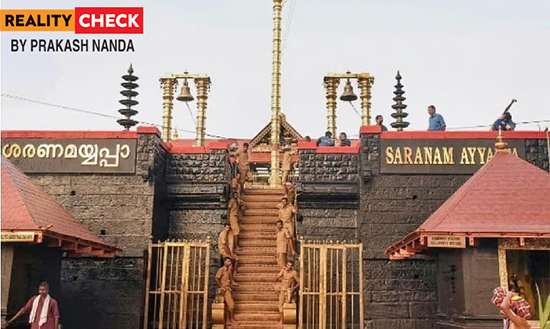
The Modi government has done well by urging the Supreme Court on Monday, through Solicitor General Tushar Mehta, that it should uphold the restriction on the entry of women of menstruating age into Kerala’s Sabarimala temple, arguing that the issue falls squarely within the domain of religious faith, tradition and denominational autonomy and lies beyond the scope of judicial review.
Hopefully, the Supreme Court, which is beginning the hearing of the issue today, will find merit in the central government’s views as well as those of the Kerala government, which has also changed its earlier supporting view of the court’s previous decision of allowing women into the temple. Now, even Kerala’s outgoing Leftist government is in favour of maintaining the tradition.
The controversy, incidentally, began when the Indian Young Lawyers Association filed a petition in the Supreme Court in 2006, arguing that the ban violated women's fundamental rights, including equality and freedom of religion. The Kerala High Court had previously upheld the restriction in 1991, citing the temple's tradition and the deity's “celibate” nature.
In September 2018, a five-judge Supreme Court bench ruled 4:1 that the ban was unconstitutional, stating it violated women's right to equality and dignity under Articles 25 and 26 of the Constitution. The majority opinion held that the exclusion was not an essential religious practice and perpetuated patriarchal stereotypes.
Incidentally, the lone woman judge in this bench, Justice Indu Malhotra, had dissented, arguing that the court should respect the temple's traditions.
The verdict sparked widespread protests and debates, with some groups arguing it was an attack on tradition and others seeing it as a victory for gender equality. The Supreme Court is now reviewing the verdict, with a nine-judge bench hearing arguments.
The Supreme Court had on April 4 notified the constitution of the nine-judge bench to hear the long-pending Sabarimala review, bringing back to life a constitutional controversy that has remained in cold storage for six years and could reshape the court’s approach to religion-rights conflicts.
The bench comprises Chief Justice of India (CJI) Surya Kant, and justices BV Nagarathna, MM Sundresh, Ashanuddin Amanullah, Aravind Kumar, AG Masih, R Mahadevan, Prasanna B Varale and Joymalya Bagchi.
In fact, a systematic disinformation campaign by the so-called left/liberal elements is that the Sabrimala temple bans the entry of women. Not at all. It only prevents the entry of women between the ages of 10 and 50, that is, women having reproductive capacity. But this restriction was challenged in the Supreme Court, leading to the 2018 judgment.
In giving such a verdict, the Supreme Court disregarded the argument in favour of maintaining the ban that is based on protecting the unique, centuries-old theological and ritualistic structure of the shrine.
In fact, supporting the ban does not necessarily reflect misogyny, but rather a commitment to respecting the specific tenets that are based on the "Naishtika Brahmacharya" (celibate) vow of Lord Ayyappa.
Lord Ayyappa at Sabarimala is worshipped as a Naishtika Brahmachari—a celibate deity who has shunned all worldly pleasures, including the proximity of women. In the Hindu tantric tradition. Lord Ayyappa is a deity believed to possess specific energies that are managed through precise, ancient rituals. The temple is not merely a prayer hall, but is considered the "home" of this celibate deity. Therefore, the restriction is viewed by devotees not as a limitation on women, but as a technical necessity to maintain the pratishta sankalpa (consecration purpose) of the deity.
Hindus believe that introducing women of reproductive age into this specific space breaks the vow, requiring the deity to be reconsecrated, which would fundamentally alter the character of the shrine.
As it is, the pilgrimage to Sabarimala is not a typical tourist visit; it is a spiritual journey requiring intense purification. Male devotees and women outside the 10–50 age bracket must follow a rigorous 41-day Vratham (vow of celibacy and asceticism), which includes sleeping on the floor, fasting, and walking barefoot. Historically, this restriction was seen as a way to preserve the sanctity of this vow, ensuring that only those who could adhere to the strict 41-day discipline—without the biological interruption of menstruation—undertake the journey.
The Travancore Devaswom Board, which manages the temple, has traditionally maintained that the restriction is not anti-women but a custom followed for centuries.
Against this background, Solicitor General Mehta’s submissions to the Supreme Court make a lot of sense. It contends that questions of who may enter a place of worship are not facets of gender discrimination but are rooted in religious practice, belief and the specific character of the deity.
The submissions have cautioned the bench against adopting standards of review that assess religious practices on grounds such as “rationality,” “modernity,” or “scientific defensibility.” Such an exercise would amount to courts substituting their own philosophical views for the internal understanding of a faith.
“An inquiry into whether a practice is rational, acceptable to judicial sensibilities or aligned with transformative constitutional doctrines is not constitutional review,” said the submissions, adding that judges are neither trained nor institutionally equipped to interpret religious texts or adjudicate theological questions.
The court is tasked with answering seven broad questions, including the scope of the “essential religious practices” doctrine, the interplay between Articles 25 and 26, and the extent to which courts can entertain public interest challenges to religious customs by those outside the faith.
In a pushback against judicial scrutiny of what constitutes an “essential religious practice”, it is argued in the submissions that the essentiality of a practice must be determined by the denomination itself, based on its understanding of scripture and tradition, and not by courts.
After all, faith and belief are also constitutionally protected freedoms that cannot be subjected to judicial balancing unless they run afoul of public order, health, morality or other fundamental rights.
The submissions have also advanced a broader doctrinal claim that the attributes of a deity are not open to judicial review. It has been argued that the Sabarimala temple is dedicated to Lord Ayyappan in the form of a Naisthika Brahmachari (eternal celibate), and that the restriction on the entry of women of childbearing age is intrinsically linked to preserving that character. Therefore, courts cannot “reform” or reinterpret the nature of a deity by declaring certain attributes to be non-essential or irrational.
The juristic personality of a deity, recognised in law, requires courts to accept the denomination’s understanding of those attributes as conclusive. Any attempt to separate “essential” from “non-essential” aspects of a deity’s character would effectively require the court to declare that worshippers are mistaken about their own faith — a role the Constitution does not envisage for the judiciary.
The submissions also criticised the reasoning adopted by the five-judge bench in 2018, which had examined whether the celibate nature of the Sabarimala deity was essential to the practice. According to the government, such an approach impermissibly places courts in the position of theological arbiters.
A significant plank of the Centre’s argument is its critique of the doctrine of “constitutional morality”, which it described as a vague and judicially evolved concept with no clear textual basis in the Constitution.
Legalities aside, it is also time to expose the forces that seek to harm and disrespect the Sansthan Dharma through the judiciary. Those advocating for the entry of women to the shrine are not actually the true practitioners of the Sanatan Dharm; In fact, most of them are either atheists or anti-Hindu.
After all, there are thousands and thousands of temples of Hindu deities. These women proponents can always visit them without any restrictions whatsoever, something not allowed under some other religions.
Lord Ayyaapa’s is a single shrine that, as pointed out above, celebrates ‘bramachraya”. So if you are a true devotee of the Lord, you would respect “His” wishes or sentiment. You cannot go to a shrine to disrespect or insult a shrine and the Lord. For you to force uniformity by disregarding these nuances is to threaten the diversity of practices that define religious freedom in India.
As I said, these proponents are not devotees. They are against Sanatan Dharm. Hopefully, the Apex Court will realise their malicious intentions and reconsider its earlier verdict.


















Leave Your Comment