


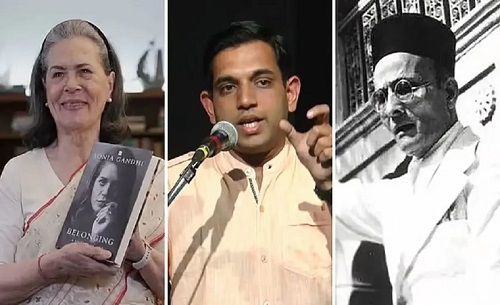
A fresh confrontation has emerged between the Congress and the legacy of freedom fighter Vinayak Damodar Savarkar, with his grandnephew Satyaki Savarkar serving a legal notice on Sonia Gandhi over references to the Hindutva ideologue in her recently published memoir, Belonging: A Journey of Love. Alleging that the book presents a distorted and historically misleading account of Savarkar’s life and ideology, he has demanded an unconditional apology, clarification and correction of the disputed passages. The notice has given the Congress leader 15 days to respond, failing which the matter could escalate into legal proceedings.
A new political and historical controversy has erupted over Congress leader Sonia Gandhi’s recently published memoir, Belonging: A Journey of Love, with the family of Hindutva ideologue and freedom fighter Vinayak Damodar Savarkar questioning the book’s account of his life and political philosophy. Satyaki Savarkar, Savarkar’s grandnephew, has issued a legal notice to Sonia Gandhi, demanding an unconditional apology, a public clarification and corrections to what he describes as a misleading and distorted representation of his ancestor. The development has brought an old ideological confrontation between the Congress and the political legacy associated with Savarkar back into the national spotlight.
The legal notice, issued through advocate Sangram Kolhatkar, specifically challenges two references appearing on pages 201 and 443 of the memoir, published by HarperCollins Publishers India on November 10. According to the notice, the statements are factually inaccurate, historically misleading and prejudicial to Savarkar’s reputation and legacy. Satyaki Savarkar maintains that the passages, when read together, create an unfair impression of the freedom fighter’s contribution to India's struggle against British colonial rule and misrepresent the ideological foundations of his political thought.
The first objection concerns a passage on page 201, which places Savarkar in the context of RSS ideologues who allegedly submitted mercy petitions to the British colonial authorities, while members of the organisation were described as collaborating with the British as informers. The notice argues that the manner in which Savarkar has been mentioned creates an impression that he was personally involved in informing against fellow freedom fighters or assisting the colonial administration in targeting them. Satyaki Savarkar has categorically disputed this implication, contending that such a characterisation cannot be accepted without examining the historical circumstances surrounding his ancestor’s imprisonment, petitions and political activities.
The notice also draws attention to Savarkar’s prolonged incarceration under British rule, particularly his imprisonment in the Cellular Jail in the Andaman Islands, where he endured severe hardships. It argues that references to petitions submitted during his imprisonment cannot be considered in isolation from the conditions of his confinement and the broader circumstances of the colonial period. According to the complainant, presenting these petitions without adequately explaining their historical background risks reducing a complicated chapter of the freedom struggle to a one-sided political interpretation.
The second objection relates to page 443, where the memoir describes Savarkar’s ideological vision as one in which Hindus are supreme and connects this outlook with the RSS, the BJP and organisations collectively known as the Sangh Parivar. Satyaki Savarkar contends that this description oversimplifies his ancestor’s political philosophy and reduces a complex body of writings, speeches and political arguments to a single proposition of religious supremacy. He maintains that Savarkar’s ideological positions should be assessed within their historical, intellectual and political context rather than through what the family considers a sweeping characterisation.
Interestingly, the legal notice also invokes the historical record of the Congress itself to strengthen its argument. It reportedly refers to former Prime Minister Indira Gandhi’s actions during her tenure, including the issuance of a commemorative postage stamp in Savarkar’s honour, her personal contribution of Rs 11,000 towards the Swatantryaveer Savarkar Rashtriya Smarak and the commissioning of a biographical documentary by the Films Division in 1983 to mark his birth centenary. By recalling these instances, the notice seeks to question the apparent contradiction between the recognition extended to Savarkar during Indira Gandhi’s premiership and the description of him in Sonia Gandhi’s memoir.
Beyond demanding an unconditional written apology, Satyaki Savarkar has sought a public clarification explaining the historical basis and intended meaning of the disputed statements. He has also asked Sonia Gandhi to substantiate the claims with authentic historical material or acknowledge and correct what he considers factual inaccuracies and misleading implications. The notice further calls for appropriate steps, in consultation with HarperCollins Publishers India, to correct, suitably qualify or withdraw the disputed passages from subsequent editions, reprints and electronic versions of the book.






















Leave Your Comment