


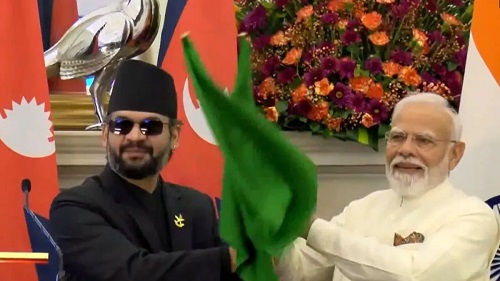
India and Nepal have taken another significant step towards deepening their historic relationship, with a new railway connection linking two of the most revered centres of the Ramayana tradition. Prime Minister Narendra Modi and Nepalese Prime Minister Balendra Shah on Monday virtually flagged off the Saryu-Kamala Express, connecting Ayodhya in Uttar Pradesh with Janakpur Dham in Nepal. Beyond improving passenger convenience, the weekly service carries cultural, religious and economic significance, bringing two destinations deeply rooted in shared civilisational traditions closer while opening fresh opportunities for cross-border tourism and regional development.
The inauguration took place from New Delhi, with Union Railway Minister Ashwini Vaishnaw and Uttar Pradesh Chief Minister Yogi Adityanath participating in the event at Ayodhya. The launch coincides with Shah's two-day state visit to India from November 22 to 23, his first visit to the country since assuming office as Nepal's Prime Minister in March 2026. The railway initiative adds a practical dimension to the diplomatic engagement between the two neighbouring countries, demonstrating how improved connectivity can translate longstanding cultural affinities into stronger people-to-people relationships.
The Saryu-Kamala Express will cover approximately 604 kilometres, connecting Janakpur Dham with Ayodhya Cantt. and passing through important towns in Nepal's neighbouring Indian states of Bihar and Uttar Pradesh. Besides its terminal stations, the train will have commercial stoppages at Jaynagar, Madhubani, Shisho, Sitamarhi, Raxaul, Narkatiaganj, Gorakhpur, Basti, Mankapur and Ayodhya Dham. Operating as a weekly service, it will depart from Janakpur Dham every Saturday and from Ayodhya Cantt. every Monday. The route has been designed to serve not only religious travellers but also passengers undertaking journeys for education, business, family visits and other purposes.
The significance of the new service extends beyond the introduction of another passenger train. Ayodhya and Janakpur occupy an important place in the religious imagination of millions of Hindus. Ayodhya is revered as the birthplace of Lord Ram, while Janakpur is traditionally associated with the birthplace of Goddess Sita. Their connection is therefore closely linked with the Ramayana, a cultural narrative that transcends national boundaries and continues to influence religious practices, traditions and social relationships across South Asia. By establishing a direct rail connection between these destinations, India and Nepal are strengthening an important dimension of their shared heritage.
Religious tourism is expected to emerge as one of the principal beneficiaries. Pilgrims travelling between the two destinations will have an additional and more convenient transport option, potentially encouraging more people to undertake journeys associated with the Ramayana circuit. Greater movement of visitors could generate demand for accommodation, restaurants, local transport, guides and other tourism-related services. Small traders, traditional artisans and local entrepreneurs along the route may also benefit from increased commercial activity. For border communities, the train offers an opportunity to participate more actively in economic exchanges and tourism-driven development.
The service also reflects the broader importance of railway connectivity in strengthening India's neighbourhood engagement. India and Nepal share an open border, deep-rooted family relationships and extensive cultural and economic interactions. Their partnership is not confined to government-level agreements; it is sustained by everyday exchanges between people living on both sides of the border. Improved transportation can make these relationships more accessible and productive, particularly for communities that depend on cross-border movement.
The Saryu-Kamala Express thus represents more than a new addition to the railway network. It connects two historic destinations, facilitates religious travel and creates fresh possibilities for regional commerce. At a time when India and Nepal are seeking to expand cooperation across multiple sectors, the new train service offers a visible example of how infrastructure can serve both economic objectives and cultural diplomacy. Its long-term success, however, will depend on reliable operations, passenger convenience and the ability to translate increased connectivity into sustained benefits for communities along the route.



















Leave Your Comment