


India’s rich political fabric is shown in the ideological contrast between the Bharatiya Janata Party (BJP) and Congress in their respective 'Sankalp Patra' and 'Nyay Patra' for the upcoming 2024 Lok Sabha elections. The scene is prepared, the crowd waits in anticipation, and the curtain opens on the deepest ideological show in democracy theatre in India.
Each party has crafted a unique manifesto that embodies the essence of India, surpassing mere policy compilations and serving as a proclamation of identity. The BJP and Congress manifestos can be read in two different ways. A checklist approach could be used to enumerate the problems, commitments, and solutions. This interpretation is helpful in determining what is stated as a significant agenda and what is purposefully left out to preserve uncertainty and misunderstanding. For example, both parties emphasise welfare programmes and economic growth for the affected groups in society to project a positive, forward-looking agenda.
However, contentious topics like NRC and CAA are conveniently ignored. Even the BJP, which has portrayed the CAA as a significant political victory, is still being extremely cautious when it comes to tying this issue to future commitments. As stated in the party manifesto, "We will implement the Citizenship Amendment Act (CAA) to confer citizenship to all eligible persons, marking a historic step." In a similar vein, neither the CAA nor citizenship is discussed in the Congress manifesto.
Sankalp Patra: Pitch for Third Term
The Bharatiya Janata Party (BJP) consistently uses a unique tactic when preparing for elections. It takes a bottom-up strategy, aggressively soliciting recommendations from the lowest echelons of society and taking them into account at the highest levels. After that, these recommendations are put into practice, guaranteeing a two-way line of contact via their committed karyakartas dispersed around the country.
With nearly all of the promises made in its 2019 platform having been fulfilled and over 25 million Indians now pulled out of extreme poverty, the party is all set to put India on the top pedestal of international affairs. Consequently, it became necessary to utilise technology to collect input to create the manifesto. To supervise the creation of this important document, which would serve as the party's platform for the next five years, a renowned committee was formed, with Defence Minister Rajnath Singh serving as chairman. The committee's convenor was Nirmala Sitharaman, with Piyush Goyal acting as co-convenor.
The committee, which was made up of 27 people, got about 400,000 suggestions via the NaMo app and about a million via video channels for a total of about 1.5 million suggestions from different sources.
These recommendations, which came from the general public, were carefully considered by the committee and included in the final document that was released on April 14, 2024. There are 24 sections in the 2024 manifesto, with 10 of them devoted to social issues. The "Modi Ki Guarantee," which stands for the public's renewed faith in our prime minister, is the central element of the manifesto.
The Bharatiya Janata Party (BJP), led by Prime Minister Narendra Modi, has asked for the people's approval to serve a third consecutive term in its manifesto for the general election of 2024. The party's performance in the last two terms serves as the foundation of its campaign. While arguing for a third term, it has emphasised its accomplishments in terms of advancing a central ideological agenda and governance pledges. During Mr. Modi's second term, the special status of Jammu and Kashmir under Article 370 was revoked and the Ram temple in Ayodhya was inaugurated.
A promise for the adoption of a Uniform Civil Code in the third term is also made, which is the third element of the BJP's fundamental plan. The BJP has already enacted a number of the policies listed in the manifesto, such as piped drinking water, numerous anti-poverty projects, especially those related to housing, and the current free grain policy that serves two-thirds of the population. According to the manifesto, during the last two terms of government, 25 crore people were brought out of poverty. Triple talaq criminalization is also mentioned as a success. The manifesto points to the increased presence of Dalits, tribal communities, and other disadvantaged groups in government—60 per cent of the outgoing Council of Ministers, to be exact—as evidence of the dedication to social justice.
The paper makes no mention of any unrealistic or perhaps harmful pledges to the state's economic development. Additionally, the idea of "divide and rule," which was proposed by certain political parties in their manifesto, is not included in the document. The 2024 BJP manifesto explicitly recognises that, in large part, the tremendous socioeconomic transformation that has been experienced by a number of groups, including women, farmers, fishermen, street vendors, small business owners, SC, ST, and OBC communities, has been made possible by technology-driven governance solutions. This transformation has resulted in our nation's remarkable growth over the last ten years. The poor, youth, women, and farmers are the only four castes that the BJP manifesto maintains exist.
In order to lead the nation through a time of international turmoil, the BJP contends in its bid for a third term that maintaining a strong, stable administration is vital. In the third term, it also pledges to enact the Women's Reservation Law and the Citizenship (Amendment) Act. Though it mentions the 10 per cent reservation it put in place for the Economically Weaker Sections, the party remains neutral on the demand for a caste census, which is a commitment in the Congress platform. A health-care guarantee for senior citizens valued up to ₹5 lakh is the main new pledge it makes for a third term.
Additionally, the manifesto places a strong emphasis on women's empowerment through the idea of Viksit Bharat, in which women take the initiative in a variety of fields and transform Viksit Bharat into a women-led society. The goal of the political and socioeconomic support for women is to fundamentally alter our society.
The youth manifesto aims to harness the energy of young people to take our country to new heights by promising greater openness in public exams. In addition, it promises to increase young employment opportunities and support and mentorship for businesses. Finally, by helping Kisan families and giving them the opportunity to live better lives, the manifesto upholds its commitment to farmers. The MSP will be gradually raised, and current programmes like the PM KISAN Yojana and Fasal Bima Yojana would be reinforced. Natural farming and crop diversity will be encouraged, with a national emphasis on millet promotion as a superfood. There will be an attempt to establish India as a global centre for wholesome food. The dairy and fishing industries will also receive a lot of attention, which will increase farmers' revenue.
The goals of the neo-middle class have a significant impact on the nation's economic output, so it is imperative to support them through a variety of policies and initiatives. The manifesto emphasises the necessity of developing a "silver economy," one that puts an emphasis on the well-being of our elderly population by employing technology to its fullest potential. The manifesto commits to working to make pilgrimages easier for our senior citizens. The manifesto pledges to give everyone, including gig workers, truck drivers, porters, domestic helpers, and street vendors, the finest chances and ease of employment.
The BJP's strategy and goal are outlined in the manifesto, which shows that the country's previous ten-year trajectory would not change. The BJP manifesto for 2024 is clearly more than simply a paper promise or a plan that will bankrupt our nation with extravagant handouts. Rather, it is a pragmatic and progressive document that will ensure that the aim of a developed India is attainable.
Nyay Patra: Going back to Future
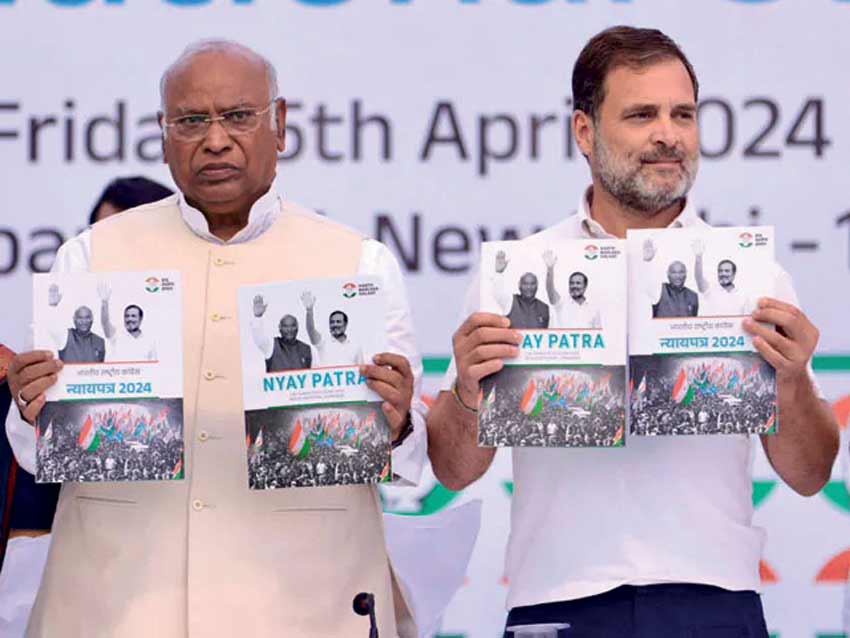
Congress iparty, the grand old party of India is still living in the past. Its manifesto, promises things which are detrimental to the future of India and takes back what the country achieved in the last 10 years. Its whole manifesto is based on safeguarding interests of its own. Whether taking powers back from Enforcement Directorate (ED) to making changes in the New Delhi state rules, everything seems to be promised by Congress keeping in mind the problem it and its allies have faced in the last one decade. Some sections of the Congress manifesto, which was released on April 5, promise to reverse important policy initiatives and promises made by the Narendra Modi government if the party comes to power. These promises range from promising to look into the PM Cares Fund and electoral bonds scheme to rejecting the idea of one nation, one election.
The party discussed "reversing the damage" caused by the Modi government under the heading "Defending the Constitution." "We pledge to thoroughly review and amend all anti-people laws passed by the BJP/NDA without appropriate parliamentary scrutiny and debate, particularly those concerning workers, farmers, criminal justice, the environment and forests, and digital data protection," the statement read.
Now, this becomes interesting, as Congress is one party which has misused all the laws of the country to promote its own interests is promising to amend laws that are passed for the benefit of common people.
Despite the fact that the international standing of India has increased in the last ten years, Congress, it seems, doesn’t impressed with this. It still wants India to be toe-toeing the western powers line instead of furthering our own national interests. The manifesto promises to “repair India’s international image that has been damaged by the present government’s intolerance of dissent and suppression of human rights”.
As primary target groups, the manifesto included the youth and working population. It also called for a one-time loan waiver on all educational loans up to March 15, a review of centrally administered exams like NEET and CUET, the elimination of application fees for government jobs and public examinations, an increase in the wage under the Mahatma Gandhi National Rural Employment Guarantee Act (MGNREGA) to ₹400 per day, and the implementation of an urban employment guarantee programme.
At the launch, the manifesto committee's chairman, former finance minister P. Chidambaram, declared, "23 crore people would be lifted out of poverty if Congress wins power. We have done it before and we can do it again."
The Congress announced that it will introduce the Mahalakshmi scheme, which will give every impoverished Indian family an unconditional ₹ 1 lakh annual cash transfer. The families at the base of the income pyramid will be considered impoverished.
Now the first question which arises is that where will Money come from to fulfil these promises? When asked, a key member of Congress Menifesto Committee, Praveen Chakravarty, was totally clueless. As per him to pay promises of ₹1 Lakh each to 1 woman per family BPL and Unemployed youth, Congress will need ₹5-6 Lakh Crore in 5 yrs. That means around ₹1 Lakh Crore every year. Where is money going to come from when the annual budget of India is ₹44.90 Lakh Crore only? He doesn't know anything on it. But brilliant Economists like Raghuram Rajan will come to help Congress and advice to print more currency as he had suggested during pandemic to revive economy. On top of it, Congress has promised MSP as per Swaminathan Committee report, something which it itself had rejected to implement saying it will skyrocket prices of Agricultural Produce. So what changed suddenly now that Congress is promising the same thing in its Manifesto?
"We will amend the election laws to combine the efficiency of the electronic voting machine (EVM) and the transparency of the ballot paper," the Congress promised in yet another odd declaration. Veteran Congress politician Digvijaya Singh tweeted, "Any machine with a chip can be hacked," following the BJP's clear victory in the Hindi heartland states of Rajasthan, Madhya Pradesh, and Chhattisgarh. "I've been against EVM voting since 2003. Should we allow Indian democracy to be manipulated by skilled hackers? This is the central query that needs to be answered by all political parties," he further added. Funny enough, the Congress party, which has won states like Karnataka and Telangana, preaches water and drinks wine while complaining nonstop about EVMs.
While both the parties have showcased their future plans for the country, it is the people who have to decide which course this country will follow. While the BJP’s Sankalp Patra hinges on the development the country has made in the last one decade, Congress’s Nyay Patra promises everything to be undone, what has been done in the last ten years. It is up to people now, what to choose for the betterment of their and country’s future.

By NILABH KRISHNA
(The content of this article reflects the views of writers and contributors, not necessarily those of the publisher and editor. All disputes are subject to the exclusive jurisdiction of competent courts and forums in Delhi/New Delhi only)



















Leave Your Comment