


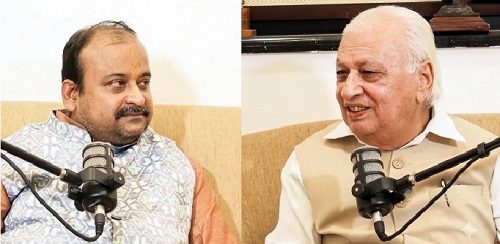
In this wide-ranging and intellectually stimulating conversation with Deepak Kumar Rath, Group Editor, Uday India, Arif Mohammed Khan, former Union Minister and former Governor of Kerala and Bihar, reflects on the philosophical foundations of Sanatan Dharma, its universal character, the teachings of the Bhagavad Gita and Upanishads, the relationship between spirituality and social responsibility, and the challenges confronting Indian civilisation. Drawing extensively upon Sanskrit scriptures, Mr Khan argues that Sanatan Dharma is not merely a collection of rituals or religious practices but a comprehensive philosophy of life founded upon the recognition of the divine presence in every living being. Excerpts:
You have repeatedly argued that the real essence of Sanatan Dharma is often misunderstood. What, in your understanding, constitutes the soul of Sanatan Dharma?
The first thing we must understand is that Sanatan Dharma cannot be defined merely through morning prayers, temple visits, rituals or ceremonies. Its foundation is a profound tradition of knowledge. The Bhagavad Gita contains a remarkable declaration by Lord Krishna:
यज्ज्ञात्वा न पुनर्मोहमेवं यास्यसि पाण्डव।
येन भूतान्यशेषेण द्रक्ष्यस्यात्मन्यथो मयि॥
The meaning is that, having acquired this knowledge, Arjuna will never again fall into delusion. Through this knowledge, he will recognise all beings without exception as existing in the Self and in the Supreme.
This is the central philosophical message. You must begin to see every living being as an extension of your own existence. When you recognise another person as part of your own larger self, how can you deliberately inflict suffering upon that person? You do not willingly hurt your own child, even when the child makes mistakes. Similarly, when you acquire the wisdom described in the Gita, you begin to recognise the same underlying relationship with every living being. This is the soul of Sanatan Dharma. It is not restricted to a particular community, caste, linguistic group or religious denomination. Its philosophical vision extends to human beings, animals, plants and the entire natural world. Another verse of the Bhagavad Gita expresses this universal vision:
यो मां पश्यति सर्वत्र सर्वं च मयि पश्यति।
तस्याहं न प्रणश्यामि स च मे न प्रणश्यति॥
The person who sees the Divine everywhere and recognises everything as existing in the Divine is never separated from that reality.
This is not merely a philosophical statement. It is an invitation to transform the way we look at the world.
You have described Sanatan Dharma as a tradition of knowledge rather than merely a religion in the conventional sense. Why do you believe the distinction between Dharma and religion is so important?
One of the greatest injustices done to the Bhagavad Gita is that it has often been presented merely as a religious book, whereas its philosophical message is much wider. Dharma and religion are not necessarily identical concepts. Dharma fundamentally concerns one's duties, responsibilities and appropriate conduct. It is a code of conduct governing our relationships and our behaviour. If I am somebody's son, I have responsibilities as a son. If I am a father, I have duties towards my children. If I occupy public office, I have obligations towards society. Each relationship carries its own responsibilities.
Our tradition speaks of Sanatan Dharma, Yuga Dharma, Kala Dharma and Swadharma. These expressions reflect different dimensions of duty and conduct. Sanatan Dharma represents enduring principles. Yuga Dharma concerns the responsibilities associated with an age. Kala Dharma relates to the demands of a particular time, while Swadharma concerns one's own responsibilities and disposition. Dharma cannot be confined to a narrow definition based only on outward religious practices. It must be reflected in how we conduct ourselves when we are alone, when we are among family members, when we interact with women, when we exercise authority and when we deal with people who are weaker than us. The real test of Dharma is conduct.
Does this mean that Sanatan Dharma rejects the distinction between the individual and the larger creation?
Its philosophical vision goes much further than ordinary distinctions. There is a beautiful statement in the Upanishadic tradition:
स कामयत बहु स्यां प्रजायेयेति।
The Supreme Reality desired: May I become many; may I manifest in manifold forms.
Consider the significance of this idea. Creation is not something entirely separate from the Creator. The many manifestations are expressions of the same underlying reality. You, I and every other living being are manifestations of that one reality. This is fundamentally different from a conception in which the creator produces something entirely separate from himself, like an independent manufacturer producing a commodity. Sanatan philosophy presents a vision of unity underlying diversity.
The famous Mahavakya of the Upanishads, Aham Brahmasmi—I am Brahman—and Tat Tvam Asi—That Thou Art—express this profound relationship between the individual and the ultimate reality. Adi Shankaracharya also explained the relationship through the statement:
ब्रह्म सत्यं जगन्मिथ्या जीवो ब्रह्मैव नापरः।
Brahma is the ultimate reality, and the individual self is not fundamentally different from Brahma. We must understand these statements philosophically. They are not invitations to arrogance or individual supremacy. They are expressions of a deeper identity that transcends superficial distinctions. There is another important teaching:
पूर्णमदः पूर्णमिदं पूर्णात् पूर्णमुदच्यते।
पूर्णस्य पूर्णमादाय पूर्णमेवावशिष्यते॥
The ultimate reality is complete, this manifestation is complete, and even when completeness emerges from completeness, completeness remains. This is the philosophical foundation of the unity of existence.
If every living being carries the same divine essence, does this not establish the philosophical foundation of equality and democracy in Indian civilisation? Absolutely. Consider the expression:
देहो देवालयः प्रोक्तो जीवो देवः सनातनः।
The body is regarded as a temple, and the living being as the eternal divine presence.
If I regard every human body as a temple in which the Divine resides, where is the justification for considering one person inherently superior to another? The same divine reality exists in everyone. India's philosophical contribution to democracy is not merely a matter of institutional arrangements. It also rests upon a vision of human dignity. However, there is a distinction between having a philosophical idea and translating that idea into conduct. An idea becomes meaningful when it is reflected in behaviour. When thought becomes conduct, communication follows naturally. There is then no need for artificial publicity. We frequently speak of the universality of Indian civilisation, but the real question is whether we practise that universality in our daily lives. Sanatan Dharma cannot be invoked merely as a slogan while its central teaching of universal dignity is ignored.
The expression Vasudhaiva Kutumbakam is often used to describe India's universal outlook. How do you understand this idea in relation to Sanatan philosophy?
Vasudhaiva Kutumbakam is a beautiful expression of the idea that the entire world is one family. But I would say that the philosophical foundation is even deeper. The idea of oneness is not simply that we should behave like a family. It is that the apparent separation between beings conceals an underlying unity. Every civilisation should be judged by the values it produces. Many societies have historically considered themselves superior to others. The distinctive feature of India's philosophical tradition is that it recognises the divine presence in others as well. The superiority of an individual, in this understanding, does not arise from birth, wealth or social position. It arises from the recognition of the same divine essence in every being. That is why this philosophy has universal relevance.
Yet, we often witness divisions in society in the name of religion, caste, ideology and identity. How can Sanatan Dharma help address this challenge?
The first responsibility is to understand what Dharma actually teaches. The word Dharma is associated with the principle of holding society together. Its purpose is not to divide people. The larger philosophical message is that Dharma must sustain and uphold life.
If your understanding of Dharma encourages hatred, hostility and division, you must examine whether you have understood its true purpose. I do not believe in insulting people or condemning them as a method of reform. If somebody has gone astray, we should approach that person with affection and patience. The responsibility of an individual is to present an example through conduct. You cannot improve society merely by criticising it. You must demonstrate the values you wish others to adopt.
You have also spoken about the deterioration of family values, particularly the increasing number of elderly people living in old-age homes. Is this a reflection of a deeper social crisis?
Certainly, it raises serious questions about our understanding of duty and responsibility. Respecting one's parents is not simply a religious instruction. It is a moral, ethical and social obligation. Yet, we increasingly encounter situations in which elderly parents are left without the care and affection they deserve. Why are old-age homes becoming increasingly necessary? Why should there not be a healthy sense of responsibility among children towards their parents? We should not assume that every family situation is identical, but the larger social question deserves attention. Our scriptures provide a very important principle:
यद्यदाचरति श्रेष्ठस्तत्तदेवेतरो जनः।
स यत्प्रमाणं कुरुते लोकस्तदनुवर्तते॥
Whatever a respected person does, others follow. Whatever standard such a person establishes becomes the standard adopted by society. This is a profound observation about social behaviour. If respected individuals fail to demonstrate the values they preach, society will inevitably be affected. Therefore, the responsibility for social reform rests particularly upon those whom society regards as exemplary.
Does this responsibility extend to political leaders and public figures?
It extends to every form of leadership. Leadership is not restricted to political office. There is social leadership, economic leadership, intellectual leadership and even leadership within a neighbourhood. Anybody whom people regard as an example carries a responsibility. The Bhagavad Gita explains this through another important verse:
न मे पार्थास्ति कर्तव्यं त्रिषु लोकेषु किञ्चन।
नानवाप्तमवाप्तव्यं वर्त एव च कर्मणि॥
Lord Krishna tells Arjuna that He has nothing to attain and nothing left to accomplish, yet He continues to perform His duties.
Why? Because if an exemplary person stops working, others may follow that example and abandon their responsibilities. This is why leadership must be rooted in personal example.
You have frequently referred to Lokasangraha as one of the most important principles of the Bhagavad Gita. What does it mean in practical life?
Lokasangraha means the welfare, preservation and collective well-being of society. I remember an episode involving Swami Ranganathananda, who was a great scholar of the Bhagavad Gita. While preparing his commentary, he discussed with people close to him which verse could best represent the central message of the entire Gita. After considerable deliberation, he selected:
सक्ताः कर्मण्यविद्वांसो यथा कुर्वन्ति भारत।
कुर्याद्विद्वांस्तथासक्तश्चिकीर्षुर्लोकसंग्रहम्॥
The meaning is that just as people without higher understanding perform their duties with attachment, the enlightened person should also perform duties with equal dedication, but without selfish attachment, for the welfare of the world.
Consider the distinction: Two individuals may perform exactly the same work and devote equal effort to it. One may work primarily for personal gain and family interests. The other may perform the same work with the objective of contributing to society. The external activity may be identical, but the motivation transforms its significance. This is the essence of Lokasangraha.
The enlightened person does not abandon work. He works with greater dedication, but his inspiration comes from the welfare of humanity. Before undertaking any action, ask yourself whether it benefits the poorest and most vulnerable person. If it does, proceed. If it does not, reconsider. Pandit Deendayal Upadhyaya discussed this principle through his emphasis on the welfare of the person standing at the last position in society. The objective of enlightened action is not personal advancement alone. It is the welfare of all.
In today's environment, people often confuse strength with aggression. How does Sanatan Dharma reconcile compassion, non-violence and the responsibility to protect oneself and society?
We must distinguish between non-violence as an inner state and the question of responding to an immediate threat. Ahimsa does not necessarily mean that a person must remain physically defenceless in every situation. If somebody threatens your life, you may be compelled to defend yourself. But the crucial point is that you should not cultivate hatred or an enduring spirit of revenge. The deeper meaning of Ahimsa is the elimination of hatred and hostility from one's consciousness.
The Bhagavad Gita also describes the person who has transcended attachment and hatred as a Nitya Sannyasi. Does this mean that renunciation does not require abandoning worldly responsibilities?
Precisely. A person who has overcome attachment and hatred can remain in the world and still embody the spirit of renunciation. The Gita teaches that renunciation is not simply a matter of abandoning one's family, profession or social responsibilities. It is primarily a transformation of consciousness. When selfish attachment, hatred, greed and delusion disappear, a person can continue performing duties without becoming a prisoner of personal desires. This is the distinction between external withdrawal and inner freedom. Sanatan philosophy does not ask everyone to abandon society. It teaches people how to live within society without becoming enslaved by ego and attachment.
How does Sanatan Dharma accommodate different forms of worship and spiritual expression?
One of the most remarkable features of Sanatan philosophy is its ability to recognise different paths. I am not particularly ritualistic, but if somebody invites me to a temple, I will go with the same reverence with which that person approaches the temple. I visit a Gurudwara and bow my head with respect. If I enter a church, my heart is filled with reverence. If I visit a mosque, I approach it with the same respect. Why should it be otherwise? If the Divine is present everywhere, why should I confine my reverence to one place?
Sanatan tradition recognises different approaches to spiritual realisation. Meditation, contemplation and image worship are among the different forms discussed in its philosophical and devotional traditions. However, we should not identify the entirety of Sanatan Dharma with any single ritual or method of worship. There is a famous Rigvedic declaration:
एकं सद्विप्रा बहुधा वदन्ति।
Truth is one; the wise describe it in many ways.
This is the spirit of acceptance and spiritual inclusiveness. Swami Ranganathananda also used the expression Eternal Values for Changing Times. The enduring values remain relevant even as circumstances, institutions and methods change.
You have repeatedly emphasised that the Bhagavad Gita does not encourage deception. Some people invoke the principle of Sam, Dam, Dand and Bhed to justify almost any means in the name of protecting Dharma. How do you interpret this?
We must distinguish between the eternal principles of Dharma and instructions found in particular Smriti traditions, which are associated with specific historical circumstances. I have read the Bhagavad Gita extensively, and I do not find it teaching that one should deliberately deceive others in the name of truth. People sometimes construct narratives around particular episodes and use them to justify conduct that the deeper philosophical teachings do not support. I would rather return to the Gita itself.
Consider the example of Lakshmana before his departure for the forest. He became extremely angry and expressed harsh feelings towards his father, King Dasharatha. Lord Rama listened patiently and responded by reminding him of the distinction between the body and the eternal Self. The body experiences physical suffering, but the Self is not limited to the body. The essential teaching is that we must overcome attachment, anger, hatred and ignorance. The Bhagavad Gita's vision of the ideal person is beautifully expressed in the words:
न द्वेष्ट्यकुशलं कर्म कुशले नानुषज्जते।
त्यागी सत्त्वसमाविष्टो मेधावी छिन्नसंशयः॥
The person established in wisdom does not harbour hatred or excessive attachment. We should not allow stories or selective interpretations to distract us from the central philosophical message.
You have referred to Swami Ranganathananda's interpretation of Saraswati worship. What does genuine devotion to knowledge mean for Indian society?
Swami Ranganathananda made a profound observation. We describe ourselves as worshippers of Goddess Saraswati, but genuine worship of Saraswati must involve an unending pursuit of knowledge. The expression he emphasised was:
तपः स्वाध्यायनिरतं।
It conveys the importance of disciplined effort and continuous self-study.
Knowledge acquisition should not stop at any particular age. We must remain students throughout our lives. But there is another dimension. Knowledge must be shared. If you acquire knowledge and refuse to communicate it to society, you are not fulfilling your responsibility. Swami Ranganathananda lamented that we had gradually weakened this tradition of sharing knowledge. We continued invoking Saraswati while failing to perform the duties of genuine worshippers of knowledge. The Shrimad Bhagavata also contains a profound warning about the misuse or neglect of knowledge. We must become a society that studies, researches, teaches and disseminates knowledge.
What is your assessment of the changes taking place in Indian society, particularly regarding social mobility and opportunities for people from economically weaker backgrounds?
One of the most encouraging developments is the growing belief among ordinary people that their children can achieve anything. I remember an incident involving a cobbler whom I met near Hauz Khas Market. He was sitting under a tree, without a proper shop, earning his livelihood by repairing shoes. I began speaking with him and asked about his income and his children. To my pleasant surprise, he told me that his son and daughter were studying at Colonel's School, one of the expensive schools in that area. Looking at his circumstances, I could understand that he must have been making considerable sacrifices to provide them with that education. But what impressed me most was his confidence that his children could achieve something significant in life. That confidence is extremely important.
A hundred years ago, many people from disadvantaged backgrounds could not even imagine such possibilities. Today, a poor child can see people rising from humble circumstances to occupy the highest positions in the country. I have often said that one of the most inspiring aspects of the present social environment is the example of a person who once sold tea at a railway station in a small town in Gujarat and eventually became the Prime Minister of India. Think about the impact of that example on a poor child. The child begins to believe that there is no predetermined ceiling on his or her aspirations.
Looking towards India's future, do you believe the country can realise its aspiration of becoming Vishwaguru?
I am optimistic about India's future. We have demonstrated our capabilities in many fields, and where unnecessary restrictions have been removed, our talent has performed exceptionally well internationally. But before discussing Vishwaguru, we must understand what the expression actually means. Does it mean having the tallest buildings, the largest military establishment or the most powerful weapons? No. India's defining identity has historically been knowledge. Without knowledge, no nation can achieve enduring greatness. Our ancient thinkers imagined an India where people from different parts of the world would come not merely to study India but also to understand their own traditions and civilisations through the knowledge available here. There is a famous traditional expression:
एतद्देशप्रसूतस्य सकाशादग्रजन्मनः।
स्वं स्वं चरित्रं शिक्षेरन् पृथिव्यां सर्वमानवाः॥
It expresses the aspiration that people throughout the world should learn from the knowledge and exemplary traditions nurtured in this land. For this to become a reality, India needs world-class teachers, research institutions, intellectual environments and scholars. We must create an atmosphere in which people from Europe, the Middle East and other regions come to study their own intellectual and cultural traditions. There is no contradiction in Indian students going abroad to acquire knowledge. Our scriptures themselves encourage openness:
आ नो भद्राः क्रतवो यन्तु विश्वतः।
Let noble thoughts come to us from all directions.
We must keep our windows open to the world. But our ambition should be to create an intellectual environment so rich that the world also comes to India to learn.
Finally, as regards philosophical foundations of Sanatan Dharma, the Bhagavad Gita and the universal values of Indian civilisation, what final message would you like to leave with our readers?
I would say that we must first understand our own inheritance. We are fortunate to belong to a civilisation that has produced an extraordinary philosophical tradition. But inheritance alone is not enough. We must study it, understand it and translate its teachings into our conduct. We should remain students throughout our lives. We should never abandon the pursuit of knowledge, and we should never forget that knowledge carries a responsibility towards society. The central message of the Bhagavad Gita is not selfishness or withdrawal. It is to perform one's duties with dedication, without attachment to personal gain, and with the welfare of humanity as the motivating principle. If we understand this, many of our contemporary divisions will begin to appear. Our greatest responsibility is to recognise the same underlying reality in every human being and to build a society founded upon dignity, compassion, knowledge and mutual respect. I believe India has an extraordinary future because its intellectual and philosophical foundations are exceptionally rich. But we must become worthy of that inheritance through our actions



















Leave Your Comment