


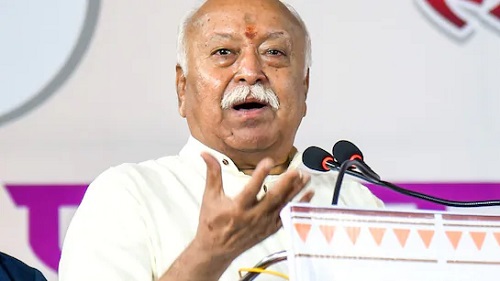
In a significant address during his first visit to Manipur since the outbreak of ethnic clashes in the state, Rashtriya Swayamsevak Sangh (RSS) Sarsanghchalak (Chief) Mohan Bhagwat delivered a powerful speech weaving together themes of civilisational endurance, cultural supremacy, and economic self-reliance. The core of his message was a bold declaration positioning Hindu society as indispensable to the world's very existence.
"A World Without Hindus Cannot Exist"
Speaking to an audience in the northeastern state, Bhagwat made a sweeping assertion about the centrality of Hindu civilisation. “Without Hindus, the world will cease to exist,” he stated, describing the Hindu way of life as "immortal." He anchored this claim in a historical comparison, noting that while ancient and mighty empires like Yunaan (Greece), Misr (Egypt), and Rome have perished, India has endured.
“Every nation of the world has seen all kinds of situations. Yunaan, Misr, and Roma, all civilizations, perished from the face of the earth. There is something in our civilization that we are still here,” Bhagwat elaborated. He framed this longevity not as a historical accident, but as a result of a unique social and spiritual fabric. “Bharat is the name of an immortal civilization… We have created a network in our society because of which the Hindu community will always be there,” he added.
By framing Hindu society as the global custodian of dharma (cosmic law and order), Bhagwat positioned it as a sustaining force for the entire world, a theme consistent with the RSS's worldview of India's spiritual primacy.
A Call for "Swadeshi" and Economic Strength
Moving beyond cultural philosophy, the RSS chief pivoted to a pressing contemporary issue: the need for economic self-reliance. He placed economic prowess at the foundation of national strength, alongside military and intellectual capabilities.
“While building the nation, the first requirement is strength. Strength means economic ability. The word ‘superiority’ sometimes carries the wrong meaning. But our economy must be completely self-reliant. We should not be dependent on anyone,” Bhagwat urged.
This emphasis on swadeshi (self-sufficiency) resonates strongly with the government's current economic policies, particularly in the context of global trade headwinds, such as the high tariffs imposed by the US on Indian imports. His comments serve as an endorsement of a resilient, inwardly-focused economic model that reduces vulnerability to international pressures.
Drawing Lessons from Societal Resolve
Bhagwat also drew upon recent Indian history to illustrate the power of collective societal will. He cited the decline of Naxalism, suggesting that it was ultimately defeated because “society decided it would not tolerate it anymore.”
He further recalled India's long struggle for independence from the British Empire. “The sun never used to set on the British Empire. But in India, their sun had already begun to set. We made efforts for 90 years. We never allowed that voice to be suppressed. Sometimes it became weak, sometimes it grew stronger, but it was never allowed to die,” he said, framing the freedom movement as a testament to persistent societal resolve.
A Visit of Significance
Bhagwat’s visit to Manipur itself carries considerable weight, given the state's recent history of violent ethnic conflict. While his speech did not directly address the ongoing tensions, his presence and his broader message of societal unity and inherent oneness—having previously stated that Muslims and Christians in India are descendants of the same ancestral lineage—were likely intended as a subtle appeal for harmony within his larger vision of a cohesive national society.
Through his remarks in Manipur, Mohan Bhagwat presented a comprehensive vision of India's identity and future—one rooted in an unbroken civilisational past, fortified by economic independence, and driven by an unwavering collective will. He positioned Hindu society not just as a survivor of history, but as its essential sustainer.


















Leave Your Comment