


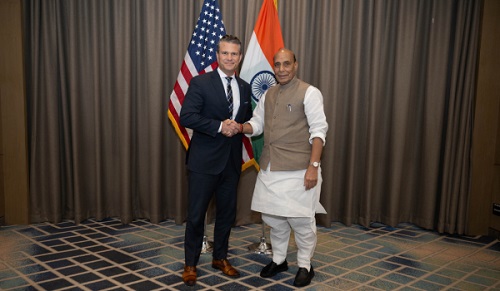
Defence Minister Rajnath Singh held separate meetings with US Secretary of War Pete Hegseth and Australian Deputy Prime Minister and Defence Minister Richard Marles on the sidelines of the 13th ASEAN Defence Ministers’ Meeting (ADMM)-Plus in the Philippines on Wednesday. The discussions underscored India’s continued engagement with key strategic partners, with the review of the India-US 10-year Defence Framework highlighting cooperation in military technology, information sharing and joint production.
Rajnath Singh shared details of his meeting with Hegseth in a social media post, stating that the two sides had reviewed progress under the 10-year India-US Defence Framework. The engagement focused on advancing strategic convergence between the two countries across critical defence sectors.
The framework provides a foundation for expanding bilateral defence cooperation at a time when emerging technologies, evolving security challenges and regional stability are becoming increasingly important to both nations. Cooperation in military technology, information exchange and co-production is particularly significant as India and the United States seek to strengthen their defence capabilities and deepen industrial collaboration.
Singh emphasised that the partnership between the two countries remains a cornerstone of efforts to maintain a free, open and secure Indo-Pacific. The statement reflects the importance both sides attach to regional stability, maritime security and sustained cooperation amid a changing strategic environment.
The Indo-Pacific has emerged as a major focus of defence diplomacy, with countries increasingly prioritising secure sea lanes, information sharing and stronger coordination to address traditional and emerging security concerns. India’s engagement with the United States forms an important part of its broader strategy of building partnerships while maintaining its independent foreign policy approach.
The meeting also provided an opportunity to assess the progress achieved under the existing defence framework and identify areas where cooperation could be strengthened further. Greater collaboration in defence technology and production can support the development of advanced capabilities while creating opportunities for closer engagement between the two countries’ defence industries.
Singh also met Australian Deputy Prime Minister and Defence Minister Richard Marles on the sidelines of the ADMM-Plus gathering. Although details of their discussions were not immediately available, the meeting highlighted the importance India attaches to maintaining regular high-level defence engagement with Australia.
India and Australia have steadily expanded their defence relationship through strategic dialogue, military exercises and cooperation on maritime security. Their engagement is particularly relevant to the wider Indo-Pacific, where both countries share an interest in regional peace, stability and respect for international law.
The 13th ADMM-Plus meeting in the Philippines brought defence leaders together on a regional platform to discuss common security challenges and strengthen dialogue among participating countries. The forum provides an avenue for ASEAN member states and their dialogue partners to exchange views on defence and security issues and explore practical avenues for cooperation.
Singh’s meetings with his American and Australian counterparts reflect India’s continued emphasis on defence diplomacy and partnerships with countries that share an interest in a stable Indo-Pacific. The review of the India-US Defence Framework, in particular, signals the importance of translating strategic alignment into tangible cooperation in technology, information sharing and defence manufacturing.
As regional security dynamics continue to evolve, sustained dialogue and practical defence collaboration are likely to remain central to India’s engagement with its partners.




















Leave Your Comment