


A political confrontation over the Opposition INDIA bloc's rally at Delhi's Ramlila Maidan has taken a new turn, with Union Minister Kiren Rijiju accusing the Congress of circulating an AI-generated image to exaggerate the size of the gathering. The controversy has intensified the war of narratives between the BJP and the Congress, with both sides disputing the turnout at the protest against Chief Election Commissioner Gyanesh Kumar. While the BJP has described the rally as a failure, the Congress has defended its mobilisation efforts by sharing photographs and drone footage. The dispute has also raised questions about the credibility of digital images in political campaigns and the growing role of artificial intelligence in shaping public perceptions.
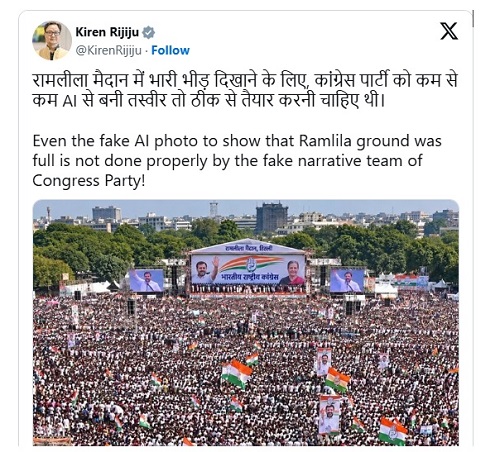
Union Minister Kiren Rijiju launched a sharp attack on the Congress after an image depicting a packed Ramlila Maidan rally was circulated on social media by several Congress party leaders and supporters. Sharing the image posted by Congress MP Vamsi Gaddam from Telangana, Rijiju alleged that the opposition party had resorted to artificial intelligence to create an exaggerated impression of public participation.
In his post on X, Rijiju criticised the Congress's communication strategy, saying that even the purported AI-generated photograph had not been produced convincingly by the party's narrative team.
The image also circulated through the social media accounts of other Congress leaders, including former MP and Congress Working Committee member Jagdish Thakor. Several users on X questioned its authenticity, pointing to apparent inconsistencies in the crowd and the stage. The depiction of Rahul Gandhi and Sonia Gandhi on the rally platform was also alleged to differ from the actual arrangements at the venue.
The controversy, however, centres on competing claims about the image's authenticity. While Rijiju and other critics described it as AI-generated, the allegations should be distinguished from independently established verification of the photograph.
The episode highlights a growing challenge for political communication in the digital age. AI-generated visuals can make fabricated scenes appear convincing, while genuine photographs can also be questioned when political opponents dispute their authenticity. Establishing the provenance of an image, therefore, requires more than competing assertions on social media.
The dispute over the photograph has added another dimension to the political battle over the size of the INDIA bloc's rally. Before the event, the Congress had projected an attendance of around 10 lakh people for the protest against Chief Election Commissioner Gyanesh Kumar and what the opposition describes as electoral irregularities.
The BJP subsequently challenged that claim, arguing that the turnout fell considerably short of expectations. BJP leaders circulated photographs and videos showing vacant chairs and claimed that approximately 40 per cent of the ground remained unoccupied.
BJP MP and spokesperson Sambit Patra described the gathering as a flop show, questioning the contrast between the Congress's advance publicity and the crowd visible in the material circulated after the event.
Patra also dismissed the Congress's presentation of the turnout, suggesting that photographic techniques could not compensate for a lack of public support. Taking a swipe at Rahul Gandhi, he argued that such tactics would not make anyone the Prime Minister.
The Congress, meanwhile, shared drone footage and other images to support its contention that a substantial number of people had attended the demonstration. The two parties thus presented competing visual narratives, each seeking to establish its own interpretation of the gathering.
The controversy illustrates how crowd size has become a political argument in its own right. For the Congress, a large turnout would demonstrate its ability to mobilise opposition parties and citizens around electoral concerns. For the BJP, questioning the attendance serves to undermine the opposition's claim that its campaign has generated widespread public momentum.
Yet neither selected photographs nor isolated video clips necessarily provide a complete picture of attendance throughout an event. A reliable assessment would require a broader examination of the venue, the timing of the footage and independently verifiable evidence.
Beyond the dispute over the photograph, the rally was an occasion for the opposition to intensify its criticism of the Election Commission. Addressing the gathering, Rahul Gandhi alleged that the 2024 general election was illegitimate because of what he described as vote theft. He directly accused Chief Election Commissioner Gyanesh Kumar of playing a role in the alleged wrongdoing.
Gandhi characterised the alleged manipulation of votes as an attack on the democratic rights of Indian citizens. He also claimed that Narendra Modi would not have become Prime Minister, nor Amit Shah Home Minister, without Kumar's alleged role. Gandhi further asserted that the Chief Election Commissioner would face imprisonment, making a forceful political accusation against the constitutional authority.
These statements represent the Congress leader's allegations and should not be treated as established findings of electoral misconduct.
The BJP responded by rejecting the opposition's approach and questioning the venue and manner in which the allegations were being advanced. Patra argued that claims about an illegal election could not be substantiated merely through speeches at Ramlila Maidan.
The exchange reflects a wider confrontation over the credibility of electoral institutions, the opposition's campaign against alleged irregularities and the BJP's defence of the electoral process. While the Congress has sought to turn the issue into a national political movement, the BJP has challenged both its claims and its methods of presentation.
The AI-image controversy has further complicated this debate by shifting attention from the substance of the opposition's allegations to the credibility of the material used to promote its campaign.
Ultimately, the episode underscores the importance of authenticity in political communication. In an environment where manipulated images, edited videos and AI-generated content can spread rapidly, political parties have a responsibility to ensure that the material they circulate accurately represents events. Equally, allegations of digital manipulation should be supported by verifiable evidence rather than accepted solely on the basis of partisan claims.
For the Congress and the BJP, the immediate contest may be over the size of a rally, but the larger issue concerns public trust. When political narratives depend heavily on disputed visuals, establishing the facts becomes essential to informed democratic debate.













Leave Your Comment