



Deepak Kumar Rath
Raksha Bandhan is perhaps one of the most beautiful expressions of India’s civilisational ethos. It celebrates the bond between a brother and sister, a relationship of affection, trust and responsibility that rises above caste, class and political identities. Yet, when caste enters even such a sacred social space, it should make us pause and ask a larger question: Are we really moving towards a casteless society, or are we making caste an increasingly permanent feature of public life?
The larger issue is far more important. It is the growing tendency to view Indians through the rigid categories of “general”, “SC”, “ST” and “OBC”, as though caste identities must remain the defining framework of social and political interaction forever.
That cannot be the India envisioned by the Constitution.
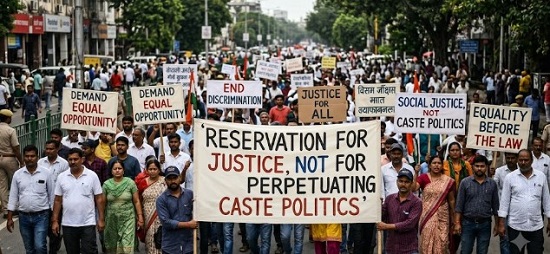
Let us be absolutely clear: reservation is not inherently wrong. It was created for a historical reason. Communities that suffered centuries of social exclusion and discrimination could not be expected to compete on an equal footing merely because the Constitution declared everyone equal. Reservation was therefore conceived as an instrument of substantive equality and social justice.
But an instrument of justice must remain directed towards those who actually require justice.
The uncomfortable question today is whether the benefits of reservation are always reaching the most disadvantaged. Within several reserved categories, a relatively prosperous and educated section has emerged. Families that have already benefited from generations of education, government employment and economic advancement may continue to access opportunities meant primarily to compensate for historical deprivation.
This is where the creamy-layer principle becomes crucial.
If the purpose of reservation is empowerment, then the system must constantly ask who remains genuinely deprived and who has already crossed the barriers that affirmative action was designed to address. The benefits should reach the first-generation learner from a disadvantaged background, the child whose parents never had access to higher education, and the family still struggling to escape structural deprivation—not become an inherited advantage available indefinitely to the already empowered.
This is not anti-reservation. It is pro-social justice.
India must also confront the growing anxiety over merit. Millions of young Indians spend years preparing for competitive examinations. They sacrifice sleep, money and opportunities because they believe that education and hard work can change their lives. Their concerns cannot simply be dismissed as opposition to social justice.
At the same time, merit cannot be reduced to marks alone. A student who studies in an elite school with private tutors and expensive coaching does not necessarily begin from the same position as a student studying in a poorly equipped government school. Equality of opportunity must therefore precede the competition for merit.
The answer lies in attacking inequality at its roots.
Instead of allowing reservation to become the principal instrument of social mobility, governments must dramatically improve government schools, higher education, scholarships, nutrition, digital access and competitive-examination preparation for disadvantaged children. The strongest form of social justice is to ensure that a child does not require preferential treatment merely because the system failed to provide an equal starting point.
Unfortunately, caste has also become an extremely profitable political currency. Political parties increasingly organise communities as vote banks and present social groups as competing claimants to a limited national pie. The result is paradoxical: while politicians speak about eliminating caste discrimination, their politics often keeps caste identities alive and politically indispensable.
This contradiction needs to end.
The goal of social justice cannot be the permanent preservation of caste consciousness. The goal must be to make caste progressively irrelevant to an individual's opportunities and aspirations.
India needs a reservation policy that is targeted, periodically reviewed and genuinely directed towards the disadvantaged. Economic and educational deprivation, social backwardness and the extent to which a family has already benefited from affirmative action should all receive serious consideration. No system of public policy should become immune from scrutiny merely because it carries the label of social justice.
The debate must therefore move beyond the tired slogans of “reservation versus merit”. India needs both justice and excellence, inclusion and opportunity, representation and competence.
The real test of reservation is not how many years it survives. The real test is whether the day eventually arrives when fewer Indians need it.
That should be our national aspiration: not an India permanently divided between “reserved” and “unreserved”, but an India where every child—irrespective of caste—is equipped to compete, succeed and rise on the strength of talent, opportunity and hard work.
Reservation was created as a bridge to equality.
It must never become a permanent monument to inequality.




















Leave Your Comment