


By Prakash Nanda
NEW DELHI: Reports are that US Vice-President JD Vance, a sceptic of the war on Iran, helped broker a two-week ceasefire via backchannel talks with Tehran officials facilitated by Pakistan.
Yesterday ( April 7), President Trump had threatened to annihilate the Iranian civilisation if Iran did not agree to open the Strait of Hormuz, through which 25 percent world’s oil and gas are imported from the Gulf countries. But with less than 90 minutes until his deadline (that was our morning 5.30 Am today), it was decided to halt the American-Israeli war in Iran conditionally, at least for now.
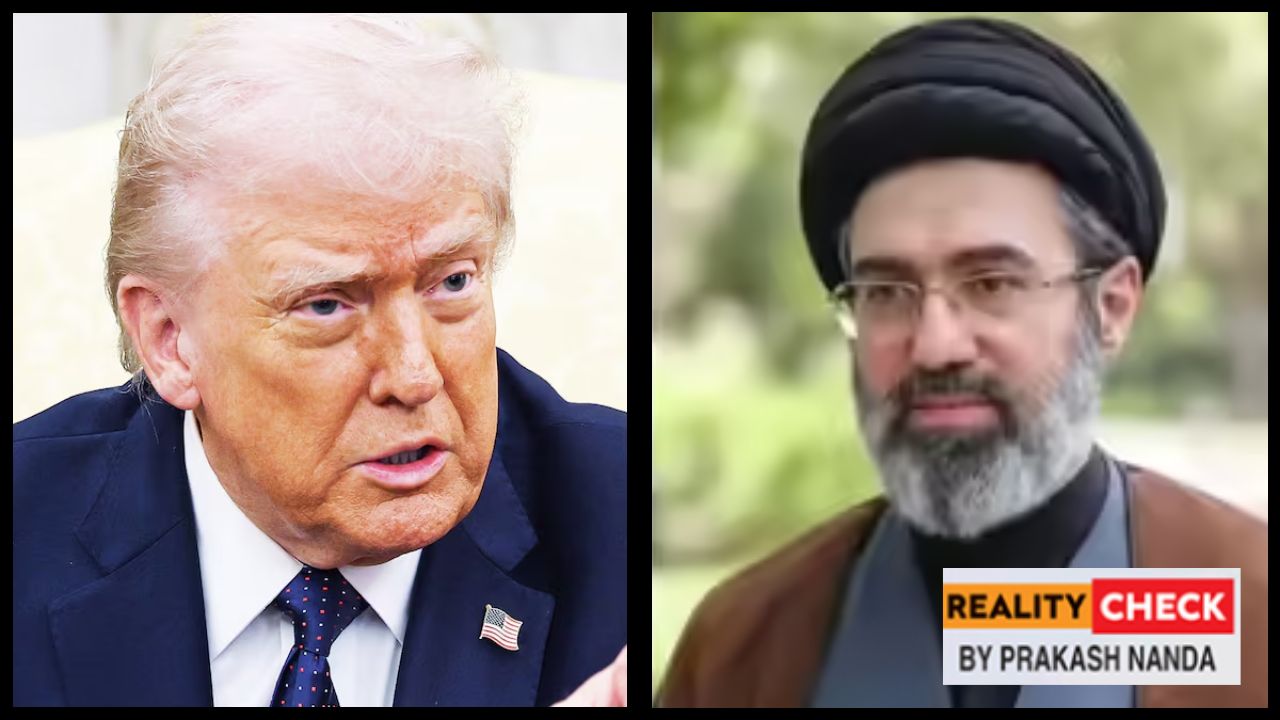
Given the conditions involved, both US President Donald Trump and the Islamic leadership of Iran can claim “ partial victory” over the temporary cease-fire of two weeks.
While Trump can be happy that the ceasefire is subject to the “Complete, Immediate, and Safe Opening of the Strait of Hormuz” by Iran, the latter can boast that the former is willing to discuss “ the ten-point peace proposal” that has been conveyed through Pakistan.
Though the conditions on both sides are interlinked, it is difficult to guess whether all the 10( ten) conditions of Iran can be agreed to by Trump, or, for that matter, any President of the United States.
These demands have not been made in any official text, but according to Iranian officials, these include the lifting of all sanctions and UN resolutions against Iran, alongside the release of Iranian assets held overseas. Other demands include the withdrawal of U.S. combat forces from military bases across the region, compensation in the form of estimated reparations, and Iran's right to nuclear enrichment.
Though each one of the above is tricky, three of them seem to be highly contentious, given their global implications.
One is related to Iran’s nuclear programme. The second is the demand that America must remove its military bases and installations from the Gulf.
However, the most worrisome seems to be the demand of recognizing Iran’s control over the Strait of Hormuz, which seemingly includes the right that was mentioned before by Tehran that the country would collect tolls from vessels that transit Hormuz, a revenue that might be shared with Oman.
There are reports of Iran's Revolutionary Guard (IRGC) collecting up to $2 million for a vessel’s "safe passage," often settled in Chinese Yuan or stablecoins.
Not only most of its Gulf neighbours but also the rest of the world may see this as nothing other than extortion. Because, under international law, such extortions are strictly prohibited.
However, it may be noted that tolls or transit fees are legitimate only in passages that are artificial, not natural, like the Strait of Hormuz. The distinction is important, indeed!
Artificial waterways like the Suez and Panama canals charge transit fees. However, the Strait of Hormuz, like any other Strait, is a natural international waterway of 21 nautical miles wide, even though it falls within the overlapping territorial waters of Iran and Oman.
And here, the United Nations Convention on the Law of the Sea (UNCLOS), which guarantees the right of “transit passage” through straits used for international navigation, makes it clear under Articles 37 to 44, ships and aircraft are entitled to continuous and expeditious passage that cannot be impeded or suspended by the coastal state even if the Strait falls under its territorial jurisdiction.
Notably, Article 26 of the UNCLOS prohibits states from levying charges on vessels merely for passage, allowing fees only for specific services rendered. It says, “ No charge may be levied upon foreign ships by reason only of their passage through the territorial sea” and “ Charges may be levied upon a foreign ship passing through the territorial sea as payment only for specific services rendered to the ship. These charges shall be levied without discrimination”.
In other words, the Strait of Hormuz is an international strait, which means all ships have the right of transit passage, free of charge and free of prior approval.
Thus, Iran’s fee collection constitutes an aggression and a violation of the United Nations agreement on the law of the sea.
Secondly, Iran cannot stretch the argument that the Strait falls under its territorial jurisdiction ( 12 nautical miles or 22 km out of the total 39km wide) beyond a point. Because the Strait also falls under the territorial waters of Oman. The entire width of the strait, thus, consists of the overlapping territorial seas of both Iran and Oman. But, unlike Iran, Oman is not talking of imposing transit fees.
In fact, since Iran has no jurisdiction on anything beyond 12 nautical miles from its coast, it cannot charge a toll if your ship uses the Omani coastline.
And, it so happens that though it has not been pointed out adequately, the shipping lanes lie mostly in Omani territorial waters, if one goes by the Encyclopedia Britannica.
Considering all this, it is apparent that what Iran is demanding is beyond laws. Its demand reflects what its leaders think to be the best timing for weaponising its geography to extract concessions, which, if granted, could have far-reaching implications.
As the Economist magazine argued recently, Hormuz is not the only weak spot for global trade, as many shipping routes are equally vulnerable, from the Strait of Malacca to the Panama Canal. If countries begin imposing toll systems on strategic waterways, it could fundamentally alter the global trading system.
Thus, ultimately, the question is whether acceding to Iranian demand does not lead to the crippling of the freedom of navigation, a diplomatic principle that has largely prevailed for more than a century.


















Comments (1)
S
Very good illustrations