



Nilabh Krishna
The controversy surrounding the alleged NEET paper leak once again shook the conscience of the country. For millions of students and parents, it was not merely another news headline; it was a painful reminder of how fragile trust in India’s education system has become. In a nation where competitive examinations are treated as the ultimate gateway to social mobility, dignity, and economic security, any compromise in fairness strikes at the very foundation of democratic aspiration. The outrage over the NEET episode is therefore not limited to a single examination. It has reopened an uncomfortable but necessary debate: is India’s education system truly serving students, or has it become an overburdened machinery driven by coaching centres, political interference, commercialization, and administrative inefficiency?
For decades, education in India has been projected as the most powerful instrument for empowerment. Families in villages, towns, and cities invest their life savings in the hope that their children will secure admission into prestigious institutions. The emotional weight attached to examinations like NEET, JEE, UPSC, and CUET is enormous. For countless middle-class and lower-middle-class households, success in these examinations is viewed as a once-in-a-lifetime opportunity to escape poverty and secure social respect. However, the increasing frequency of paper leaks, cheating rackets, proxy candidates, and irregularities has created a dangerous perception that merit alone may no longer guarantee success. This erosion of credibility is perhaps the biggest crisis confronting Indian education today.
The NEET controversy exposed not only administrative loopholes but also the deeper structural weaknesses embedded within the system. The first major issue is the excessive centralization of opportunity around a handful of examinations. In India, a student’s future is often decided by performance in a single high-pressure exam conducted on a single day. Years of preparation, emotional investment, and financial sacrifice hinge upon a few hours inside an examination hall. Such a system naturally creates enormous pressure and incentivizes malpractice. Whenever one examination becomes the sole gateway to professional education, criminal networks find opportunities to exploit desperation.
The rise of the coaching industry is another disturbing dimension of this crisis. Over the years, education has increasingly transformed into a commercial enterprise. Cities like Kota have become symbols of both aspiration and anxiety. Students as young as thirteen or fourteen are pushed into relentless coaching routines, isolated from normal childhood experiences. The focus gradually shifts from learning to scoring, from understanding to memorization, and from curiosity to survival. Education becomes less about intellectual development and more about cracking an examination formula. In such an environment, ethical values often take a back seat. If society glorifies rank over learning, shortcuts inevitably emerge.
The psychological impact of this hyper-competitive culture cannot be ignored either. India has witnessed alarming cases of student depression, burnout, and suicides linked to academic pressure. The tragedy lies in the fact that students are burdened not only by their own ambitions but also by societal expectations. Failure in an examination is often portrayed as failure in life itself. Instead of nurturing creativity, emotional intelligence, and critical thinking, the current system rewards conformity and mechanical repetition. This approach may produce examination toppers, but it raises serious questions about whether it is producing well-rounded citizens capable of innovation and independent thought.
Another crucial issue exposed by repeated examination controversies is the weakness of institutional accountability. Whenever a paper leak occurs, blame games begin between agencies, state governments, examination bodies, and law enforcement institutions. Yet systemic reform remains elusive. India conducts some of the largest examinations in the world, involving millions of candidates across thousands of centres. Such operations require impeccable coordination, technological security, and transparent oversight. However, outdated processes, weak digital safeguards, corruption at local levels, and lack of real-time monitoring continue to undermine credibility. In many cases, investigations reveal organized criminal syndicates operating with astonishing sophistication, suggesting that examination fraud has evolved into a parallel underground industry.
The deeper concern is that the education system has increasingly become disconnected from the actual needs of society and the economy. Even after years of intense academic competition, many graduates struggle with employability. Employers frequently complain about lack of practical skills, communication abilities, analytical thinking, and adaptability among graduates. This exposes a contradiction at the heart of the system: students are trained extensively to clear examinations, but not necessarily to solve real-world problems. The obsession with marks and ranks often overshadows vocational learning, creativity, research orientation, and interdisciplinary understanding.
India’s school education framework also deserves serious introspection. The disparity between elite private schools and poorly funded government schools remains stark. While privileged students access advanced infrastructure, digital learning tools, and specialized mentorship, millions of children in rural and underdeveloped areas still struggle with basic facilities. The unequal starting point creates a deeply unfair competition. A student from a remote village preparing for NEET or JEE often battles not only academic challenges but also poor internet connectivity, inadequate teaching resources, and economic hardship. When paper leaks or examination irregularities occur, the sense of injustice becomes even more severe for such students who rely entirely on hard work.
Teacher training and academic culture form another neglected area. In many institutions, teachers themselves operate within outdated pedagogical frameworks focused on rote memorization rather than conceptual understanding. The education system often discourages questioning and independent thinking. Students are conditioned to reproduce textbook answers rather than engage critically with ideas. This culture limits innovation and suppresses intellectual confidence. Nations that lead in scientific advancement and research generally cultivate curiosity from an early age, whereas India’s system frequently prioritizes obedience over imagination.
Technology, which was expected to democratize education, has also produced mixed outcomes. Online learning platforms expanded rapidly after the pandemic and created new opportunities for access. Yet they also intensified commercialization and inequality. Digital education remains inaccessible to many economically weaker sections. Moreover, the increasing dependence on technology in examinations raises cybersecurity concerns. If systems are not adequately protected, digital vulnerabilities can become new pathways for malpractice. Therefore, modernization without institutional preparedness can sometimes create fresh problems rather than solutions.
The debate around the NEET controversy also reflects a broader trust deficit between citizens and institutions. Students today are more aware, more vocal, and less willing to accept opaque explanations. Social media amplifies both grievances and scrutiny. While this democratization of public discourse strengthens accountability, it also means that institutions cannot survive on reputation alone; they must continuously demonstrate fairness and transparency. Every paper leak damages not only an examination process but also public faith in governance itself.
At the policy level, several reforms have been proposed over the years, but implementation remains inconsistent. The National Education Policy (NEP) introduced ambitious ideas aimed at transforming learning, reducing rote culture, promoting flexibility, and integrating skill development. The vision behind such reforms is encouraging, yet policy declarations alone are insufficient. The real challenge lies in execution. Educational transformation requires investment in teachers, infrastructure, technology security, curriculum redesign, and institutional autonomy. More importantly, it demands a cultural shift in how society defines success.
India must begin reimagining education beyond examinations alone. Competitive tests are necessary to ensure merit-based selection, especially in a country with enormous population pressure. However, reducing an entire educational journey to a few entrance exams is neither healthy nor sustainable. Continuous assessment models, stronger university-level evaluation systems, practical learning methods, and diversified career opportunities can reduce excessive dependence on single high-stakes examinations. Countries with robust education systems generally offer multiple pathways for professional growth, whereas India still channels millions of students into narrow academic funnels.
Vocational education also requires urgent attention. For too long, vocational careers have been socially undervalued in India. This mindset has contributed to overcrowding in conventional professional streams while simultaneously creating skill shortages in other sectors. A balanced education system should respect both academic and vocational excellence. The future economy will require not just doctors and engineers but also skilled technicians, researchers, designers, entrepreneurs, and innovators. Educational planning must align with these evolving realities.
Parents and society too have a responsibility in reshaping the system. The pressure to achieve socially prestigious careers often leaves students with little freedom to explore individual talents and interests. Education should not become a race where children are treated as investments expected to yield returns through examination ranks. A healthier environment would encourage learning as a process of growth rather than merely competition.
Ultimately, the NEET paper leak controversy is not an isolated administrative failure. It is a mirror reflecting the deeper anxieties, contradictions, and imbalances within India’s education ecosystem. The issue is not only about securing question papers or arresting culprits; it is about restoring faith in fairness, dignity, and equal opportunity. Education is the backbone of any nation’s future. If students begin to believe that the system rewards manipulation more than merit, the consequences will extend far beyond classrooms and examination halls.
India stands at a critical juncture. It possesses one of the world’s youngest populations and immense intellectual potential. But demographic advantage can become a demographic burden if education fails to inspire trust, competence, and innovation. The country therefore needs not cosmetic corrections but a serious national introspection about what education should truly achieve. The goal must be to create a system that values integrity as much as intelligence, understanding as much as scoring, and human development as much as economic ambition.
The debate triggered by the NEET controversy should not fade away after the news cycle changes. Instead, it should become an opportunity to rethink priorities and rebuild institutions. The future of millions of young Indians depends upon whether the country can transform education from a stressful examination factory into a genuinely empowering system of learning. Only then can India claim to be preparing not just successful candidates, but capable, ethical, and confident citizens for the future.
From Access to Excellence: How Modi’s 12-Year Education Transformation Is Reshaping India
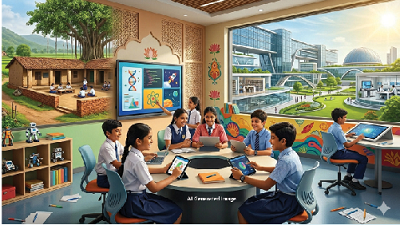
For decades, India’s education system carried a contradiction. It produced world-class scientists, engineers, and entrepreneurs, yet millions of students struggled with basic learning outcomes. The system remained heavily examination-oriented, linguistic barriers restricted opportunities for large sections of society, and access to quality education varied significantly across regions. Over the last twelve years, however, the Narendra Modi government has attempted to address these structural challenges through a combination of policy reforms, technological interventions, and a renewed focus on India's linguistic and cultural diversity. The result has been one of the most significant periods of educational transformation since Independence.
At the heart of this transformation lies the recognition that education is not merely about literacy or degrees but about empowering individuals with skills, confidence, and opportunities. The government's flagship reform, the National Education Policy (NEP) 2020, sought to fundamentally redesign the architecture of Indian education. Unlike previous approaches that often emphasized rote learning and rigid academic streams, the new policy introduced flexibility, multidisciplinary learning, critical thinking, and skill development. It aimed to prepare students not only for examinations but also for the demands of a rapidly changing global economy.
One of the most consequential aspects of this educational shift has been the emphasis on learning in the mother tongue and regional languages. For decades, many students faced the challenge of acquiring knowledge through a language that was not their own. Educational research across the world has consistently shown that children learn concepts more effectively when taught in their native language during their formative years. Recognizing this reality, the Modi government encouraged mother-tongue instruction, particularly at the foundational stage. This marked a departure from the long-held assumption that quality education was possible only through English.
Critics initially feared that greater emphasis on Indian languages could isolate students from global opportunities. However, the government’s approach sought to balance local empowerment with international competitiveness. While promoting regional languages in classrooms, it simultaneously expanded digital learning resources, online courses, and access to global knowledge platforms. The objective was not to replace English but to remove the disadvantage faced by millions who were excluded because of linguistic barriers. Students were encouraged to develop strong conceptual understanding in their own languages while retaining access to English and other international languages as tools for global engagement.
The technological revolution in education has further strengthened this vision. Platforms such as DIKSHA, SWAYAM, PM eVIDYA, and other digital initiatives have dramatically expanded access to learning resources. During the COVID-19 pandemic, when educational systems worldwide faced unprecedented disruption, India leveraged its digital infrastructure to ensure continuity of learning. Online content became available in multiple Indian languages, helping bridge regional disparities and making quality educational material accessible to students regardless of their location.
The government has also invested significantly in expanding higher education infrastructure. Over the past decade, new Indian Institutes of Technology (IITs), Indian Institutes of Management (IIMs), All India Institutes of Medical Sciences (AIIMS), central universities, and other institutions have been established across the country. This expansion has increased opportunities for students from smaller towns and underserved regions. Simultaneously, reforms in medical education, engineering education, and vocational training have aimed to align academic institutions with the evolving needs of industry and society.
Skill development has emerged as another pillar of the education agenda. Recognizing that economic growth requires a workforce equipped with practical capabilities, the government launched initiatives such as Skill India, PM Kaushal Vikas Yojana, and various vocational education programs. These efforts sought to break the traditional divide between academic learning and employable skills. By integrating vocational exposure into the education system, policymakers aimed to create pathways for students with diverse aspirations and talents.
Another notable achievement has been the rapid expansion of educational inclusion. Schemes focused on girls’ education, scholarships for disadvantaged communities, direct benefit transfers, sanitation facilities in schools, and improved school infrastructure have contributed to higher enrollment and retention rates. The emphasis on foundational literacy and numeracy through programs such as NIPUN Bharat reflects an understanding that long-term educational success depends on strengthening learning outcomes at the earliest stages.
India’s growing international academic profile also reflects the changing landscape. Indian universities have increasingly participated in global collaborations, while foreign universities have shown greater interest in establishing partnerships with Indian institutions. The NEP’s emphasis on multidisciplinary education, research, and innovation seeks to create an ecosystem that can compete with leading global education systems. Initiatives supporting research, entrepreneurship, and startup culture have further connected education with innovation-driven economic growth.
Perhaps the most distinctive feature of the Modi government's educational approach has been its attempt to reconcile national identity with global ambition.
(The content of this article reflects the views of writer and contributor, not necessarily those of the publisher and editor. All disputes are subject to the exclusive jurisdiction of competent courts and forums in Delhi/New Delhi only)




















Leave Your Comment