


The Rajya Sabha on Wednesday passed the Prevention of Insults to National Honour (Amendment) Bill, 2026, paving the way for granting the national song Vande Mataram the same statutory protection as the national anthem, Jana Gana Mana. The legislation amends the Prevention of Insults to National Honour Act, 1971, making deliberate insults to Vande Mataram punishable with imprisonment of up to three years, a fine, or both.
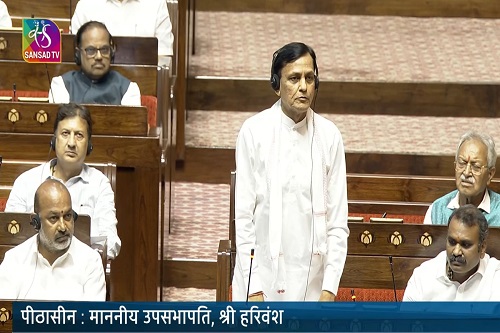
Replying to the discussion in the Upper House, Minister of State for Home Nityanand Rai said the amendment is "not merely a legislative change" but a reflection of India's collective commitment to its national consciousness, cultural heritage, and the ideals of the freedom movement. He said the 1971 Act had originally provided legal safeguards for the National Flag, the Constitution, and the National Anthem, and that the amendment seeks to extend similar protection to the national song.
Rai said that any deliberate insult to Vande Mataram would now attract the same legal consequences as disrespect shown to Jana Gana Mana. He described the move as a recognition of the song's historic role in inspiring India's freedom struggle and strengthening national unity.
Tracing the history of Vande Mataram, the minister noted that the song was composed in 1875 by Bankim Chandra Chattopadhyay. He claimed that in 1935, when Jawaharlal Nehru served as Congress president, the song was limited to its first two stanzas. In contrast, he said that in 1928, Congress president Netaji Subhas Chandra Bose requested Timir Baran Banerjee to prepare a complete and dignified musical rendition of the song.
Rai also recalled that on August 15, 1947, Sardar Vallabhbhai Patel requested renowned vocalist Pandit Omkarnath Thakur to perform the complete Vande Mataram on All India Radio at 6:30 a.m., marking the beginning of independent India's first Independence Day celebrations.
Highlighting the constitutional significance of the song, the minister referred to the statement made by Dr. Rajendra Prasad in the Constituent Assembly on January 24, 1950, wherein he said that Vande Mataram, owing to its historic importance in the freedom struggle, would enjoy the same respect as Jana Gana Mana. Rai further alleged that opposition to Vande Mataram reflected a policy of appeasement that weakened national pride.
Initiating the debate on the Bill, BJP MP Dr. Radha Mohan Das Agrawal argued that Vande Mataram had faced disrespect for over 123 years despite its pivotal role in inspiring revolutionaries and freedom fighters. He alleged that the song had been insulted during a Congress session in 1923 under the party's then president.
Supporting the legislation, Golla Baburao of the YSR Congress Party urged all members of Parliament to uphold and respect the national song. Thanking the government for introducing the Bill, he said Vande Mataram was far more than a patriotic composition, describing it as a powerful source of inspiration that motivated countless freedom fighters to sacrifice their lives for the nation.
Members from several political parties also participated in the discussion, including Sulata Deo of the Biju Janata Dal, Sanjay Singh of the Aam Aadmi Party, and Dr. M. Thambidurai of the AIADMK, among others. The passage of the Bill in the Rajya Sabha marks another legislative step toward according greater legal recognition and protection to one of India's most enduring symbols of the freedom movement.




















Leave Your Comment