


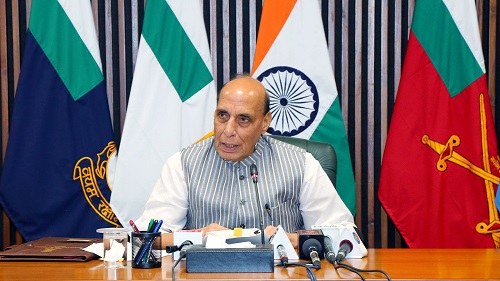
Amid shifting geopolitical equations and growing security challenges in the Indo-Pacific, India and Japan are moving to strengthen their strategic and defence partnership. Defence Minister Rajnath Singh's November 18-19 visit to Japan for the fourth India-Japan Foreign and Defence Ministers’ Dialogue (2+2) is expected to give fresh momentum to bilateral military cooperation, defence technology partnerships and maritime security. The high-level engagement will also reaffirm the shared resolve of the two democracies to maintain a free, open and rules-based Indo-Pacific.
India and Japan are preparing to take their strategic and defence partnership to a higher level, with Defence Minister Rajnath Singh scheduled to visit Japan on November 18-19, 2026. The visit, centred on the fourth edition of the India-Japan Foreign and Defence Ministers’ Dialogue (2+2), comes at a time when security dynamics in the Indo-Pacific are undergoing significant changes. Against the backdrop of growing regional uncertainties, the two countries are expected to strengthen defence cooperation, expand technological collaboration and reinforce their shared commitment to a free, open and rules-based Indo-Pacific.
The 2+2 Ministerial Dialogue, scheduled to take place in Tokyo, will be co-chaired by Rajnath Singh and External Affairs Minister S Jaishankar from the Indian side, alongside Japan’s Defence Minister Shinjiro Koizumi and Foreign Minister Toshimitsu Motegi. The discussions will cover the entire spectrum of bilateral strategic and defence relations, providing an opportunity to assess ongoing initiatives and identify fresh areas of cooperation. The ministers will also exchange perspectives on important regional and global developments, particularly those affecting peace, stability and security in the Indo-Pacific. The dialogue is expected to reaffirm the determination of both countries to uphold an inclusive regional order based on international law, freedom of navigation and respect for national sovereignty.
A significant component of the visit will be the bilateral meeting between Rajnath Singh and his Japanese counterpart Shinjiro Koizumi. It will mark their third meeting this year, reflecting the increasing frequency and depth of defence-level engagement between New Delhi and Tokyo. Their previous interactions in New Delhi in August 2026 and on the sidelines of the ASEAN Defence Ministers’ Meeting-Plus in Cebu in October have provided momentum to the relationship. Building on these engagements, the two ministers will explore ways to expand cooperation in defence equipment and technology, strengthen maritime security and improve the operational capabilities of their armed forces through more extensive joint exercises.
Particular emphasis is expected to be placed on increasing the scale and complexity of military exercises involving the armies, navies and air forces of both countries. Such engagements are important not merely for improving interoperability but also for developing mutual understanding, coordinating operational responses and enhancing preparedness against emerging security challenges. Maritime cooperation will remain another crucial priority, given the strategic significance of the Indo-Pacific's sea lanes and the shared interest of India and Japan in maintaining a secure maritime environment. The two sides will also examine opportunities to deepen defence industrial partnerships, encouraging greater collaboration in manufacturing, technology development and equipment-related initiatives.
India and Japan enjoy a Special Strategic and Global Partnership founded on democratic values, mutual trust and converging strategic interests. Over the years, their relationship has expanded beyond conventional diplomatic and economic engagement to encompass maritime security, defence technology, regional connectivity and broader strategic coordination. Japan's technological strengths and India's growing defence manufacturing capabilities offer considerable opportunities for mutually beneficial cooperation. The upcoming ministerial engagement is therefore expected to provide fresh direction to this partnership, particularly in translating political commitments into practical defence and industrial outcomes.
At a time when the Indo-Pacific is increasingly central to global geopolitical calculations, stronger India-Japan cooperation carries significance beyond their bilateral relationship. Both countries recognise the importance of maintaining regional stability, preventing unilateral changes to the status quo and ensuring that international maritime routes remain open and secure. Rajnath Singh's visit is expected to consolidate this shared vision while establishing a roadmap for greater operational coordination and industrial synergy. The fourth 2+2 Dialogue will thus represent another important step towards building a more resilient strategic partnership capable of responding to the evolving security challenges of the region.





















Leave Your Comment