


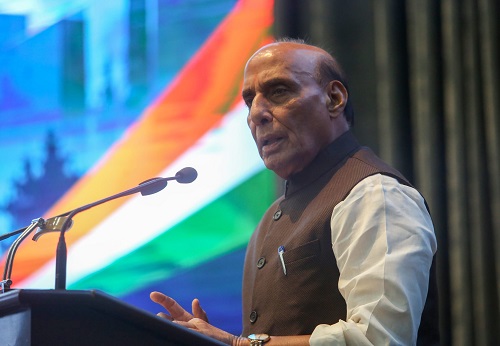
Defence Minister Rajnath Singh’s visit to Tajikistan for the 25th Meeting of the Council of Heads of Government of the Shanghai Cooperation Organization (SCO) underscores India’s continued engagement with a multilateral platform that brings together countries with diverse political, economic and strategic interests. As the two-day meeting begins in Dushanbe, the focus on trade, connectivity, investment, innovation and cultural exchanges offers India an opportunity to advance practical cooperation while protecting its national interests in an increasingly complex regional environment.
Defence Minister Rajnath Singh has departed for Dushanbe, the capital of Tajikistan, to represent India at the 25th Meeting of the Council of Heads of Government of the Shanghai Cooperation Organization. The two-day meeting is expected to deliberate on strengthening cooperation among member states across a broad range of economic, institutional and people-centric areas.
According to the Defence Ministry, the discussions will cover trade, economic cooperation, investment, connectivity, innovation, culture and humanitarian exchanges. The participating countries will also review the progress of ongoing initiatives and consider decisions concerning the organization's financial and institutional functioning.
For India, the significance of the meeting extends beyond diplomatic participation. The SCO provides a forum for engaging with countries that occupy important positions in Eurasia, a region central to international trade, energy security, transport networks and evolving geopolitical equations. Sustained engagement with the organization allows New Delhi to maintain dialogue with regional partners even when bilateral relationships or broader strategic interests do not always align.
The challenge, however, lies in translating diplomatic discussions into tangible outcomes. Multilateral meetings frequently produce declarations of intent, but their real value depends on the implementation of agreed initiatives, the removal of practical barriers and the willingness of participating countries to cooperate consistently.
Economic Cooperation and Connectivity in Focus
Trade, investment and connectivity are among the most consequential subjects on the meeting's agenda. Better economic links can create opportunities for businesses, improve access to regional markets and strengthen commercial relationships between member states.
For India, improved connectivity with Central Asia remains a significant strategic and economic objective. The region offers potential opportunities in energy, pharmaceuticals, information technology, agriculture, infrastructure and other sectors. However, geographical constraints and complicated regional politics continue to make direct and efficient access to several Central Asian markets difficult.
India's participation in the SCO therefore provides an opportunity to discuss ways of improving regional transport links and facilitating trade. Progress in these areas would require more than broad commitments: efficient logistics, predictable transit arrangements, compatible regulations and sustained institutional coordination would all be necessary.
Investment and innovation also offer scope for mutually beneficial partnerships. Cooperation in technology, industrial development, digital services and research could help member states diversify their economies and develop new sources of growth. India, with its expanding technological capabilities and services sector, has potential to contribute to such initiatives.
Yet the benefits will depend on whether member states can identify projects that deliver measurable results rather than allowing economic cooperation to remain confined to diplomatic statements.
Institutional Functioning and Financial Stability
The meeting is also expected to review the SCO's financial and institutional functioning, an aspect that may receive less public attention than trade or connectivity but remains essential to the organization's effectiveness.
Multilateral institutions require reliable funding, efficient administrative structures and clear mechanisms for implementing decisions. Without these foundations, even ambitious cooperation programmes can struggle to produce lasting results.
Reviewing ongoing initiatives and institutional arrangements can help member states assess whether existing mechanisms are delivering the intended outcomes. It also provides an opportunity to improve coordination and ensure that the organization's resources are directed towards shared priorities.
For India, a more effective SCO would mean a stronger platform for pursuing regional economic cooperation and maintaining communication with other member states. At the same time, New Delhi's engagement must remain guided by a realistic assessment of what the organization can achieve, given the different priorities and interests of its members.
Culture and People-to-People Ties
The emphasis on cultural and humanitarian exchanges highlights another dimension of regional cooperation. Educational partnerships, cultural programmes, tourism and professional exchanges can build familiarity and strengthen relationships beyond formal government channels.
Such engagement can be particularly valuable in a region with a long history of cultural interaction and economic connections. Stronger people-to-people ties can complement official diplomacy by encouraging collaboration among students, researchers, entrepreneurs and cultural institutions.
However, these initiatives need sustained support to make a meaningful difference. Regular exchanges, accessible educational opportunities and collaborative programmes are more likely to create lasting relationships than occasional ceremonial events.
A Platform for Dialogue Amid Regional Complexities
The SCO brings together countries with different political systems, economic priorities and strategic calculations. This diversity creates opportunities for cooperation but also complicates consensus-building.
India's approach to the organization must consequently balance engagement with strategic autonomy. Participation in multilateral discussions allows New Delhi to articulate its interests, explore areas of common ground and preserve channels of communication without necessarily sharing every position adopted by other members.
The Dushanbe meeting offers an opportunity to assess how far the SCO can move towards practical cooperation in areas where common interests exist. Economic development, investment, technological collaboration and cultural exchanges provide potential avenues for progress, even when wider geopolitical differences remain unresolved.
Ultimately, the success of the 25th meeting will depend not simply on the subjects discussed but on the decisions taken and the extent to which they are implemented. For India, Rajnath Singh's participation represents an opportunity to reinforce regional engagement and promote cooperation that produces concrete economic and diplomatic benefits.
As the SCO continues to evolve, its credibility will increasingly depend on its ability to convert shared ambitions into workable initiatives. India's engagement in Dushanbe will be meaningful to the extent that it advances that objective while remaining consistent with the country's long-term strategic and economic priorities.




















Leave Your Comment