


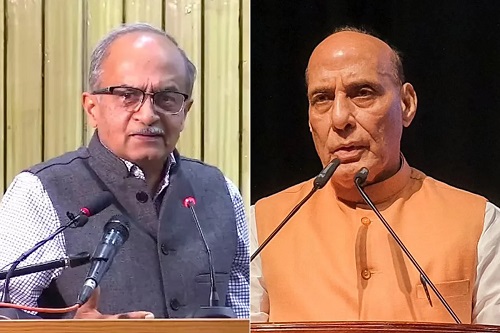
The controversy over protests against Chief Election Commissioner Gyanesh Kumar has taken a political turn after senior advocate Prashant Bhushan openly declared that the movement was now a fight for “regime change”. His statement has lent weight to the charge made by Defence Minister Rajnath Singh that the protesters’ agenda extends beyond electoral reform and is aimed at creating political instability. Singh has accused the opposition of attempting to turn the youth into instruments of a politics of chaos, drawing a parallel with the upheaval in Bangladesh. While advocating a change of government is a legitimate democratic right, Bhushan’s declaration raises questions about whether the anti-CEC campaign is primarily concerned with electoral transparency or is being used to advance a broader political objective.
Reacting to the developments, Rajnath Singh accused the protesters and their political associates of seeking to create disorder rather than confining themselves to electoral concerns. Speaking in Lucknow on Friday, the Defence Minister said the protesters had attempted to turn the country’s youth into “pawns” in a politics of chaos and alleged that their objective was to engineer regime change along the lines of what occurred in Bangladesh.
Singh argued that Bhushan’s declaration, together with remarks attributed to other protest participants about Bangladesh, had made the movement’s political intentions clearer. He also cautioned Rahul Gandhi against encouraging instability.
“Democracy is not a licence to spread chaos, undermine the credibility of constitutional institutions, or obstruct India’s development journey,” Singh said, according to the remarks reported from Lucknow.
The BJP has similarly argued that the Special Intensive Revision (SIR) of electoral rolls is merely a smokescreen for a broader attempt to undermine Indian democracy and capture power outside the normal democratic process. Party spokesperson CR Kesavan alleged that Bhushan’s comments and Neha Bora’s reference to Bangladesh exposed what he described as an anarchic agenda associated with Rahul Gandhi and his political ecosystem.
These accusations represent the BJP’s political assessment and should not automatically be treated as established facts. Bhushan’s statement confirms that he supports regime change, but it does not, by itself, establish that the entire protest movement intends to engineer an unconstitutional transfer of power or replicate Bangladesh’s political upheaval. Such claims require evidence of their own.
Nevertheless, Singh’s criticism raises a legitimate question about the distinction between a campaign for institutional reform and a movement whose participants openly advocate replacing the government.
If the central objective of the protests is to ensure that elections are conducted fairly, the movement should be able to identify specific irregularities, provide verifiable evidence and propose remedies through constitutional mechanisms. Its demands should be sufficiently precise to allow independent scrutiny and meaningful institutional responses.
A declaration that the struggle is now “really a fight for regime change” complicates that position. It risks giving the impression that the electoral controversy is not merely about correcting alleged procedural shortcomings but is also being used to mobilise public opposition to the incumbent government.
Bhushan may contend that the two objectives are inseparable because, in his view, the government is undermining democracy. But that argument requires evidence and reasoning, not merely political conviction. This is where Rajnath Singh’s criticism acquires political significance. The Defence Minister has sought to portray the protests as part of a larger opposition strategy to delegitimise constitutional institutions and create disorder. Bhushan’s explicit endorsement of regime change strengthens the BJP’s ability to question the campaign’s declared purpose, even though it does not prove every allegation levelled against the protesters.
For Rahul Gandhi and other opposition leaders associated with the agitation, the challenge is therefore substantial. They must explain whether their principal objective is to secure specific electoral reforms or to use the SIR controversy as a platform for a wider political campaign against the BJP-led government.
Rajnath Singh’s warning about the dangers of a politics of chaos and Bhushan’s open call for regime change have brought this question to the forefront. If the protest movement is genuinely concerned about electoral integrity, it must demonstrate how its demands will improve the electoral process. If its objective is to replace the government, that ambition should be pursued through democratic political competition.






















Leave Your Comment