


Defence Minister Rajnath Singh has called upon the Indian Army’s top leadership to develop a long-term strategic vision for the next two to three decades while maintaining the ability to respond swiftly to immediate security threats. Emphasising that the changing geopolitical environment demands constant vigilance, flexible planning and stronger coordination among the armed forces, he cited Operation Sindoor as an example of India’s evolving military capabilities and underlined the importance of preparing for the increasingly complex nature of modern warfare.
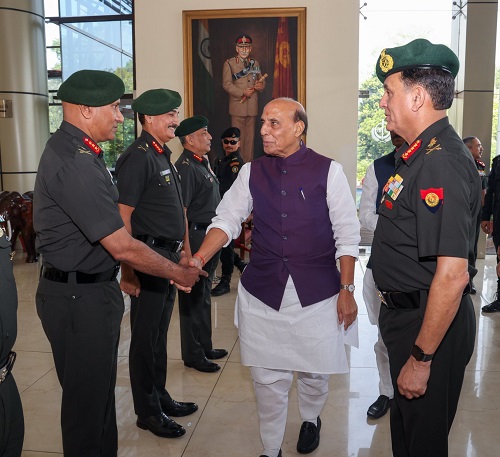
Defence Minister Rajnath Singh has urged Army Commanders to look beyond immediate security concerns and prepare the Indian Army for the challenges that could emerge over the next 20 to 30 years. Addressing the Army Commanders’ Conference in New Delhi, he stressed that military preparedness must combine a clear long-term vision with the flexibility to respond effectively to rapidly changing circumstances.
The Defence Minister highlighted the importance of continuously assessing geopolitical shifts, regional developments and emerging security threats. In an international environment marked by changing strategic equations and evolving forms of conflict, he said, the Army’s senior leadership must remain alert to both established and unforeseen challenges.
Singh’s emphasis on long-term planning reflects the need for a military strategy that can anticipate future threats rather than merely react to existing ones. At the same time, he cautioned against rigid approaches, stressing that operational strategies must remain dynamic and adaptable as circumstances change. The objective, therefore, is to build a force that combines institutional preparedness with the ability to make timely decisions in unpredictable situations.
Commending the armed forces for adjusting to changing operational requirements, Singh pointed to Operation Sindoor as an illustration of the Indian military’s growing capacity to integrate innovative thinking, advanced weaponry and coordinated action. He said the operation demonstrated enhanced synergy and superior coordination, reinforcing the importance of combining technological capabilities with effective operational planning.
According to the Defence Minister, the operation also conveyed a clear message to the international community that India would take the necessary measures to protect its national interests. His remarks underlined the relationship between military preparedness and strategic resolve, suggesting that credible defence capabilities remain essential to safeguarding national security in a challenging regional environment.
Singh also stressed that the character of warfare is changing and that future military success will increasingly depend on the ability to operate across multiple domains. Conventional ground operations alone may not be sufficient to address emerging threats, making coordination among different military capabilities and services increasingly important.
An integrated approach to warfare, he said, must become central to the armed forces’ planning and operational thinking. Seamless coordination in joint operations, supported by advanced technologies and effective command structures, will be crucial to ensuring that military resources can be deployed efficiently when required.
The focus on multi-domain capabilities also highlights the growing importance of integrating intelligence, surveillance, communications, modern weapon systems and operational planning. As the nature of conflict evolves, the ability to combine these elements into a coherent strategy could prove decisive in determining the effectiveness of military operations.
Alongside operational preparedness, Singh highlighted the progress made in strengthening India’s domestic defence industry. He said defence production reached a record ₹1.78 lakh crore in the financial year 2025–26, while defence exports rose to an all-time high of approximately ₹38,000 crore.
These figures reflect the expanding role of domestic manufacturing in meeting the country’s defence requirements and supplying military equipment to international markets. A stronger indigenous industrial base can support the armed forces by improving the availability of equipment, reducing dependence on external suppliers and creating greater scope for technological development.





















Leave Your Comment