


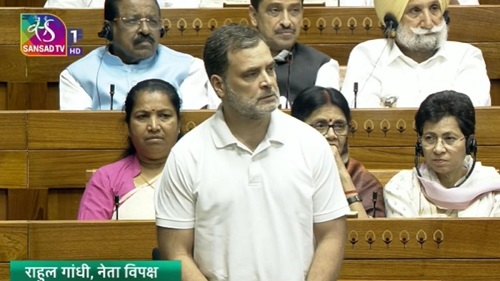
Leader of Opposition Rahul Gandhi on Friday stirred political debate in the Lok Sabha with an unusual claim that the number “16” holds significance in the government’s plan to push forward delimitation alongside amendments to the women’s reservation law.
Speaking during discussions, Gandhi remarked that while Prime Minister Narendra Modi addressed the House, he appeared “low on energy” and unable to fully engage. Gandhi said his attention then shifted to the date — April 16 — prompting his cryptic observation. “The answer to the riddle is in the number 16,” he said, hinting that the figure might explain the political calculations behind the proposed legislation.
Gandhi’s comment is widely seen as a veiled reference to parliamentary arithmetic. Following the 2024 Lok Sabha elections, the ruling Bharatiya Janata Party (BJP) holds 240 seats, falling short of a majority on its own in the 543-member House. The party relies on allies within the National Democratic Alliance (NDA), including the Telugu Desam Party led by N. Chandrababu Naidu, which contributes 16 MPs — the very number Gandhi highlighted.
This has led to speculation that Gandhi was संकेतिंग the strategic importance of the TDP, particularly as a southern party whose stance on delimitation could be निर्णायक. Southern states have expressed concerns that any reallocation of seats based on population could reduce their representation in Parliament.
However, Andhra Pradesh minister Nara Lokesh recently thanked Modi for assuring that no state would face injustice during the delimitation exercise, indicating that the TDP may not oppose the Centre’s plans.
The legislative challenge before the government is steep. Constitutional amendments — such as those required to modify the women’s reservation framework — demand a special majority: over 50% of the total membership and a two-thirds majority of members present and voting.
With around 540 members currently in the Lok Sabha, at least 360 votes would be required if all members participate. The NDA’s strength stands at approximately 293 MPs, well short of this threshold. The विपक्ष bloc, including the Indian National Congress, holds around 233 seats.
Even in a scenario where abstentions reduce the effective strength of the House, the NDA would still need support or abstention from major opposition parties such as the Samajwadi Party, Trinamool Congress, or the Dravida Munnetra Kazhagam. So far, these parties have indicated they are unlikely to cooperate.


















Leave Your Comment