


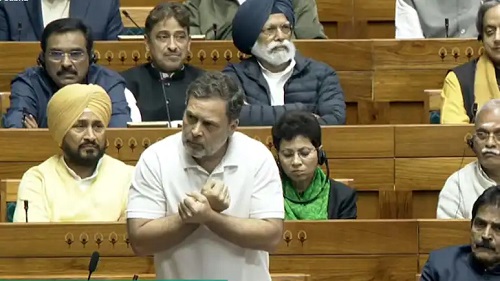
Congress leader and Leader of the Opposition Rahul Gandhi launched a fierce attack on the government in Parliament on Wednesday, accusing it of having "sold out Bharat Mata" through the newly signed India-U.S. trade and tariff agreement. He claimed the pact would crush the nation's small farmers by opening price-sensitive agriculture and dairy markets to American goods.
The criticism centres on what Gandhi described as a lopsided deal that endangers crores of livelihoods. "You have sold India… are you not ashamed of selling India?" Gandhi thundered, addressing the treasury benches. "For the first time in history our farmers are facing a storm (and) you have opened the door to crush our poor farmers."
At the heart of Gandhi's argument are shifting tariff figures. He asserted that U.S. tariffs on Indian goods had surged from an average of 3% (pre-2025 under MFN rates) to 18% under the new deal, a six-fold increase. He traced this rise to former U.S. President Donald Trump's "reciprocal" levies and a subsequent 25% 'penalty' on India for purchasing Russian oil.
"What have you done... US imports will go from US$46 billion to US$146 billion... this is absurd," Gandhi stated. He particularly criticised a provision committing India to buy $500 billion in U.S. energy and tech products. "They have no commitment to us... we have a commitment to them. We are standing like fools. Our tariff has gone up to 18 per cent... and theirs has come down from 16 per cent to zero."
The government swiftly rebutted the charges. Parliamentary Affairs Minister Kiren Rijiju interrupted, demanding Gandhi present facts. "India's progress makes you unhappy. The Congress weakened the nation till 2014 (and is) now unhappy…" Rijiju said, hailing Prime Minister Narendra Modi as "the strongest ever." The government has previously assured that the deal includes safeguards to protect Indian farmers' interests.
The controversy was further fueled by a revision in U.S. documentation. Hours before Gandhi's speech, the United States Trade Representative (USTR) updated a 'factsheet' on the agreement, removing the phrase "certain pulses" from a list of U.S. agricultural products for which India agreed to lower tariffs. The original text had specified tariffs would be cut on items including "certain pulses," raising alarms in a sector where India is a major producer and consumer. The revised document now reads more generically, referring to "a wide range of US food and agricultural products."
This sector is critically important, accounting for about a fifth of India's GDP. Consultancy McKinsey estimated its current value between $580-$650 billion, with potential to grow to $1.4 trillion by 2035.
Gandhi's assault follows similar criticism from Congress President Mallikarjun Kharge, who argued the trade pact undermines India's strategic autonomy, farmers, and the textile sector. The opposition's unified stance sets the stage for a heated political battle over an agreement the government champions as a milestone in strategic and economic ties with the U.S., and which critics condemn as a surrender of economic sovereignty.



















Leave Your Comment