


At a time when geopolitical tensions, economic uncertainties and emerging security threats are reshaping the global order, the Quad has renewed its commitment to safeguarding the Indo-Pacific through collective action. At the Manila Summit in the Philippines, the leaders of India, the United States, Australia and Japan unveiled a series of initiatives spanning maritime security, artificial intelligence, cybersecurity and critical infrastructure connectivity. The announcements underline the grouping’s determination to move beyond diplomatic commitments and build practical partnerships that promote regional stability, economic resilience and shared prosperity.
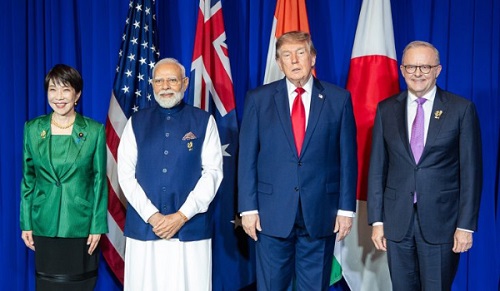
The Manila Summit brought together Prime Minister Narendra Modi, US President Donald Trump, Australian Prime Minister Anthony Albanese and Japanese Prime Minister Sanae Takaichi. In a joint press release, the four leaders reaffirmed their shared vision of a free, open, safe and prosperous Indo-Pacific, describing the Quad as a “partnership of action” committed to advancing peace, stability and prosperity in the region.
The meeting carried particular significance as it marked nearly a decade since the revival of the Quad and the 10th anniversary of the vision of a Free and Open Indo-Pacific, originally articulated in 2016 by former Japanese Prime Minister Shinzo Abe. The vision has since become a defining principle of cooperation among the four democracies, particularly as strategic competition and security challenges have intensified across the region.
A major message emerging from the summit was the collective opposition to attempts to alter the regional status quo through force or coercion. The leaders expressed concern that destabilising and unilateral actions could aggravate tensions, undermine mutual trust and threaten regional peace. Without naming any country, their statement reflected a shared determination to uphold international rules and ensure that the Indo-Pacific remains free from coercive influence.
Economic security also figured prominently in the discussions. The four leaders voiced grave concern over economic coercion, including arbitrary export restrictions, recognising that disruptions in global trade and supply chains can have consequences far beyond national boundaries. They stressed the need to build resilient supply chains, protect freedom of navigation and overflight, and harness emerging technologies to strengthen regional connectivity.
Maritime security emerged as another important pillar of the partnership. Given the Indo-Pacific's significance to international trade and global commerce, the leaders committed to working together to ensure that maritime transit corridors remain open, safe and resilient. Their emphasis reflects the understanding that secure sea routes are essential not only for regional economies but also for global energy supplies, trade and connectivity.
The summit also sought to strengthen the economic dimension of the Quad by bringing governments and businesses closer. The four countries announced the inaugural Quad Business Leaders’ Forum, scheduled to take place in early 2027. The proposed forum will bring together business leaders, government representatives and policy experts from all four nations to encourage private-sector participation, promote commercial agreements and develop partnerships that contribute to the economic prosperity of the Indo-Pacific.
The initiative is expected to provide a platform for translating strategic cooperation into tangible economic opportunities. By encouraging businesses to work across national boundaries, the Quad aims to deepen commercial relationships, strengthen investment flows and create more dependable supply-chain networks.
The broader agenda covering artificial intelligence, cybersecurity and critical infrastructure connectivity also signals the grouping's recognition that the nature of regional security is changing. Traditional maritime and territorial concerns are increasingly intertwined with digital infrastructure, technological capabilities and economic vulnerabilities. Cooperation in these emerging fields will therefore be crucial to maintaining the region's long-term stability.
Ultimately, the Manila Summit reinforces the Quad's ambition to evolve into a practical mechanism for addressing shared challenges rather than remaining merely a diplomatic platform. Its success will depend on how effectively the four countries convert their common vision into coordinated action, credible partnerships and measurable outcomes. For India, the strengthened engagement offers an opportunity to deepen its strategic and economic presence in the Indo-Pacific while advancing its commitment to a stable, inclusive and rules-based regional order.






















Leave Your Comment