



Deepak Kumar Rath
For decades, Daman and Diu occupied a curious place in India’s imagination: blessed with beaches, heritage, and strategic potential, they were rarely mentioned when the country spoke about development and modern infrastructure. That began to change decisively after Praful Khoda Patel assumed charge as administrator in 2016. Under his tenure, Daman and Diu became the site of an increasingly ambitious development push—one that reflected Prime Minister Narendra Modi’s emphasis on taking infrastructure, connectivity, and public services beyond India’s traditional metropolitan centers.
Patel’s approach was significant because it challenged the idea that a small Union Territory should settle for modest ambitions. Instead, the administration pursued visible and large-scale interventions in roads, public infrastructure, tourism, healthcare, education, and connectivity. The political significance of this approach lies in its attempt to turn development into something tangible and visible to citizens: roads that improve mobility, public facilities that raise service standards, and infrastructure designed to attract visitors and economic activity.
The strongest symbol of this transformation is the NAMO Airport in Daman. For years, the lack of direct commercial air connectivity had been one of the territory’s major limitations. The development and operationalisation of the airport, followed by the launch of direct commercial flights, including the Daman-Delhi service, represented a dramatic change in the territory’s connectivity profile. It placed Daman more directly on India’s aviation map and created a new gateway for tourism, business and investment.
The importance of such a project goes beyond the airport terminal itself. The underlying political message of the development model is that infrastructure should reach regions that have historically remained outside the spotlight. Daman did not need another promise of potential; it needed the physical infrastructure to convert that potential into economic activity. The administration’s focus on connectivity, roads, highways and civic infrastructure was therefore central to its development strategy.
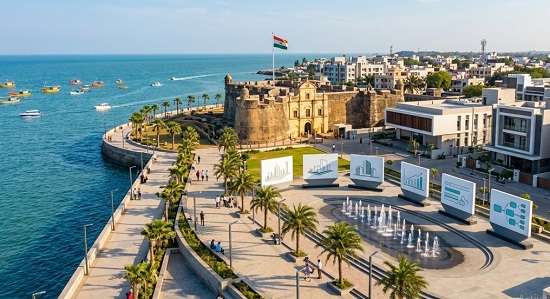
Tourism became another major instrument of this transformation. Daman and Diu had always possessed natural and historical attractions, but Patel’s administration placed greater emphasis on developing the infrastructure around those assets. Beautification, hospitality facilities, improved public spaces and enhanced connectivity were intended to reposition the territory from a relatively quiet coastal destination into a nationally recognisable tourism hub.
The 2020 merger of Daman and Diu with Dadra and Nagar Haveli added another important dimension. The creation of a single Union Territory brought the three districts under one administrative structure, opening greater scope for integrated planning and coordinated development. Seen politically, the merger represented an effort to move away from fragmented administration and towards a more consolidated governance framework. The economic agenda has also sought to look beyond tourism. Daman and Diu’s coastline gives the region considerable potential in fisheries and the wider aqua economy. Plans involving expanded airport infrastructure and cargo facilities point towards an ambition to strengthen logistics and connect local economic activity with wider markets. This is an important distinction: development cannot depend solely on visitors arriving for a weekend. It must create conditions for businesses, entrepreneurs, workers and local producers to participate in sustained economic growth.
Equally important is the focus on education and healthcare. Modern development is not simply about concrete, airports and roads; it is also about the quality of human capital and public services. Investments in educational facilities, healthcare infrastructure and schooling have sought to strengthen the social foundations of the territory. Diu’s performance in national education assessments has added another dimension to the development narrative.
The political importance of Patel’s tenure ultimately lies in the scale of ambition it brought to a small Union Territory. The broader Modi-era development philosophy has repeatedly stressed that India’s growth must extend beyond its largest cities and states. Daman and Diu became one example of how that philosophy could be translated into a concentrated programme of infrastructure and administrative change.
Daman and Diu’s journey is a story of political ambition meeting administrative execution. A region once discussed largely for its beaches and heritage is increasingly being discussed in terms of connectivity, investment, infrastructure and economic potential. Whether this momentum ultimately produces durable, broad-based prosperity will depend on what comes next. But one fact is difficult to overlook: under Praful Patel’s administration, Daman and Diu moved from being a relatively overlooked corner of India to a Union Territory demanding a place in the country’s wider development conversation.



















Leave Your Comment