


When political criticism degenerates into personal abuse and influential politicians appear to enjoy exceptional legal treatment, the credibility of democratic institutions inevitably comes under scrutiny.
An examination of political rhetoric in India reveals that debates regarding intemperate language, political polarisation, and the application of defamation laws reflect a deeply divided democratic landscape. The evolution of language used by major political figures, particularly from the Indian National Congress (INC) towards Prime Minister Narendra Modi and the ruling Bharatiya Janata Party (BJP), has triggered widespread discussion about the limits of fair political criticism.
Concurrently, the legal challenges faced by opposition leaders like Rahul Gandhi highlight the intricate intersections between political speech, judicial interpretation, and the principle of equality before the law.
Indian democracy has always accommodated vigorous political disagreements. Parliament, electoral campaigns and public platforms are intended to provide opportunities for competing political parties to challenge one another's policies, expose failures of governance and present alternative visions of the country's future. However, there is an important distinction between legitimate political criticism and the systematic use of personal insults, abusive language and demonisation.
Unfortunately, this distinction appears increasingly blurred in the political discourse of the Congress party, particularly in its attacks on Prime Minister Narendra Modi, the Rashtriya Swayamsevak Sangh (RSS) and the broader ideological constituency associated with them.
The question is not whether the Opposition should criticise the Prime Minister. It absolutely should. The question is whether political criticism has increasingly become an instrument of personal humiliation, and whether the country's institutions are sufficiently assertive in defending standards of public conduct and equality before the law.
Kharge: A Pattern of Intemperate Political Language
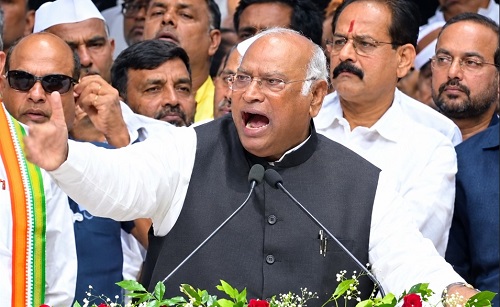
Congress president Mallikarjun Kharge has repeatedly attracted controversy through his choice of language against Prime Minister Modi. His political disagreements with the Prime Minister are legitimate, but the manner in which those disagreements are expressed raises questions about the standards expected from a senior parliamentary leader.
The latest controversy, on October 25, 2026, provides a particularly relevant example. Addressing a public gathering in Patna, Kharge reportedly declared, "Modi ka baap bhi jayega," while responding to an assertion that Modi would not leave office. The remark immediately provoked criticism from the BJP, with Union ministers describing it as indecent and an unacceptable departure from political decorum.
This was not simply a disagreement over government policy, economic performance or electoral conduct. It was a personal expression directed at the Prime Minister and his family.
The controversy becomes more significant when considered against Kharge's earlier conduct. During parliamentary proceedings, he has also used language against the Rajya Sabha Chairman that subsequently required an apology.
In March 2025, Kharge used the Hindi colloquial phrase "thokenge" (loosely meaning to strike or knock out) during a debate on the National Education Policy. While the ruling party interpreted the remark as an aspersion cast directly upon the Deputy Chairman and the Chair, Kharge subsequently clarified that his expression was directed at challenging central government policies rather than the presiding officer. He explicitly offered an apology to the Chair to restore parliamentary order, although the words were expunged from official records.
The incident demonstrated that even the presiding authority of a constitutional institution could become the target of intemperate political expression. An apology is welcome, but it does not automatically erase the larger question: why should a senior leader repeatedly find himself in situations where an apology becomes necessary?
In 2023, campaigning for his party for the assembly elections, he described the BJP and RSS as “Venomous snakes”. His son, a home minister in Karnataka, only emits venom against the Hindus and the RSS. Political opposition to the RSS, its organisational activities and its ideology is entirely legitimate. But there is a difference between challenging an organisation's political philosophy and portraying its supporters as inherently sinister, dangerous or unworthy of participation in national life.
When political language crosses that boundary, it ceases to contribute to democratic debate and begins to encourage social polarisation.
The Congress's Long Campaign of Personalising Its Opposition to Modi
The Congress's approach to Narendra Modi predates his becoming Prime Minister in 2014.
Since he emerged as Gujarat's chief minister, senior Congress leaders have frequently resorted to personal attacks that went beyond conventional criticism of his administration.
The expression "merchant of death", used by Sonia Gandhi during the 2007 Gujarat election campaign, became one of the most prominent examples. The phrase was directed at Modi during a politically charged period and subsequently became a major controversy.
Other Congress leaders have made remarks about Modi's humble background, including the frequently repeated reference to him as a "chaiwala" and “ neech Aadmi”. Although such references may be intended to ridicule his political opponents, they can also convey contempt for the social circumstances from which a political leader emerged.
Rahul Gandhi, in particular, has made Modi the central target of his political rhetoric. His repeated accusations, including descriptions of the Prime Minister as a thief and allegations of corruption, have become defining features of his political campaign.
The opposition has every right to investigate and raise questions about corruption. Indeed, exposing wrongdoing is among its most important responsibilities. But allegations must be supported by evidence, and political rhetoric should not substitute for establishing facts.
The same principle applies to accusations against the RSS and Hindu organisations. Criticism of religious nationalism, majoritarian politics or particular ideological positions is legitimate. However, indiscriminate demonisation of Hindus or the suggestion that their political beliefs make them inherently suspect crosses the line between ideological disagreement and prejudice.
Democracy cannot function on the assumption that one political constituency possesses a monopoly on patriotism, secularism or constitutional values.
Nor can it survive if the political language of one side increasingly treats the other as an enemy rather than a competitor.
Is the Judiciary Showing Rahul Gandhi Exceptional Leniency?
The judicial treatment of Rahul Gandhi raises a different, but equally important, question.
There is a growing perception that the judiciary is frightened of Rahul Gandhi. The public is entitled to ask whether influential politicians receive the same treatment as ordinary citizens when criminal complaints, defamation proceedings and other legal disputes arise.
A classic case study is the "Modi surname" defamation suit filed in Gujarat. In March 2023, a Surat magistrate court convicted Rahul Gandhi, awarding him the maximum statutory punishment of two years' imprisonment for criminal defamation.
While the trial court immediately suspended the execution of the sentence for 30 days to allow an appeal, the conviction triggered an automatic administrative disqualification from his Lok Sabha seat under the Representation of the People Act, 1951. Following subsequent rejections of relief by the Surat Sessions Court and the Gujarat High Court, the Supreme Court of India ultimately stayed the conviction in August 2023, restoring his parliamentary status.
The apex court clarified that its intervention was rooted in the trial court's failure to provide substantive reasoning for awarding the absolute maximum sentence of two years, which appeared uniquely tailored to trigger legislative disqualification.
But then a stay of conviction or suspension of a sentence is not the same as acquittal.
Rahul Gandhi has faced multiple criminal complaints and investigations, some involving allegations connected with political statements and others concerning financial or organisational matters. But he treats all these a matter of pride; the other day he said he is trying to have 100 FIRs against him. He is confident to say all this because he thinks that the judiciary will not touch him.
There are merits in the argument that the speed with which upper echelons of the judiciary hear, grant bail, or stay proceedings for high-profile politicians indicates an unequal legal tier system. While ordinary under-trials languish in prisons for years awaiting basic bail hearings due to systemic backlogs, political leaders command immediate interventions from elite legal teams, ensuring swift structural relief.
The point is that equality before the law must not merely exist in constitutional language; it must also be visible in the practical experience of citizens.
This does not mean that courts should deny Rahul Gandhi relief because he is a prominent politician. That would itself violate equality before the law. It means that the legal standards applied to him should be transparent, consistent and demonstrably applicable to similarly situated accused persons.
The Larger Democratic Question
The consequences of political abuse and perceived judicial indulgence extend beyond individual leaders.
When Parliament becomes a venue for personal insults, the dignity of parliamentary institutions suffers. When political opponents are routinely demonised, public discourse becomes increasingly hostile. When allegations are treated as facts before judicial determination, confidence in the legal process weakens.
And when citizens believe that influential politicians enjoy privileges unavailable to ordinary people, the credibility of the judiciary itself comes under pressure.
Political leaders must recognise that their language influences public behaviour. Courts must ensure that their decisions are legally sound, reasoned and consistent. Opposition parties must distinguish between exposing governmental failures and undermining the legitimacy of constitutional institutions.
Criticism Is Democratic; Abuse Is Not
India needs a vigorous Opposition, an independent judiciary and political leaders capable of disagreeing without abandoning basic standards of public conduct.
The Prime Minister is not above criticism. Rahul Gandhi is not above the law. Mallikarjun Kharge is not entitled to use parliamentary stature as a licence for personal abuse. And the judiciary must remain beyond political pressure, while ensuring that its decisions do not create a reasonable impression of unequal treatment.




















Leave Your Comment