


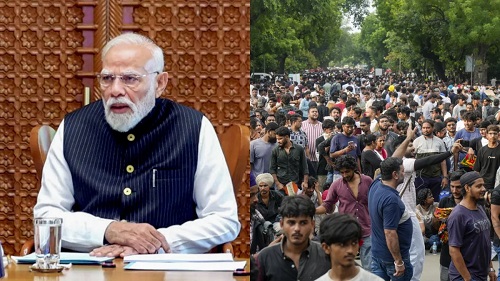
Prime Minister Narendra Modi on Thursday announced that the Centre will establish fast-track courts to ensure the speedy trial and strict punishment of those involved in examination paper leak cases, breaking his silence amid the ongoing controversy over the alleged NEET paper leak and nationwide protests demanding accountability.
In a strong message, the Prime Minister said that protecting the future of students remains the government's top priority and asserted that those responsible for jeopardising the careers of young people would face stringent action. He also said that the concerned departments and officials have been directed to take all necessary measures to implement the decision.
"Nothing is more important than the welfare and future of our youth. We have decided to set up fast-track courts to ensure swift and stringent punishment for those involved in paper leaks. Necessary instructions have been issued to the concerned authorities to take all required steps. This is another important step towards safeguarding the interests of students. Those who try to harm the future of our youth will not be spared," the Prime Minister said.
The announcement comes against the backdrop of sustained protests over the NEET paper leak issue by activists associated with the social media platform Cockroach Janta Party (CJP) and several opposition parties. Demonstrators have been demanding the resignation of Union Education Minister Dharmendra Pradhan, alleging that the government has failed to curb recurring examination paper leaks.
The controversy intensified after Leader of Opposition Rahul Gandhi claimed on Wednesday that more than 150 paper leaks had taken place across the country over the last decade, while alleging that not a single conviction had been secured in these cases. He accused the government of failing to protect the integrity of public examinations and called for stronger accountability.
The protests have spread across Delhi and several other cities, with activists organising demonstrations and a "Chalo Sansad" march earlier this week to press for their demands. Protesters have put forward three key demands: the resignation of Education Minister Dharmendra Pradhan, compensation of ₹1 crore to the families of students who allegedly died by suicide following the NEET paper leak controversy, and the withdrawal of FIRs registered against peaceful protesters. They have also sought assurances that no future legal action would be taken against those participating in peaceful demonstrations.
CJP spokesperson Sourav Das described the resignation of Dharmendra Pradhan as a "non-negotiable" demand, stating that the agitation would continue until the minister stepped down.
"Dharmendra Pradhan's resignation is non-negotiable. Without this, the protest will continue for as long as it has to," Das said.
He also said that he had spoken several times with environmentalist Sonam Wangchuk, who has reportedly continued his hunger strike even after being admitted to hospital. According to Das, both agreed that the movement should remain entirely peaceful.
"I spoke with Sonam Wangchuk several times today. The conclusion was that this protest should remain peaceful. He has also publicly appealed to all protesters to maintain peace and conduct this protest in the right manner," Das said.
Meanwhile, Union Health Minister J.P. Nadda appealed against politicising the issue, describing examination paper leaks as a serious challenge that requires comprehensive discussion and systemic reforms rather than political confrontation.
The Centre's decision to establish fast-track courts is being seen as its most significant response so far to growing concerns over the integrity of competitive examinations. The proposed mechanism aims to ensure quicker disposal of paper leak cases and stricter punishment for offenders, amid increasing public pressure for stronger safeguards to protect students and restore confidence in the examination system.




















Leave Your Comment