


Why the "Last Human" and the Algorithm are Co-Starring in Cinema’s New Era
The creation of Tilly Norwood in 2025 marked a definitive "before and after" moment for the global film industry. Developed by Xicoia, the AI division of Particle6 Group, and championed by founder Eline Van der Velden, Norwood was not just a digital avatar but a "personality engine" designed to look, emote, and eventually compete for roles alongside human actors. However, the release of the character’s first project, AI Commissioner, and subsequent reports that talent agencies were vying to represent her, ignited a firestorm of ethical criticism and a profound existential crisis for performers worldwide.
When AI Commissioner debuted, critics from The Guardian, PC Gamer, and The A.V. Club were quick to point out the "uncanny valley" effect. Still, the deeper sting was the implication of the character's existence. The project was viewed by many as a Trojan horse—a way to normalize "synthetic performers" who do not require trailers, health insurance, or residuals.
The ethical tension reached a breaking point when it was revealed that talent agencies were interested in signing Norwood. High-profile actors like Melissa Barrera, Toni Collette, and Emily Blunt voiced immediate outrage. Barrera famously labeled the move "gross," while the SAG-AFTRA union issued a stern reminder: "Tilly Norwood is not an actor. It’s a character generated by a computer program that was trained on the work of countless professional performers without permission or compensation."
The central ethical issue is one of personality rights. Norwood’s face is a composite of thousands of real human images, leading to allegations that she is essentially "stolen labor" personified. While Van der Velden defends the character as a "piece of art" and a "new paintbrush," many in the industry see it as a mechanism to slash production costs by bypassing human talent entirely.

While Hollywood grappled with the fallout of the Norwood character, a different narrative was being written in Bangalore and Geneva. Navin Manaswi, the co-founder of the AI company NavSar, has emerged as a leading voice in the "Synthetic Cinema" movement. Unlike the purely digital existence of characters like Tilly Norwood, Manaswi’s approach focuses on the integration of AI as a co-creator for full-length feature films.
NavSar’s upcoming AI feature film, scheduled for a global release this year in major hubs like New York and London, represents the first serious attempt to sustain a 90-minute narrative using generative tools. Manaswi believes that the fear surrounding AI actors is misplaced.
"We are not just using AI for VFX; we are treating it as a co-creator that spans the entire lifecycle of the film," says Navin Manaswi. "The challenge isn't making a 15-second clip of a character like Tilly. The real Everest is maintaining visual consistency and emotional depth over a 90-minute feature. AI is a tool of logic and lyricism. It allows a small team in a Bangalore lab to achieve the visual scale of a $200 million Hollywood blockbuster."
Manaswi argues that AI actors are a natural evolution of storytelling. "If we master this, Bangalore won’t just be a back-office for VFX; it will be the creative cockpit of the world," he asserts.
Interestingly, the NavSar film features one human actor: Kajal Tiwari. Her experience provides a unique counterpoint to the Norwood controversy. Tiwari describes working alongside AI characters not as a threat, but as a liberating form of performance.
"Working on this film has been a revelation," Kajal Tiwari explains. "I am the only human presence on screen, but I never felt alone. The AI characters respond with a precision that forces you to be more present. It’s not about replacement; it’s about a new kind of chemistry. I believe AI films will create a new genre where human actors can explore roles that were previously impossible due to physical or budgetary constraints."
Tiwari’s support is echoed by other members of the NavSar creative team. K B John, a veteran film consultant and FTII alumnus, sees the technology as a way to "curate" rather than just "direct."
"AI gives us a new way to manipulate light and time," John notes. "I can iterate a scene fifty times in an afternoon. The role of the director is shifting from a commander of a massive crew to a curator of intelligent systems."
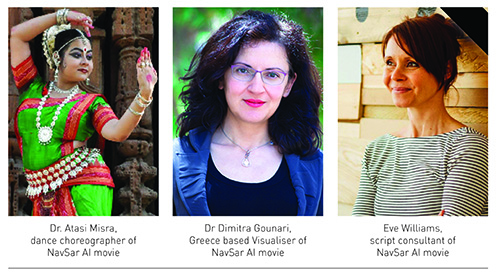
Dr. Atasi Misra, a renowned dance choreographer, adds that AI allows for a "new vocabulary of movement." "We can choreograph sequences that defy human physics but still retain the grace of traditional dance," she says. Meanwhile, Eve Williams, an AI script consultant from Essex, UK, emphasizes the narrative potential: "AI helps us identify emotional beats and linguistic patterns that resonate globally. It’s about enhancing the human story, not erasing it."
Despite the optimism from the NavSar camp, many Indian actors are following Hollywood’s lead in opposing the casting of AI actors like Tilly Norwood. For them, the issue is not just about technology—it’s about the soul of Indian cinema and the livelihoods of millions of workers.
Sonali Sharmisstha, a prominent voice in the Indian film community, has been vocal about her distaste for the "synthetic shift."
"Acting is about rasa—the essence of human emotion," Sharmisstha argues. "An AI like Tilly Norwood can mimic a tear, but she can't understand the grief that caused it. By replacing actors with algorithms, we are sanitizing our culture for the sake of profit."
Mamta Kumari echoes these concerns, focusing on the economic impact. "In India, a film set supports hundreds of families—from the spot boys to the makeup artists. If you use an AI actor, you aren't just taking away a role from a girl like me; you are removing the need for an entire ecosystem of human labor. It is a crisis of existence for everyone in the industry."
The Tilly Norwood incident has forced a global conversation that can no longer be ignored. While Eline Van der Velden views AI actors as "responsive puppets" that can save performers from dangerous stunts and grueling makeup sessions, the creative community remains deeply divided.
As Navin Manaswi prepares to launch his AI feature film in New York and London, the industry stands at a crossroads. Will AI characters become a separate genre, as Van der Velden suggests, or will they slowly erode the "human connection" that Emily Blunt and others hold so dear?
The existence of Tilly Norwood is a "cultural stress-test." It asks us what we value more: the efficiency and cost-saving of a digital star, or the flawed, unpredictable, and deeply moving performance of a human being.
The conversation around Tilly Norwood and the Xicoia controversy isn't just about one digital avatar anymore. It has morphed into a global debate about the "soul" of cinema. While the West remains largely skeptical—with The Guardian calling Norwood a "hollow mimicry of life"—the energy in the East, particularly within the NavSar camp, is surprisingly defiant.
Navin Manaswi, the brain behind the upcoming AI trilogy, doesn't see himself as a disruptor of art, but as a liberator of it. I caught up with him recently, and his perspective is far more layered than the "tech-bro" stereotype usually associated with AI founders.
"People look at Tilly Norwood and they see a threat to their paycheck," Manaswi says, leaning back in his office in Bangalore. "But they should look at the history of the camera itself. When photography started, painters thought it was the end of art. It wasn't. It was the birth of a new perspective."
Manaswi is currently finishing the first installment of a massive AI-driven trilogy. This isn't just a movie; it’s an experiment in "generative consistency."
"The biggest challenge we faced wasn't making a pretty face," Navin Manaswi explains. "It was the physics of emotion. In our trilogy, the AI characters have to age over thirty years. In traditional film, you’d need expensive prosthetic makeup or de-aging VFX that costs millions. With our 'NavSar' engine, we simply adjust the temporal parameters of the character's seed model. We are creating a digital lineage."
He’s particularly dismissive of the "personality rights" arguments coming out of Hollywood. "If I create a character from a billion data points, who is being 'stolen'? It’s like saying a chef steals from every farm they’ve ever visited. No, they create a new flavor. Our trilogy features characters that don't exist in the real world, yet they have backstories, linguistic quirks, and even 'digital memories' that influence their performance in Part 2 and Part 3."
One of the most fascinating defenders of the AI movement is Dr. Atasi Misra, a legendary Odissi dancer and choreographer. You wouldn't expect a traditionalist to embrace algorithms, but Dr. Misra sees a strange, mathematical beauty in it.
"In Odissi, we talk about Tribhanga—the three-bend posture. It is a very specific, divine geometry," Dr. Misra explains. "When I worked with Navin on the dance sequences for the trilogy, I realized that human muscles have limits. A dancer can only hold a pose for so long before gravity takes over."
She describes a sequence in the second film where an AI character performs a "celestial dance."
"I choreographed the movements using motion capture, but then we used AI to 'transcend' the human frame," Dr. Atasi Misra says. "The AI actor could execute a turn that lasted twelve seconds while maintaining the perfect mudra (hand gesture). It wasn't 'fake'; it was an extension of my vision. For the first time, I saw the dance I had only ever seen in my dreams. To call this 'artificial' is to misunderstand the word. It is 'aspirational' art."
For Kajal Tiwari, the experience is more visceral. As the only human actor in the trilogy, she has become the bridge between two worlds. While actors like Sonali Sharmisstha worry about being replaced, Tiwari is more concerned with the evolution of the craft.
"There is a scene in the first movie where I have to argue with a character who represents my grandfather’s ghost," Kajal Tiwari recounts. "There was no one there—just a green screen and a voice prompt. But the AI voice wasn't just reading lines. It was reacting to my tone. If I cried, the AI’s 'logic gate' shifted its pitch to be more comforting."
Tiwari believes the "existential crisis" is actually a "vanity crisis."
"Actors are used to being the center of the universe. In an AI film, you are part of a digital tapestry. You have to be more disciplined. You can't rely on 'star power' because the AI character next to you is literally perfect. It forces you to find the 'human errors' in your own performance—the stutters, the heavy breathing—that make you unique. I tell Mamta Kumari and others: don't fear the machine. Use the machine to highlight why you are irreplaceable."
The friction hasn't gone away, though. In Essex, Eve Williams, the AI script consultant, spends her days "de-biasing" the models. "The danger with Tilly Norwood wasn't that she looked real," Williams says. "It was that she was a 'blank slate' that could be used to perpetuate stereotypes. In the NavSar trilogy, we spend months fine-tuning the cultural nuances. If an AI character is from a specific village in Odisha, they need to speak with that specific lilt. AI allows us to be hyper-local on a global scale."
However, the "production cost" argument remains a double-edged sword. While it allows NavSar to compete with Hollywood, it also scares the traditional workforce. Sonali Sharmisstha remains unconvinced: "If Dr. Misra creates a 'perfect' dance with AI, what happens to the thousands of students who spend twenty years trying to master that turn? We are devaluing the struggle."
Adding Dr. Dimitra Gounari to the mix really changes the flavor of the conversation. As the lead visualiser for the NavSar trilogy, she brings a certain European academic rigour that balances out the raw tech-enthusiasm coming from Bangalore. Speaking from her base at the University of West Attica in Greece, she views the creation of AI characters not as "faking" reality, but as a new form of digital sculpting.
"In my classes in Athens, we talk a lot about the 'semiotics of the pixel'," Dr. Dimitra Gounari says during a late-night Zoom call, her Greek accent punctuating the air. "With the NavSar trilogy, we aren't just making a 'Tilly Norwood' clone. We are building a visual grammar that hasn't existed before. For example, in the third film of the trilogy, the lighting isn't just simulated—it is 'emotive'. The AI adjusts the color temperature of the character’s skin based on the subtext of the script. You can't do that with a traditional camera and a human actor without hours of post-production."
Gounari is quick to dismiss the "uncanny valley" criticisms that dogged AI Commissioner. She believes the "crisis" for human actors is actually a misunderstanding of what "acting" is in the digital age.
"My role at NavSar is to ensure that the AI doesn't just mimic a human, but interprets the human condition," Dr. Dimitra Gounari explains. "We use 'Latent Space' to explore expressions that a human face might be too inhibited to show. It’s a collaboration between my photographic eye and the machine’s infinite iterations. When Kajal Tiwari performs, the AI actors are tuned to her biological frequency. It is a visual symphony. I tell my students: don't fear the algorithm. The algorithm is just a mirror with a better memory."
She admits there are "human errors" in the process—sometimes the AI renders a shadow that doesn't make sense, or a character's gaze is too static—but she sees these as "digital brushstrokes." For Gounari, the upcoming premieres in London and New York will prove that AI isn't the death of the "Auteur," but the birth of the "Synthesist."
As the release date for the first film in the trilogy approaches, Manaswi is preparing for a polarized reception in New York and London.
"We are prepared for the critics," Navin Manaswi laughs. "They will look for the flaws. They will call it 'soulless.' But when the audience sits in that theater in London and sees a world that is more vivid than reality, they won't care if the actor was born in a hospital or rendered in a server. They will care if they felt something. And I promise you, with Kajal’s heart and our AI’s precision, they will feel everything."
The Norwood incident might have been a clumsy first step, but the NavSar trilogy feels like a sprint toward a new horizon. Whether we like it or not, the "human" element of cinema is no longer limited to biology. It’s now a collaboration between the pulse and the processor.
Sarat C. Das
(The content of this article reflects the views of writer and contributor, not necessarily those of the publisher and editor. All disputes are subject to the exclusive jurisdiction of competent courts and forums in Delhi/New Delhi only)



















Leave Your Comment