


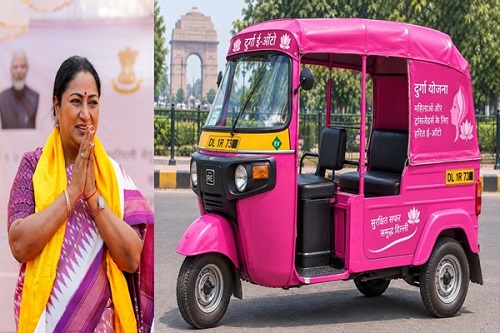
The Delhi government has approved the DURGA scheme, a new initiative aimed at expanding livelihood opportunities for women and transgender persons through electric auto-rickshaws. The scheme seeks to combine economic empowerment with cleaner urban transport, with 1,300 pink electric autos to be distributed in its first phase. Of these, 1,170 will be allotted to women and 130 to transgender beneficiaries.
The Delhi government has given the go-ahead to the DURGA scheme, an initiative designed to create safer, cleaner and more dignified employment opportunities for women and transgender persons in the national capital.
The decision was taken at a cabinet meeting chaired by Chief Minister Rekha Gupta in New Delhi on Thursday. The scheme will initially facilitate the allocation of 1,300 pink electric autos, with women and transgender persons receiving dedicated shares.
Of the total vehicles planned in the first phase, 1,170 electric autos have been earmarked for women, while 130 will be allocated to transgender beneficiaries. The initiative is intended not merely to provide employment but also to encourage beneficiaries to become owners as well as drivers of electric autos.
Under the allocation framework, each revenue district can have a maximum of 90 electric autos allotted to women and up to 10 vehicles for transgender beneficiaries. The district-wise distribution is expected to provide opportunities across different parts of the capital rather than concentrating the scheme in a limited area.
Chief Minister Rekha Gupta said the scheme would provide women and transgender persons with an opportunity to build independent livelihoods through ownership and operation of electric autos. The initiative, she said, represents a step towards creating a Delhi that is safer, greener and more inclusive.
The focus on electric vehicles also gives the scheme an environmental dimension. By promoting electric autos, the government is linking livelihood generation with the broader objective of cleaner urban mobility and reduced dependence on conventional fuel-powered vehicles.
For women, the scheme could open another avenue for income generation in the city's expanding urban transport ecosystem. For transgender beneficiaries, the dedicated allocation creates a specific opportunity for participation in the formal economic and transport space.
The government has positioned DURGA as a measure that brings together three objectives—economic empowerment, cleaner transportation and social inclusion. With the first phase covering 1,300 electric autos, its implementation will determine how effectively these objectives translate into sustainable employment opportunities on the ground.
The scheme therefore represents an attempt to use Delhi's transition towards electric mobility not only as an environmental measure but also as a platform for expanding livelihood opportunities among groups that have traditionally faced barriers to employment and economic independence.




















Leave Your Comment