


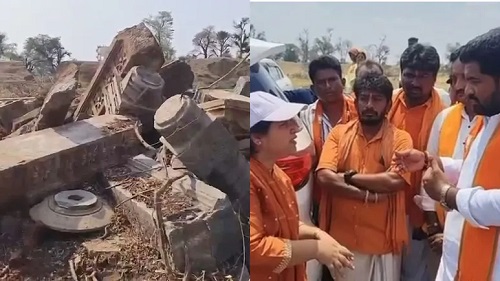
A major controversy has erupted in Telangana after the alleged demolition of an 800-year-old Shiva temple from the Kakatiya era in Warangal district triggered outrage among historians, heritage activists, and the Union Ministry of Culture. The ancient temple, located in Ashok Nagar of Khanapur Mandal, was reportedly bulldozed during land-clearing operations for the construction of a government Integrated School.
The temple is believed to date back to the reign of Kakatiya ruler Ganapatideva in the 13th century. Historians say the structure carried immense archaeological and cultural value, particularly because it housed a rare seven-line Telugu inscription dated February 1231 AD. The inscription reportedly referred to the king with royal titles such as “Maharaja” and “Rajadhirajulu,” offering valuable insight into the political and cultural history of the Kakatiya dynasty.
The site had earlier been documented by the Heritage Department in 1965 and was situated within the historic “Kota Katta” mud fort region, an area known for ancient fortifications and remnants of Kakatiya architecture. Experts and conservationists argue that the heritage structure could have either been preserved in its original form or carefully relocated without destroying its historical significance.
The incident drew sharp reactions after Telangana rights lawyer Rama Rao Immaneni filed a complaint before the National Monuments Authority. Following the complaint, the Union Ministry of Culture and the Archaeology Department reportedly registered a case into the matter. Legal action is now being sought under Section 30 of the Telangana Heritage Act against officials accused of allowing the demolition without mandatory permissions from the Archaeology and Endowments Departments.
The complaint also raised concerns over the alleged failure of the Telangana government to constitute a mandatory Heritage Conservation Committee, which activists say could have prevented the destruction of historically significant sites.
As public anger intensified, the Warangal District Collector’s office issued a clarification after a joint inspection conducted on May 6. Officials denied any intentional demolition of a protected monument, claiming that workers had only encountered “remnants of an old dilapidated structure” while clearing thick vegetation across the 30-acre land parcel earmarked for the school project. The administration further stated that the structure was not officially listed as a protected monument.
Despite the clarification, criticism continued to mount from historians and heritage enthusiasts who questioned how a historically documented site could be overlooked during development planning. Many pointed out that the absence of formal protection does not diminish the cultural and archaeological value of centuries-old structures.
In an effort to calm the growing backlash, Warangal Collector Dr. Satya Sharada and Narsampet MLA Donthi Madhava Reddy visited the site and assured the public that the temple would be fully reconstructed at the same location. Authorities said the restoration work would be carried out in consultation with historians, traditional temple architects known as Stapathis, and the Archaeology Department.
Officials also announced that steps would be initiated to formally recognize and protect the site to ensure that such controversies do not recur in the future. The incident has once again reignited the debate between rapid infrastructure development and the preservation of India’s ancient cultural heritage.





















Leave Your Comment