


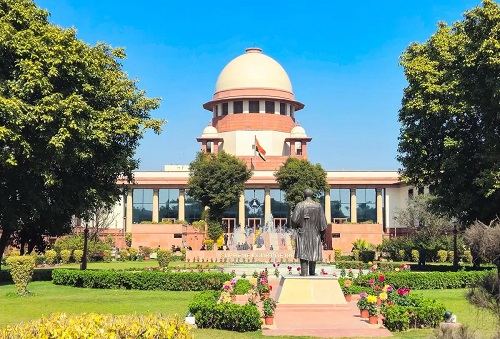
The Supreme Court has delivered a stern reminder to the judiciary that the authority of a judge is defined by law, not by personal ambition or a desire to demonstrate power. Pulling up a Bihar sessions judge for convicting a superintendent of police over alleged disobedience of a judicial direction, the apex court cautioned him against behaving like a “Robin Hood” or a “Bahubali”. The sharp observations by Chief Justice of India Surya Kant-led bench underline a fundamental principle of justice: judicial authority must be exercised with restraint, legal understanding and strict adherence to jurisdiction. A judge may command respect through the law, but cannot become the law unto himself.
The Supreme Court has sent a strong message to the judicial fraternity that the authority of a judge must always remain within the boundaries of law and jurisdiction. In an unusually sharp observation, the apex court on Monday reprimanded a Bihar sessions judge for exceeding his judicial authority by convicting a superintendent of police (SP) over alleged non-compliance with his directions. Making it clear that judicial power cannot become a tool for personal assertion, the court cautioned the officer against behaving like a “Robin Hood” or a “Bahubali” and advised him to undergo proper judicial training. The observations underline a fundamental principle of the justice system: a judge may exercise authority firmly, but such authority must be rooted in established legal procedures and cannot be stretched beyond the limits prescribed by law.
A bench headed by Chief Justice of India Surya Kant and comprising Justices Joymalya Bagchi and V Mohana expressed serious displeasure over the manner in which sessions judge Anil Kumar initiated criminal proceedings against the Rohtas SP. “Enough of adventure. Go to the National Judicial Academy and have training. You don’t have to become Robin Hood… Do you want to become a Bahubali? You must understand your limits and jurisdiction as a judge,” the bench observed. The sharp remarks came while hearing a challenge to the proceedings initiated by the judicial officer, who had treated the police officer's failure to comply with his directions as an offence committed in the face of the court. The sessions judge had subsequently convicted the SP and imposed a fine of Rs 1 lakh, an action that the Supreme Court found legally questionable.
At the heart of the controversy was the interpretation of Section 384 of the Bharatiya Nagarik Suraksha Sanhita (BNSS) and Section 345 of the Code of Criminal Procedure (CrPC), which deal with offences committed in the presence or view of a court. The Supreme Court questioned whether the sessions judge had properly understood the scope of these provisions before invoking them against the police officer. Explaining the legal distinction, the bench pointed out that an offence committed in the face of the court would involve conduct such as physically assaulting someone inside the courtroom, abusing the court or refusing to leave the courtroom despite an explicit direction from the judge. Such acts directly disrupt judicial proceedings and undermine the authority of the court in its immediate presence. However, the failure of a government official to comply with a judicial direction outside the courtroom cannot automatically be placed in the same category. The bench made it clear that merely directing an individual to register an FIR and subsequently finding that the direction was not followed does not constitute an offence committed in the face of the court. Describing the judicial officer's understanding of the law as “appalling”, the court emphasised that judicial authority must operate within the framework of statutory provisions rather than personal interpretations.
The dispute originated in September 2025, when the sessions court directed the police to register an FIR against the victim and the informant in a criminal case. However, the police acted on the direction only in July 2026, nearly ten months after the original order. The delay apparently became a major source of friction between the sessions judge and the Rohtas SP. The judge also took note of other instances of alleged administrative non-compliance, including a delayed response to his demand for an explanation and the failure to submit a status report concerning his recommendation for disciplinary action against the police officer. Treating these developments seriously, Kumar summoned the SP, initiated proceedings against him and eventually imposed a fine of Rs 1 lakh following his conviction.
The matter had earlier reached the Patna High Court, which, in its October 8 order, described the circumstances as “peculiar” and “unprecedented”. The high court observed that the sessions judge was expected to maintain procedural integrity, particularly because the underlying judgment, including the direction to register the FIR, was already under challenge before it. It also sought the complete records relating to the criminal proceedings initiated against the SP and directed that no further steps be taken to precipitate the matter until an early hearing of the appeal. The appeal was scheduled for November 25.
The Supreme Court's intervention brings into focus an important institutional distinction: respect for judicial orders is essential, but the enforcement of those orders must also follow the law. Police authorities cannot disregard judicial directions at their convenience, and delays in compliance may invite appropriate legal or administrative consequences. At the same time, judges cannot assume powers that the law does not confer upon them. The credibility of the judiciary depends not merely on the authority it exercises but also on the restraint, discipline and legal understanding with which that authority is exercised. The Supreme Court's pointed warning serves as a reminder that the courtroom is governed by the Constitution and the rule of law, not by individual notions of authority or personal displays of power.






















Leave Your Comment