


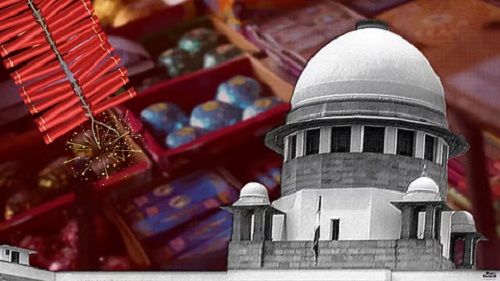
As Diwali approaches, the Supreme Court has signalled a significant shift from the binary debate of either a complete firecracker ban or unrestricted celebrations. The Bench of Justices M M Sundresh and P B Varale has indicated that permissible firecrackers could be allowed during specified hours, while rejecting round-the-clock bursting. The approach attempts to reconcile the cultural and religious significance of Diwali with the environmental and public-health concerns that become particularly acute in Delhi-NCR and other northern regions during the festive season.
The Supreme's Court’s position on firecrackers is important because the firecracker debate has for years been framed as a conflict between religious freedom and the right to breathe clean air. The latest proceedings suggest that the judiciary is seeking a regulatory framework rather than an absolute prohibition. In other words, the question is increasingly shifting from whether firecrackers should be permitted to which crackers should be permitted, for how long, and under what safeguards.
The Bench made it clear that a complete prohibition could affect the sentiments of people celebrating Diwali, while permitting crackers throughout the day would have consequences for the environment and vulnerable sections, including children, elderly people and those who are ill.
This balance is particularly relevant for Delhi-NCR, where the annual deterioration in air quality during the post-monsoon period creates a complicated pollution picture. Firecracker emissions are one component, but pollution levels are also influenced by multiple other sources. The Supreme Court itself has previously directed comprehensive studies to assess the contribution of firecrackers and their health impact rather than treating the issue in isolation.
A potentially important development is the Court's openness to joint firecrackers, or ‘larri’, subject to prescribed conditions. Earlier restrictions had specifically covered joined strings of crackers in Delhi-NCR. The current proceedings indicate that newer-generation variants could be considered if they satisfy specified technical, emission and noise requirements.
The scientific assessment will therefore play a crucial role in determining the eventual regulatory framework. Additional Solicitor General Aishwarya Bhati sought time until October 15 for the Centre and the Central Pollution Control Board to place their assessment of barium-based firecrackers before the Court. CSIR-NEERI is also conducting studies on the ambient-air impact of barium-containing Generation-2 green crackers in Delhi, Bhopal, Kolkata and Chennai.
The issue of barium is especially significant because the newer generation of green crackers seeks to reduce emissions while retaining some of the characteristics associated with conventional fireworks. According to the Centre's submissions, NEERI's interim findings indicated substantial reductions in particulate emissions from formulations using reduced quantities of barium salts compared with conventional formulations. The final scientific assessment, however, is expected to inform the Court before it determines which categories can be permitted.
The larger significance of the proceedings lies in the Court's attempt to move towards evidence-based regulation. A blanket ban is simple to announce but difficult to reconcile with the cultural importance attached to Diwali and can also raise questions about enforcement and compliance. At the other extreme, unrestricted use ignores the concentrated environmental and health consequences of fireworks in already polluted urban environments.
A time-bound system, combined with clearly identified permissible products and enforcement of emission and noise standards, represents a more structured regulatory model. Its effectiveness, however, will ultimately depend on implementation. Restrictions have little meaning if prohibited crackers continue to be manufactured, sold or used with limited enforcement.
The October 15 proceedings are therefore likely to be important. The CPCB and scientific assessments could provide the technical basis for deciding the permissible categories, while the Court will have to determine the conditions and timing of their use. The emerging framework is not simply about allowing or banning fireworks; it is about establishing whether festive celebration and environmental responsibility can coexist through measurable limits and effective regulation.




















Leave Your Comment