


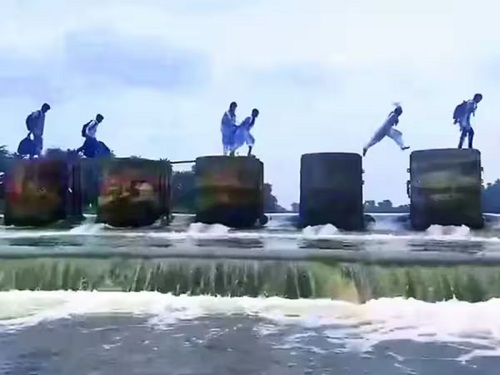
The National Human Rights Commission (NHRC), India, has taken suo motu cognizance of a media report highlighting the dangerous ordeal faced by schoolchildren in Kakraua village of Madhya Pradesh’s Vidisha district. The students reportedly risk their lives every day by hopping across exposed check dam pillars to cross the Betwa River on their way to school.
According to the report, nine students, including five girls, use the perilous route regularly because it reduces their journey from nearly 13 kilometres by road to just about 1.5 kilometres. A video showing the children carefully navigating wide gaps between the check dam pillars has reportedly gone viral on social media, drawing attention to the serious safety risks involved.
The NHRC has observed that if the contents of the report are found to be true, they raise serious issues concerning the violation of human rights. The Commission has particularly emphasised that access to education cannot be separated from the safety and dignity of children.
Article 21A of the Constitution guarantees free and compulsory education to children between six and 14 years of age. The Right of Children to Free and Compulsory Education Act, 2009, similarly establishes education as a statutory right for children in this age group.
The Commission also referred to the Supreme Court’s judgment in Avinash Mehrotra v. Union of India (2009), in which the apex court held that the right to education necessarily encompasses the right to a safe school and safe infrastructure.
Against this backdrop, the NHRC has stated that the absence of a safe means of reaching school effectively negates children’s fundamental right to education with dignity. It has therefore issued a notice to the Chief Secretary of Madhya Pradesh, seeking a detailed report on the matter within two weeks.
The situation reportedly reflects the difficult choice confronting families in Kakraua. Villagers have said that they are unable to accompany their children to a distant school because they need to work in their fields. With the school located much farther away by road, families are reportedly left with two options—stop sending their children to school or allow them to undertake the extremely hazardous river crossing.
The consequences have already been serious. According to the media report, one girl student reportedly failed her final examinations after missing school because she was unable to cross the exposed check dam pillars due to her short height.
The District Education Officer has reportedly visited the site and brought the matter to the attention of the District Collector. However, there is apparently no clear timeline yet for constructing a safe passage across the river.
The NHRC’s intervention has put the spotlight on the gap between the constitutional promise of universal education and the ground realities faced by children in remote and rural areas. While enrolment and school access are often measured in terms of the availability of educational institutions, the Kakraua case demonstrates that physical safety and reliable connectivity are equally essential for ensuring meaningful access to education.
For the children of Kakraua, the issue is not merely about travelling a longer distance to school. It is about whether they can exercise their right to education without putting their lives at risk. The NHRC notice now puts the responsibility on the state authorities to explain the existing arrangements and, more importantly, take concrete steps to provide the children with a safe route to school.



















Leave Your Comment