


Israeli Prime Minister Benjamin Netanyahu announced on Thursday that his government has not responded to a joint proposal from the United States, France, and several other allies calling for a 21-day ceasefire in Israel's ongoing conflict with the Lebanese armed group Hezbollah.
In a statement from Netanyahu's office, it was emphasized that the prime minister had not even formally addressed the ceasefire initiative. "It is an American-French proposal, which the prime minister has not even responded to," the statement said, underscoring Netanyahu's resolve to continue military operations. Netanyahu further ordered the Israeli Defense Forces (IDF) "to continue the fighting with full force," signaling the government's commitment to intensifying its military campaign against Hezbollah.
The proposal for a temporary ceasefire was issued by the United States, European Union, and several Arab states, including Qatar, Saudi Arabia, and the United Arab Emirates. In a joint statement, U.S. President Joe Biden, French President Emmanuel Macron, and other world leaders expressed deep concern over the escalating violence in Lebanon and Israel.
The international leaders described the situation in Lebanon as "intolerable" and said it was in neither Israel's nor Lebanon's interest to continue the conflict. "We call for an immediate 21-day ceasefire across the Lebanon-Israel border to provide space for diplomacy towards the conclusion of a diplomatic settlement," the statement said. The call came during a meeting on the sidelines of the United Nations General Assembly in New York.
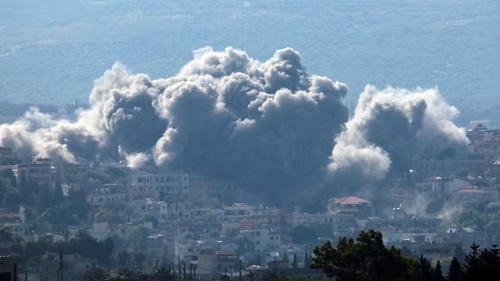
Tensions between Israel and Hezbollah have reached alarming levels over the past week, with Israeli airstrikes targeting Hezbollah strongholds across Lebanon, resulting in the deaths of hundreds and the displacement of tens of thousands. Hezbollah, in turn, has launched a series of retaliatory rocket attacks, with reports of a ballistic missile strike targeting Tel Aviv.
As the violence escalates, Israeli Army Chief Lieutenant General Herzi Halevi on Wednesday warned troops to be ready for a potential ground offensive against Hezbollah. The Israeli military has focused on aerial bombardments but could expand its operations on the ground if Hezbollah's attacks persist.
The call for a ceasefire reflects growing international concern over the humanitarian crisis in Lebanon and the broader implications of the conflict. The United Nations and various non-governmental organizations have warned that the destruction and displacement caused by the fighting could exacerbate the already fragile situation in Lebanon.
However, Netanyahu’s dismissal of the ceasefire proposal suggests that the Israeli government is determined to continue its military operations until Hezbollah is weakened. With Israel poised for a potential ground offensive, and Hezbollah maintaining its rocket attacks, the prospect of a diplomatic solution remains uncertain.
The joint call for a 21-day ceasefire is aimed at halting the violence and opening the door to diplomacy, but with both sides showing little interest in backing down, the conflict looks set to continue.






















Leave Your Comment