


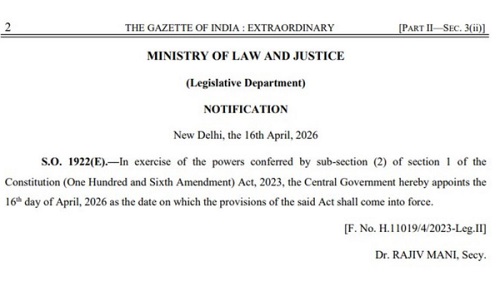
India has taken a historic stride toward gender equality with the implementation of the One Hundred and Sixth Constitutional Amendment Act, 2023, popularly known as the Nari Shakti Vandan Adhiniyam. The landmark legislation, which came into force yesterday, marks a significant milestone in the nation’s democratic journey by ensuring greater representation of women in legislative bodies.
Passed by Parliament in 2023, the Act mandates the reservation of one-third of all seats for women in the Lok Sabha and State Legislative Assemblies, including the Assembly of the National Capital Territory of Delhi. The reservation will be implemented on a rotational basis, aiming to provide equitable opportunities for women to participate in governance across the federal structure.
Prime Minister Narendra Modi underscored the importance of women’s empowerment, stating that feminine power is the hallmark of a strong India. In a social media post, he shared a Sanskrit Subhashitam, highlighting the enduring strength and contributions of women. He emphasized that the mothers, sisters, and daughters of the nation are elevating the pride of Bharatvarsha across diverse fields through their determination, dedication, and spirit of service.
Parliamentary Affairs Minister Kiren Rijiju described the notification of the Act as a step toward implementing long-pending reforms. He noted that earlier provisions related to women’s reservation had remained unimplemented and stressed that the current move is part of a broader process of institutional change. He also urged the Opposition to refrain from politicising the issue.
Welcoming the development, BJP MP Dinesh Sharma termed the legislation historic and said it offers an opportunity for political parties to reaffirm their commitment to women’s upliftment. He criticised past governments for not doing enough to empower women politically.
Janata Dal (United) MP Sanjay Jha also supported the move, calling it a long-overdue reform. Drawing from Bihar’s experience, he pointed out that women’s representation in Panchayats has already exceeded 50 per cent in the state, creating a strong pipeline of grassroots women leaders over time. He stressed that the legislation deserves unanimous support across party lines.
Adding to the chorus of support, BJP MP Laxmi Verma from Chhattisgarh described the Act as a moment of immense pride for the nation. She credited the leadership of the Prime Minister for advancing women’s empowerment and noted that the legislation opens new avenues for women, who constitute nearly half of India’s population, to take on leadership roles and shape policymaking.
The implementation of the Nari Shakti Vandan Adhiniyam is expected to transform India’s political landscape by fostering inclusive governance and strengthening democratic institutions. As the country moves toward its Vision 2047 of becoming a developed nation, this reform stands as a powerful testament to India’s commitment to equality, representation, and the empowerment of its women.


















Leave Your Comment