


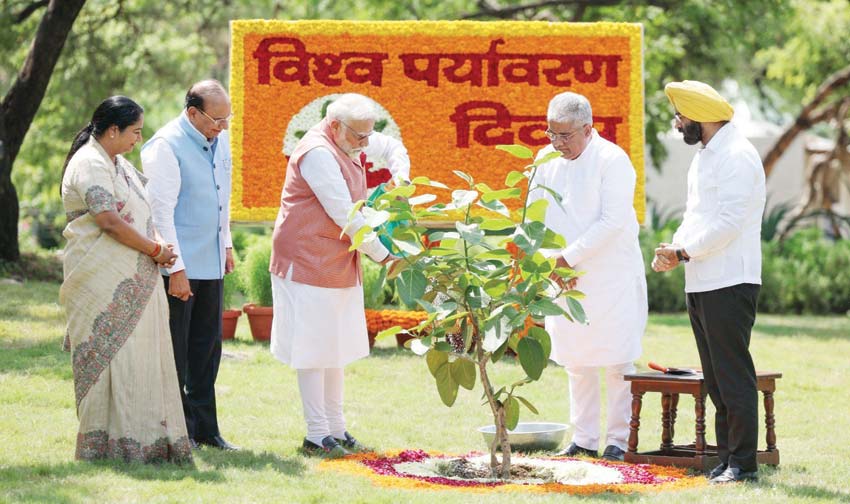
When one thinks of Prime Minister Narendra Modi, the images that often come to mind are those of a decisive leader steering India's economic and geopolitical trajectory. Yet, beneath the veneer of a "Pradhan Sevak" (Prime Servant) lies another, equally significant identity: that of a "Pradhan Paryavaran Senani" (Prime Environmental Warrior). For the past 11 years, the government led by him has embarked on a silent, yet profound, revolution aimed at protecting India's natural heritage and addressing the pressing global challenge of climate change. This environmental crusade is not merely a political slogan but a cornerstone of a new national consciousness, blending ancient Indian values of living in harmony with nature with modern, technology-driven solutions. The proactive and comprehensive measures adopted across the domains of environmental protection, wildlife conservation, and ecosystem restoration have not only fortified India's ecological resilience but have also positioned the nation as a global leader in the fight against climate change.
Environmental Protection & The Global Green Agenda
The Modi government's approach to environmental protection has been multifaceted, focusing on both domestic action and international collaboration. A major pillar of this strategy is the ambitious push for renewable energy. India has been a trailblazer in solar energy, with its installed capacity growing exponentially. The government's target of achieving 500 GW of non-fossil fuel energy capacity by 2030 is a testament to this unwavering commitment. This push is underpinned by schemes like the Pradhan Mantri Kisan Urja Suraksha evam Utthaan Mahabhiyan (PM-KUSUM), which promotes solar pumps for farmers, and the Rooftop Solar Program, which incentivizes households to generate their own clean energy. Beyond national boundaries, PM Modi's vision led to the formation of the International Solar Alliance (ISA), a global initiative to create a common platform for solar-rich countries to cooperate and reduce the cost of solar technology. The ISA has now grown into a treaty-based intergovernmental organization with over 120 member countries, cementing India's leadership in the global solar revolution.
Tackling air pollution, particularly in urban centers, has been another key area of focus. The National Clean Air Programme (NCAP) was launched with the goal of reducing particulate matter concentration by up to 30% by 2024. The government has also been promoting electric mobility through schemes like FAME India (Faster Adoption and Manufacturing of (Hybrid &) Electric Vehicles in India), which offers subsidies for EV purchases and infrastructure development. The push towards cleaner fuels and stricter emission norms (like Bharat Stage-VI) has also contributed significantly to improving air quality.
The fight against plastic pollution, a menace to both land and marine ecosystems, has been taken head-on with a nationwide ban on single-use plastics from July 2022. This was complemented by the Swachh Bharat Mission (Clean India Mission), a large-scale sanitation and cleanliness drive that has not only improved public health but has also instilled a sense of civic responsibility towards waste management. The mission’s second phase, Swachh Bharat Mission-Urban 2.0, focuses on making cities "garbage-free," emphasizing solid waste management and a circular economy approach. To finance these green initiatives, the government has also pioneered the use of financial instruments like Sovereign Green Bonds, becoming one of the first major economies to do so. These bonds channel funds towards public sector projects aimed at reducing carbon emissions and promoting environmental sustainability.
Wildlife Conservation: From Apathy to Ambitious Action
India's rich biodiversity is its greatest treasure, and the Modi government has demonstrated an unprecedented commitment to its protection. The most celebrated success story is the spectacular comeback of the tiger. Under Project Tiger, which received renewed impetus and funding, the tiger population has more than doubled from a mere 1,411 in 2006 to over 3,167 in 2022, earning India the distinction of being home to over 70% of the world's wild tiger population. This achievement is a result of a multi-pronged approach involving strict anti-poaching measures, habitat restoration, and active engagement with local communities. Similarly, Project Lion, launched with the goal of conserving the Asiatic lion, has seen a steady rise in their numbers.
Perhaps the most iconic and symbolic wildlife conservation effort has been the reintroduction of cheetahs to India. This landmark project, launched after more than seven decades of the species being declared extinct in the country, involved translocating cheetahs from Namibia and South Africa to the Kuno National Park in Madhya Pradesh. This is not just about bringing back a species but about restoring a complete ecosystem and re-establishing a vital link in the food chain. The government’s conservation efforts extend to other species as well, with dedicated programs for the Asian elephant and the one-horned rhinoceros, both of which have seen their populations stabilize or grow. The government's mantra of "Jan Bhagidari" (people's participation) has been crucial in these efforts, recognizing that conservation is most effective when it is a community-driven initiative rather than a top-down mandate. The concept of eco-tourism has been promoted responsibly to create economic incentives for local communities to protect their natural surroundings.
Ecosystem Restoration & A Sustainable Future
The third pillar of the government's environmental strategy is a strong focus on ecosystem restoration, an area that often goes unaddressed. India has been a strong advocate for Land Degradation Neutrality, committing to restoring 26 million hectares of degraded land by 2030. The emphasis on afforestation and increasing green cover is visible through a number of schemes and initiatives. The restoration of degraded forests, a vital carbon sink, is a key component of India’s Nationally Determined Contributions (NDCs) under the Paris Agreement.
The rejuvenation of rivers, particularly the sacred Ganga, has been a flagship program. The Namami Gange Mission, launched with a massive budget, focuses on pollution abatement, riverfront development, and maintaining ecological flow. Its success is evident in the tangible improvement in the river’s water quality and the restoration of its biodiversity. Similarly, the Jal Jeevan Mission, which aims to provide safe and adequate drinking water to all rural households, is intrinsically linked to the health of water sources and the restoration of local water bodies. The government has also launched the Mangrove Initiative for Shoreline Habitats & Tangible Incomes (MISHTI) to conserve and restore mangrove ecosystems, which act as crucial buffers against cyclones and coastal erosion.
At a broader level, the government has championed the concept of a "Lifestyle for Environment" (LiFE). This global movement, spearheaded by PM Modi, promotes a shift from mindless and wasteful consumption to a mindful and deliberate utilization of resources. It encourages individuals to adopt sustainable living practices in their daily lives, transforming environmental protection from a government-mandated policy into a people's movement. By connecting the dots between individual actions and global impact, LiFE aims to create a new paradigm of environmental stewardship, one that is rooted in personal responsibility and collective action. This philosophy recognizes that true environmental change will come not just from government policies, but from a fundamental shift in human behavior.
Conclusion: A Legacy of Green Governance
Over the past decade, the Narendra Modi government has demonstrated that environmental protection and economic development are not mutually exclusive but are two sides of the same coin. The journey from being seen as a developing nation with a carbon footprint to a leader in climate action and conservation has been remarkable. The policies and programs implemented, from the ambitious solar push and the reintroduction of the cheetah to the mass movement for cleanliness and the LiFE initiative, reflect a holistic and deeply committed approach to environmental governance. PM Modi’s vision extends beyond mere compliance with international treaties; it is about building a sustainable and resilient India for future generations. His role as the Prime Environmental Warrior is not defined by a single policy or a one-off project, but by a consistent and comprehensive effort that has woven the green thread into the very fabric of India's national narrative. It is a legacy that promises not just prosperity, but a harmonious coexistence with the planet.

By Viral Desai
(The author is a known Environmentalist and the pioneer of Satyagraha Against Pollution movement, viraludayindia@gmail.com )
(The content of this article reflects the views of writer and contributor, not necessarily those of the publisher and editor. All disputes are subject to the exclusive jurisdiction of competent courts and forums in Delhi/New Delhi only)















Leave Your Comment