


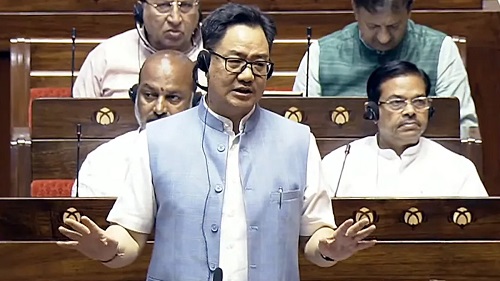
Union Parliamentary Affairs Minister Kiren Rijiju on Thursday said the recently concluded Monsoon Session of Parliament was successful in terms of legislative business, with 12 bills passed, but acknowledged that repeated disruptions prevented adequate debate and discussion.
Addressing the media after the session, Rijiju said the government had assessed the proceedings from two perspectives. While the legislative agenda progressed as planned, frequent disruptions in both Houses significantly affected the overall productivity of Parliament.
“In terms of business, it was a very successful session; we passed a total of 12 bills. However, from the perspective of debate and discussion, it was not as successful,” Rijiju said.
According to the minister, the Lok Sabha functioned at only 19 per cent of its scheduled time, while the Rajya Sabha recorded 39 per cent productivity. He blamed repeated disruptions and walkouts by opposition parties for the low productivity, while noting that members of the ruling NDA and some opposition MPs continued to participate in debates.
Rijiju also pointed out that only one bill received a full-fledged discussion in the Lok Sabha during the session. He highlighted the legislation aimed at preventing paper leaks and the use of unfair means in examinations as an example of substantive parliamentary discussion.
The Public Examinations (Prevention of Unfair Means) legislation was discussed in both the Lok Sabha and the Rajya Sabha before being passed. The government has maintained that the legislation is aimed at strengthening the examination system and ensuring strict action against organised attempts to compromise competitive examinations.
The Monsoon Session, which began on July 20, was marked by repeated disruptions in both Houses, with opposition parties raising several issues and demanding discussions and accountability from the government.
The protests initially centred on the NEET paper leak controversy and allegations concerning financial irregularities related to donations at the Ram temple in Ayodhya. The opposition subsequently focused on alleged police action against students participating in protests over the examination controversy.
Opposition parties demanded that Prime Minister Narendra Modi and Union Home Minister Amit Shah be present in Parliament and respond to the allegations. The government, however, maintained that it was prepared to hold a discussion on the issue.
In an attempt to break the deadlock, the government proposed a debate on the NEET paper leak and related matters on Monday, with Amit Shah offering to respond to the discussion. The proposal was rejected by the Congress.
A similar effort was made on Wednesday, but the deadlock continued. Congress leader and Leader of Opposition in the Lok Sabha Rahul Gandhi argued that young people were seeking answers about the alleged use of pellet guns against protesting students.
Gandhi also questioned the government's responsibility for the alleged police action, saying that if Shah had authorised it, he was accountable, while if he had not, it represented a failure of leadership.
The standoff ultimately prevented Parliament from devoting more time to substantive discussions, despite the government's legislative agenda moving forward.
Rijiju's assessment thus underlined the contrast between the legislative output of the session and its limited scope for debate. While 12 bills were passed, the low productivity figures and repeated disruptions highlighted continuing differences between the government and the Opposition over issues they wanted Parliament to address.
With the Monsoon Session now concluded, the challenge for both sides will be to ensure that future sessions provide greater space for discussion, scrutiny and debate alongside the passage of legislation.





















Leave Your Comment