


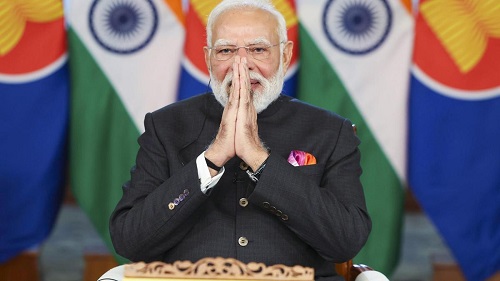
India's engagement with Southeast Asia is entering another significant phase as Prime Minister Narendra Modi embarks on a two-day visit to the Philippines to participate in the 23rd ASEAN-India Summit and the 21st East Asia Summit. At a time when geopolitical equations across the Indo-Pacific are undergoing considerable changes, New Delhi is seeking to strengthen its regional partnerships through diplomacy, economic cooperation and maritime engagement. Underscoring the strategic importance of the visit, Modi has described India's relationship with ASEAN as the cornerstone of its Act East Policy and an integral pillar of its broader MAHASAGAR vision. His Manila visit is expected to provide fresh momentum to regional cooperation while reaffirming India's commitment to a peaceful, stable and prosperous Indo-Pacific.
Prime Minister Narendra Modi arrived in Manila on Monday, November 16, for a two-day diplomatic engagement at the invitation of Philippine President Ferdinand R. Marcos Jr., whose country is hosting the regional summits as the ASEAN Chair for 2026. The visit brings India's growing strategic engagement with Southeast Asia into focus, particularly at a time when maritime security, regional stability, economic resilience and emerging technologies are becoming increasingly important to the Indo-Pacific order.
In his departure statement, Modi emphasised that India's relationship with ASEAN occupies a central position in the country's foreign policy priorities. He highlighted the historical and civilisational foundations of these ties, noting that centuries of cultural exchanges have gradually evolved into a comprehensive partnership encompassing trade, connectivity, maritime security, technology and people-to-people relations. According to the Prime Minister, the visit would generate fresh momentum for India's engagement with the regional grouping and strengthen the collective resolve to build a peaceful, prosperous and resilient Indo-Pacific.
At the 23rd ASEAN-India Summit, Modi is expected to engage with regional leaders on consolidating the Comprehensive Strategic Partnership and expanding cooperation across areas of mutual interest. The discussions will include an assessment of the progress achieved so far and the implementation of the ASEAN-India Plan of Action for 2026–2030. The summit will also provide an opportunity to identify emerging priorities and establish a framework for deeper engagement in the coming years.
The timing of the visit carries additional significance as 2026 is being observed as the ASEAN-India Year of Maritime Cooperation. Maritime engagement has acquired greater strategic importance for India, given the region's vital sea routes, expanding commercial networks and emerging security challenges. For New Delhi, stronger cooperation with ASEAN is not merely an extension of its neighbourhood diplomacy but an essential element of its larger vision for regional stability and economic integration.
The relationship is also approaching important milestones. India and ASEAN will commemorate 35 years of Dialogue Relations and five years of their Comprehensive Strategic Partnership in 2027. These anniversaries offer an opportunity to evaluate the progress of bilateral engagement and explore new avenues for collaboration. India's emphasis on connectivity, trade, digital development and maritime security reflects its intention to transform longstanding diplomatic goodwill into tangible regional outcomes.
The 21st East Asia Summit will provide another important platform for the Prime Minister to exchange views with participating leaders on international and regional developments. The forum brings together influential countries with a shared interest in maintaining stability and strengthening cooperation across East Asia and the wider Indo-Pacific. Modi has described the summit as an important mechanism for dialogue on regional and global challenges, expressing his willingness to work with participating leaders towards greater peace, stability and cooperation.
Another significant dimension of the Manila engagement is the expected meeting of Quad leaders on the sidelines of the ASEAN Summit. According to a senior US official, Prime Minister Modi, US President Donald Trump, Australian Prime Minister Anthony Albanese and Japanese Prime Minister Sanae Takaichi are scheduled to meet. If held as planned, it would be the first gathering of Quad leaders in two years and the first such meeting during Trump's current presidential term.
The previous Quad leaders' summit took place in Delaware on September 21, 2024, under the administration of then US President Joe Biden. Established in 2007, the grouping of India, the United States, Australia and Japan subsequently regained momentum as the four countries sought to promote a free, open and inclusive Indo-Pacific. The proposed Manila interaction is therefore expected to attract considerable diplomatic attention, particularly in the context of evolving regional strategic equations.
Beyond multilateral diplomacy, Modi will also interact with members of the Indian community in the Philippines. The diaspora has historically contributed to strengthening cultural, economic and social connections between the two countries. The Prime Minister's interaction is expected to acknowledge the community's role in nurturing these longstanding relations.
India's participation in the Manila summits reflects a broader foreign policy approach that combines strategic autonomy with active regional engagement. ASEAN remains central to this approach because of its geographical significance, economic potential and institutional role in shaping the Indo-Pacific. Through the Act East Policy and the MAHASAGAR vision, India seeks to build partnerships that extend beyond conventional diplomatic engagement to encompass shared prosperity, maritime cooperation and regional resilience.
The Manila visit, therefore, represents more than participation in two international summits. It provides an opportunity for India to reaffirm its regional priorities, strengthen its strategic partnerships and contribute to shaping a stable Indo-Pacific order. The extent to which these diplomatic engagements translate into concrete cooperation will determine their long-term significance for India and its Southeast Asian partners.




















Leave Your Comment