


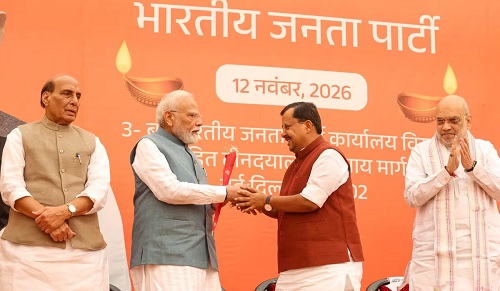
Prime Minister Narendra Modi used the Diwali Milan programme at the BJP headquarters in New Delhi on Thursday to revisit some memorable moments from his political journey, underline the changing relationship between politics and the media, and share his confidence in India's ambition to become a developed nation by 2047. Interacting with journalists, he recalled an unusual incident from the 1990s when a group of reporters arrived at his room at the party office with sweets, claiming that he was about to become Gujarat Chief Minister, a development that only a handful of senior BJP leaders reportedly knew about at the time.
During the interaction, Modi recalled his early days at the BJP headquarters at 11 Ashoka Road, where he handled organisational responsibilities during two major nationwide political journeys in the early 1990s. He pointed out that communication between political parties and journalists was considerably different in those days. Even sending a press release was not a simple exercise, as it required access to a fax machine. Recalling an incident that remained memorable for him, Modi said a group of journalists, including members of what he described as a women's brigade, suddenly entered his room and demanded sweets. When he asked the reason, they told him that he was being sent to Gujarat and would become the state's Chief Minister. Modi said the development was not widely known within the party and only a few senior leaders were aware of it. However, the journalists had somehow obtained the information beforehand. Their prediction eventually came true, he recalled, highlighting the media's ability to pick up political developments even before they become public knowledge.
The Prime Minister also reflected on the transformation of journalism and political communication over the past three decades. He observed that journalists gradually assume different responsibilities as they move from reporting to editorial positions, while political leaders also experience a similar transition when their roles change. Referring to his own journey, Modi said he had completed 25 years as the head of a government over the past month. During this period, India, the world and the nature of political engagement had undergone considerable transformation. The shift from fax machines and conventional press releases to Instagram reels, digital platforms and instant communication illustrated the scale of technological change. He noted that while certain aspects of traditional media had become easier, the emergence of new platforms had also created fresh challenges. The interaction offered an opportunity to acknowledge how the media ecosystem had evolved alongside the country's political and technological developments.
Moving beyond personal memories, Modi used the occasion to emphasise that India's ambition of becoming a developed nation by 2047 was realistic and achievable. He argued that the country's achievements over the past decade demonstrated its growing capabilities across different sectors. Citing India's successful landing near the Moon's south pole, its emergence as the world's second-largest mobile phone manufacturer and the construction of the world's highest railway arch bridge over the Chenab river, he highlighted the country's expanding technological and infrastructural strengths. He also referred to the rapid expansion of renewable energy and entrepreneurship, noting that India's solar power generation capacity had increased more than 50 times in 12 years. Similarly, the country had developed the world's third-largest start-up ecosystem during this period. According to him, these accomplishments were evidence that India could set ambitious objectives and deliver results through sustained effort, institutional commitment and public participation.
Explaining how the 2047 vision could be achieved, Modi drew a parallel with India's freedom movement. He said complete independence was never expected to materialise overnight. Instead, the movement progressed through smaller objectives, each achievement strengthening people's belief in the ultimate goal. Gradually, this confidence brought more people together around the common national aspiration. The Prime Minister suggested that the same approach was necessary for building a developed India. Rather than treating 2047 as a distant destination and waiting for the deadline, the country must continuously establish and accomplish measurable targets. Progress in individual sectors, improvements in infrastructure, technological advancement and greater public participation would collectively move India closer to its larger ambition. His message at the Diwali Milan gathering was that national transformation depends not merely on setting a grand vision but on converting it into a series of achievable milestones.





















Leave Your Comment