


The first bilateral foreign visit of Nepal Prime Minister Balendra Shah to India has opened an important diplomatic opportunity for the two neighbouring countries to redefine their partnership around economic cooperation, infrastructure development and shared strategic interests. His meeting with Prime Minister Narendra Modi at Rashtrapati Bhavan on Monday carries significance beyond diplomatic protocol, reflecting the mutual desire to strengthen centuries-old ties while addressing emerging economic and geopolitical challenges. With investment, financial assistance, cross-border connectivity and reconstruction support featuring prominently on the agenda, the visit could provide fresh momentum to India-Nepal relations.
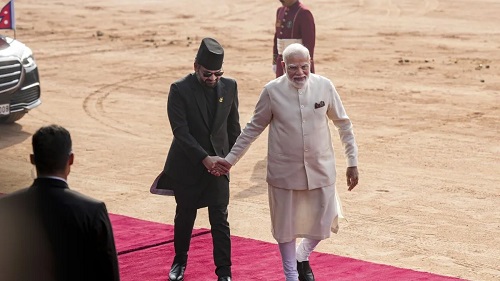
Nepal Prime Minister Balendra Shah's meeting with Prime Minister Narendra Modi at Rashtrapati Bhavan marks an important moment in the evolving relationship between the two neighbouring countries. Shah, who selected India for his first bilateral foreign visit after assuming office, was accorded a ceremonial welcome before the two leaders interacted with members of their respective delegations. The high-level engagement reflects Kathmandu's recognition of India's importance as a development partner and New Delhi's interest in maintaining a stable, prosperous and cooperative neighbourhood.
The discussions between Modi and Shah are expected to provide a political roadmap for strengthening bilateral cooperation across several areas, including trade, investment, infrastructure, energy, technology and social development. Both countries face common challenges arising from climate change, natural disasters and the need for sustainable economic growth. Their geographical proximity and interconnected economies make cooperation not merely desirable but essential for long-term regional prosperity.
A major focus of Shah's visit is expected to be Nepal's economic requirements and India's potential contribution to its development priorities. Kathmandu has sought an economic assistance package worth $2 billion, including $1 billion in grants. Nepal has also requested Indian assistance in rebuilding areas severely affected by the devastating Bhote Koshi flash floods in August. The reconstruction requirement highlights the importance of disaster management cooperation between the two countries, particularly given their shared vulnerability to floods, landslides and other climate-related emergencies.
Another significant issue on the agenda is Nepal's request to make the Kathmandu-Mahendranagar air corridor operational in both directions. At present, international flights are permitted to depart Nepal through this route, but the absence of reciprocal access restricts its potential. Greater flexibility in air connectivity could improve Nepal's aviation infrastructure, facilitate tourism and strengthen commercial exchanges.
India, meanwhile, has proposed developing a joint long-term vision for bilateral relations. Such a framework could help transform traditional goodwill into measurable cooperation through investments, infrastructure projects and expanded economic partnerships. The presence of a 35-member Nepali delegation, including Foreign Minister Shishir Khanal, Finance Minister Swarnim Wagle, senior advisers and business representatives, underlines the economic importance attached to the visit.
The Nepal-India Business Forum being organised during Shah's visit is another important component of the engagement. Nepal is keen to attract greater Indian investment, particularly in sectors that can generate employment, expand industrial capacity and improve infrastructure. Indian businesses have opportunities in Nepal's hydropower, tourism, manufacturing, information technology and connectivity sectors. For India, deeper economic engagement with Nepal can strengthen regional supply chains while opening new avenues for trade and investment.
The cultural dimension of the visit has been equally prominent. The two prime ministers virtually flagged off the Saryu-Kamala Express, connecting Ayodhya in Uttar Pradesh with Janakpur Dham in Nepal. The railway connection is particularly meaningful because the two destinations occupy an extraordinary position in the religious and cultural imagination of millions of people.
Ayodhya is revered as the birthplace of Lord Ram, while Janakpur is traditionally associated with the birthplace of Goddess Sita. Their connection through a railway service represents more than an improvement in transportation. It provides a practical expression of the shared religious heritage that has sustained people-to-people relations between India and Nepal for generations.
Uttar Pradesh Chief Minister Yogi Adityanath, addressing the gathering during the inauguration, emphasised the historical depth of the relationship. He described the India-Nepal connection as one rooted in faith, family relationships and shared traditions, popularly recognised through the expression 'roti-beti'. Referring to the cultural celebrations surrounding Vivaha Panchami, he highlighted how the festivities associated with the divine marriage of Ram and Janaki resonate on both sides of the border.
The reference underlined the extraordinary continuity of cultural traditions between the two countries. Religious festivals, pilgrimage routes, family relationships and common linguistic and social practices have historically created an emotional connection that goes beyond conventional diplomatic relations.
However, the real test of this renewed engagement will lie in translating diplomatic understanding into concrete outcomes. Nepal's economic expectations, India's development priorities and unresolved connectivity issues will require sustained political dialogue and administrative coordination. Both sides must ensure that agreements are implemented within reasonable timelines and that economic cooperation delivers tangible benefits to ordinary citizens.





















Leave Your Comment