


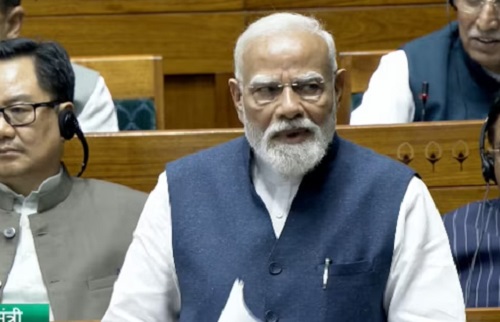
Prime Minister Narendra Modi on Thursday made a strong pitch for the immediate implementation of the women’s reservation framework while addressing the Lok Sabha during a special session convened to deliberate on the women’s quota and delimitation bills.
Emphasising urgency, the Prime Minister said the government is committed to operationalising the long-pending women’s reservation measure at the earliest, even as delays in conducting the latest Census had stalled its rollout. Originally passed unanimously in 2023, the legislation had remained in limbo pending updated population data. The Centre is now pushing to implement it based on the 2011 Census figures.
The proposed amendment—popularly referred to as the Nari Shakti Vandan Adhiniyam—seeks to reserve around 33 per cent of seats in the Lok Sabha for women. In tandem, it also proposes increasing the total strength of the House to 815 seats, out of which approximately 273 would be earmarked for women lawmakers.
Linking the reform to India’s broader development goals, Modi said greater representation of women in policymaking is essential for achieving a “Viksit Bharat” (developed India). “A developed India does not mean only good infrastructure but participation of women in policy making,” he told the House, underscoring the transformative potential of the bill.
In a pointed message to critics, the Prime Minister cautioned opposition parties against resisting the proposal. He argued that political opposition to women’s reservation no longer remains confined to elite circles, noting that grassroots political participation by women—particularly through panchayat-level governance—has significantly increased awareness and expectations.
“Those who oppose the women’s reservation bill today will have to pay the price for a long time,” Modi said, adding that women voters are now more politically conscious and unlikely to overlook resistance to their representation.
However, the session witnessed disruptions as opposition members raised slogans during the Prime Minister’s address, reflecting the broader tensions surrounding the delimitation exercise and the sequencing of reforms.
The ongoing special session is expected to see intense debate over both the women’s reservation proposal and the delimitation bill, with the government seeking consensus while the opposition continues to question the



















Leave Your Comment