


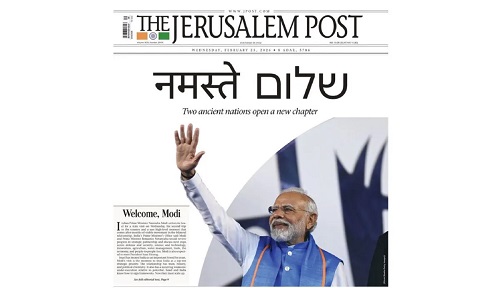
As Prime Minister Narendra Modi touched down in Israel for his highly anticipated two-day visit, the country's most prominent English-language newspaper, the Jerusalem Post, made its enthusiasm unmistakably clear — plastering the Indian leader's photograph across its front page on Wednesday.
The newspaper's Editor-in-Chief, Zvika Klein, shared the edition on social media, showcasing a front page that carried a photograph of a waving Modi alongside multiple stories devoted to the visit and the strengthening ties between New Delhi and Jerusalem. Two headlines captured the mood succinctly: "Welcome, Modi," and "New Delhi's burgeoning partnership with Jerusalem" — a front-page treatment that underscored just how significant Israel considers this diplomatic moment.
Perhaps the most symbolically charged element of the visit is Modi's planned address to the Knesset, Israel's parliament — a first for any Indian Prime Minister. JP Singh, India's envoy to Israel, was interviewed by the Jerusalem Post ahead of the visit and described the address as carrying enormous historic weight.
"One of the most important elements will be that he will be the first prime minister from India to address the Knesset," Singh said. He also outlined the broader ambitions driving the visit, noting that both countries are working toward a comprehensive bilateral framework that stretches well beyond traditional areas of cooperation. Financial collaboration, trade, cross-border payments, and money transfer infrastructure are all on the table — a sign that the partnership is maturing into genuinely multi-dimensional territory.
This is not Modi's first time in Israel. In 2017, he made history simply by arriving — becoming the first-ever Indian Prime Minister to set foot in the country. That visit broke a decades-long pattern of diplomatic distance, and the relationship has moved quickly since. This second visit, coming at the personal invitation of Israeli Prime Minister Benjamin Netanyahu, is being framed by both sides as a deepening of what is now formally described as a Strategic Partnership.
On the agenda are wide-ranging discussions covering science and technology, innovation, defence and security, agriculture, water management, trade, and people-to-people exchanges. Modi is also scheduled to call on Israeli President Isaac Herzog, with the meeting expected to reaffirm the shared democratic values and strategic alignment that both nations increasingly point to as the foundation of their relationship.
The Israeli Prime Minister has made little effort to understate the significance of the occasion. Describing Modi as a "dear friend," Netanyahu opened his cabinet meeting this week with remarks about the visit, calling it "historic" and characterising the India-Israel relationship as one that "continues to scale new heights."
He went further, using notably ambitious language to describe the partnership's scope: "Together, we are building an axis of nations committed to stability and progress," he said, pointing specifically to cooperation in emerging technologies and broader geopolitical coordination. Calling it "a powerful alliance between two global leaders," Netanyahu framed India and Israel not merely as bilateral partners but as like-minded pillars of a shared strategic vision.
The imagery of a front-page welcome from the Jerusalem Post, combined with the diplomatic choreography of a Knesset address and high-level bilateral meetings, paints a clear picture of where this relationship stands. What began as cautious engagement has evolved into a partnership that both governments are keen to showcase — and expand.
For India, the visit reinforces its increasingly confident multi-alignment foreign policy, building strong ties with Israel while maintaining its historically broad diplomatic relationships across the Middle East. For Israel, a deepening partnership with the world's most populous democracy and one of Asia's largest economies carries obvious strategic and economic value.
As Modi takes to the floor of the Knesset — the first Indian Prime Minister ever to do so — that moment alone will serve as a marker of just how far this relationship has come.


















Leave Your Comment