



Dr. Vikas Bhardwaj
On 7 October 2001 Narendra Modi, who had never held elected office, was sworn in as Gujarat's chief minister. Twenty-five years on, his economic approach faces a live test. On 6 October 2026 the World Bank raised its FY2026–27 growth forecast to 7.1 per cent from 6.6 per cent in April, while warning of trade uncertainty and a monsoon shortfall (PTI, 2026). Meanwhile disruption around the Strait of Hormuz has exposed an economy importing roughly 88 per cent of its crude, and India–US trade talks have, in the finance minister's word, reached a "plateau" (Modern Diplomacy, 2026).
This paper asks how far the Gujarat Model has become a national framework that strengthens productive capacity and resilience to external shocks. I treat the "Modi Doctrine" as a proposition to be tested: investment-led development, organisational continuity, national ambition and strategic autonomy. My argument is that the evidence supports resilience in macroeconomic management and policy continuity, but not yet structural insulation, because productive depth has lagged headline growth.
Gujarat: performance versus perception
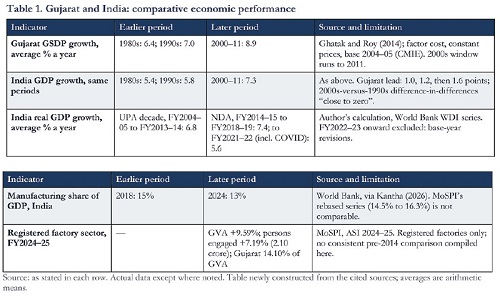
Gujarat's reputation rests on two claims: that it grew faster under Modi, and that Modi made it hospitable to business. The second is better supported than the first. Ghatak and Roy (2014) show Gujarat's average GSDP growth exceeding India's in every decade: 6.4 against 5.4 per cent in the 1980s, 7.0 against 5.8 in the 1990s and 8.9 against 7.3 in 2000–11 (Table 1). The lead widened modestly, from 1.2 to 1.6 points, but their difference-in-differences estimate for the 2000s relative to the 1990s is "close to zero", and Haryana and Tamil Nadu accelerated comparably. A panellist cites 10 per cent against 8.25 per cent for 2004–12 (Modi at 25 Material, 2026); that 1.75-point gap sits within the same band, though window and series differ.
What changed more visibly was process and perception. Vibrant Gujarat from 2003, promises of single-window clearance and the 2008 relocation of the Tata Nano from Singur to Sanand signalled a state ready for investors. Yet summit announcements are memoranda, not capital formation, and the programme's own economic journalist notes that even Gujarat has not delivered single-window clearance everywhere. The evidence is more consistent with a change in investor perception layered on a strong inherited base than with a break in growth trajectory.
From Gujarat to the Union
After 2014 the template was scaled and altered. GST arrived in July 2017, although a panellist recalls that Modi opposed it as chief minister; alongside came the Insolvency and Bankruptcy Code, dedicated freight corridors, digital public infrastructure, Jan Dhan, Make in India, Aatmanirbhar Bharat and production-linked incentives. The national phase differs mainly in political machinery: a disciplined RSS–BJP organisation and, in 2014, the first majority government since 1989 (Modi at 25 Material, 2026). Organisational continuity plausibly lowered the political cost of long-gestation reforms. It does not demonstrate that they worked.
The outcomes are mixed. Growth is robust: 7.8 per cent in FY2025–26 (PTI, 2026). In the registered factory sector, gross value added rose 9.59 per cent and employment 7.19 per cent in 2024–25, to 2.10 crore persons (MoSPI, 2026). But these cover registered factories only. Manufacturing's share of GDP, which Make in India aspired to raise to 25 per cent, was 15 per cent in 2018 and 13 per cent in 2024 on World Bank data, against 24 per cent in Vietnam and 25 per cent in China (Kantha, 2026). MoSPI's rebased series shows a rising share, from 14.5 to 16.3 per cent, a reminder that measurement matters (Kantha, 2026). Recent expansion has been driven chiefly by consumption and public investment, not an East Asian-style industrial transformation (PTI, 2026).
Geoeconomic resilience under pressure
Energy is the sharpest exposure. Import dependence was 88.2 per cent in FY2024–25 (India Sea Trade News, 2025) and 89.1 per cent, provisionally, in April–June 2026, when the crude import bill reached US$49.66 billion, a record for the quarter (KNN, 2026). Roughly half of India's 5 million barrels a day of crude transits Hormuz, and commercial stocks cover about 40–45 days of disrupted flows (Outlook Business, 2026). Diversifying suppliers lowers concentration risk; it does not change India's status as a price-taker.
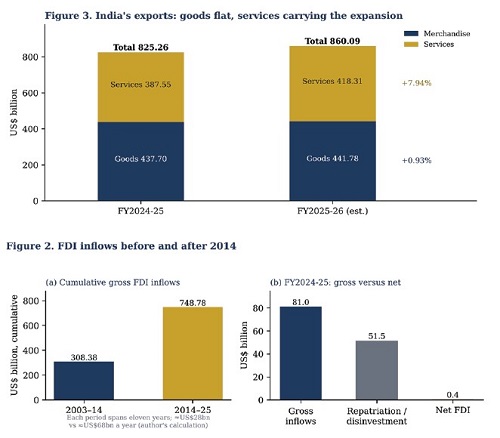
Trade tells a similar story. Total exports are estimated at US$860.09 billion in FY2025–26, up 4.22 per cent, but merchandise grew 0.93 per cent against 7.94 per cent for services The expansion is concentrated in services, where tariffs do not bite. The February framework cutting US tariffs on Indian goods from 50 to 18 per cent was followed by a Supreme Court ruling that left a 10 per cent baseline, while pending legislation could impose up to 100 per cent over Russian oil purchases.
On productive capacity, the programme argues that assembly relies on Chinese intermediates; I found no verified import-content series, the test that is missing. On capital, gross FDI of US$748.78 billion in 2014–25 is 143 per cent above 2003–14 (Business Today, 2025), yet in FY2024–25 repatriation of US$51.5 billion left net FDI at US$0.4 billion (Business Standard, 2025; Figure 2). Gross inflows reflect investor interest, not durable capital.
Resilience is not immunity. The World Bank sees private consumption as the main driver of FY2026–27 growth, with public investment offsetting weak private investment (PTI, 2026). That is resilience conditional on domestic demand and favourable monsoons, not yet structural.
UPA and NDA: a window-dependent comparison
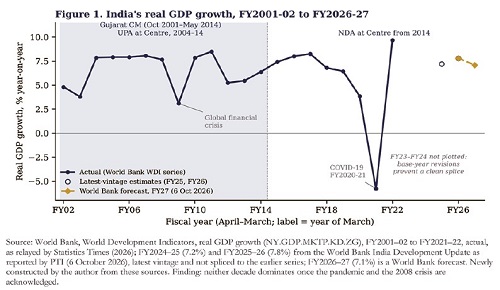
Comparison is window-dependent. On the World Bank series, growth averaged 6.8 per cent over the UPA decade (FY2004–05 to FY2013–14) and 7.4 per cent over FY2014–15 to FY2018–19, but 5.6 per cent if the pandemic years to FY2021–22 are included (author's calculation; Figure 1). The pre-pandemic NDA leads by about 0.6 points; the full window favours the UPA decade by 1.2. Neither controls for the 2008 crisis, oil prices or statistical revision: the 2018 back series lifted 2010–11 growth from 8.91 to 10.78 per cent (Business Standard, 2018).
The UPA-era controversies must be stated precisely. The CAG estimated a presumptive 2G loss of ₹1.76 lakh crore (CAG, 2010) and windfall gains of ₹1.86 lakh crore in coal allocation (CAG, 2012); the Supreme Court quashed 122 telecom licences in 2012 and declared coal allocations illegal in 2014. But the special CBI court acquitted all 2G accused in December 2017. The audit findings, judicial rulings and criminal outcomes are different things. The slowdown from 8.5 per cent in FY2010–11 to 5.2 per cent a year later coincided with these controversies; coincidence is not causation. The NDA's record likewise includes reversals, notably the withdrawn land-acquisition ordinance.
Counterargument and conclusion
The strongest objection is that headline numbers flatter. Gujarat's lead pre-dated Modi; manufacturing's share of GDP fell on World Bank data; registered factories employ 2.10 crore against some 64 crore workers nationally (MoSPI, 2026; Kantha, 2026); net FDI was negligible; goods exports are nearly flat. These facts constrain any claim of structural transformation.
Yet the objection overreaches if it dismisses what the evidence does show: faster pre-pandemic growth than the UPA decade, an upgraded World Bank forecast and rising total exports. My answer is that the Gujarat Model scaled nationally as a method — investor signalling, centralised delivery, political continuity — more than as a measurable change in industrial depth. India has demonstrated stamina against shocks. It has not yet demonstrated that it can absorb them without trading away long-term growth; withstanding a shock and being built to absorb one are different achievements.
(The content of this article reflects the views of writer and contributor, not necessarily those of the publisher and editor. All disputes are subject to the exclusive jurisdiction of competent courts and forums in Delhi/New Delhi only)






















Leave Your Comment