


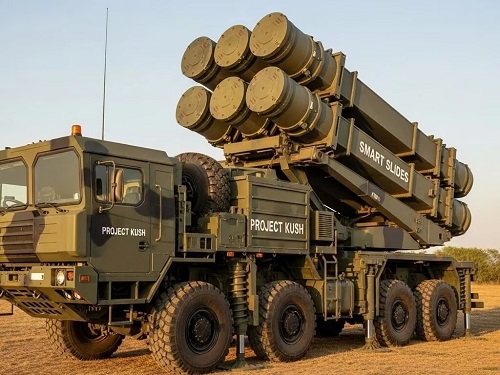
India is accelerating the development of its indigenous long-range air and missile defence capabilities under Prime Minister Narendra Modi's ambitious Mission Sudarshan Chakra, with the Defence Research and Development Organisation (DRDO) set to conduct a series of crucial interceptor missile tests over the next year. The upcoming trials under Project Kusha are expected to significantly strengthen India's multi-layered air defence architecture by introducing a new generation of long-range surface-to-air missile (LR-SAM) systems capable of neutralising missiles, drones and hostile aircraft at distances of up to 400 kilometres.
The latest milestone came on Thursday when DRDO successfully carried out the maiden test-firing of the Kusha M-1 interceptor off the coast of Odisha. The interceptor, designed to engage aerial threats at a range of around 120 kilometres, marks the first major step in the operationalisation of the ambitious project.
In the coming months, DRDO is expected to test the M-2 interceptor with an engagement range of approximately 150 kilometres, followed by the most advanced M-3 interceptor, which is being developed to destroy incoming threats at distances of up to 400 kilometres. Together, the three interceptor variants will provide India with a layered shield capable of responding to diverse aerial threats ranging from fighter aircraft and cruise missiles to ballistic missiles and unmanned aerial systems.
Project Kusha was approved by the Cabinet Committee on Security (CCS) in May 2022, but the programme has gained fresh urgency following Operation Sindoor. During the operation, Pakistan reportedly launched nearly 1,000 projectiles, including missiles and kamikaze drones, targeting Indian territory. According to officials, India's existing integrated air defence network, including the Akash Teer missile system, successfully intercepted all incoming threats, preventing damage to critical installations.
The experience of Operation Sindoor highlighted the importance of expanding India's long-range interception capability. Defence planners concluded that while India possesses effective medium-range systems and the Russian-origin S-400 Triumf air defence system, there remains a critical capability gap in the 150-400 kilometre engagement range. Project Kusha has been designed specifically to bridge this gap.
Once operational, the M-1, M-2 and M-3 interceptors will complement the existing network of medium-range surface-to-air missiles and the S-400 system, creating a seamless multi-layered defence shield capable of intercepting threats at varying altitudes and distances. This integrated approach is expected to significantly improve India's ability to defend major cities, military bases, strategic assets and critical infrastructure.
Mission Sudarshan Chakra goes beyond interceptor missiles alone. Defence officials view the project as a comprehensive anti-ballistic missile shield that combines advanced interceptor missiles with sophisticated long-range surveillance radars capable of detecting hostile missile launches across borders. These radars will provide valuable early warning, allowing air defence units additional time to identify, track and neutralise incoming threats before they reach Indian airspace.
Recent conflicts have further reinforced the strategic importance of such systems. The extensive use of long-range missiles, drones and precision-guided weapons in modern warfare has demonstrated that future conflicts are increasingly likely to rely on stand-off attacks rather than conventional ground offensives. The missile exchanges witnessed in West Asia have underscored both the effectiveness and the challenges of modern air defence networks, even those operated by technologically advanced militaries.
Indian defence planners believe these developments have made indigenous missile defence capability an urgent strategic necessity. The emphasis is now on creating a robust layered defence capable of handling saturation attacks involving multiple missiles and drones launched simultaneously.
Alongside Project Kusha, India is also strengthening its existing air defence inventory through additional acquisitions of the Russian S-400 Triumf system. The fifth contracted S-400 squadron is expected to arrive later this year, further enhancing the country's long-range interception capability.
In parallel, preparations have reportedly begun for the acquisition of another five S-400 systems under a "buy and make" framework. The proposed expansion would substantially increase India's inventory of S-400 interceptor missiles and extend coverage over additional strategic regions.
The combination of indigenous Project Kusha interceptors and imported S-400 systems is expected to create one of the most comprehensive layered air defence networks in the region. While the S-400 provides proven long-range engagement capability, Project Kusha is intended to reduce dependence on foreign suppliers by delivering a domestically developed solution tailored to India's operational requirements.
Officials indicate that Operation Sindoor has not formally concluded, and security agencies continue to maintain heightened vigilance along India's borders. Given the possibility of future missile or drone-based attacks, India is simultaneously enhancing its offensive and defensive long-range missile capabilities.
As DRDO prepares for the next series of interceptor trials, Project Kusha is emerging as one of India's most significant indigenous defence programmes. If the forthcoming M-2 and M-3 tests are successful, the project will move a step closer to providing the country with a modern anti-ballistic missile shield capable of protecting both military assets and civilian infrastructure against evolving aerial threats. Mission Sudarshan Chakra, therefore, represents not only a technological milestone but also a key pillar in India's long-term strategy to build a self-reliant and resilient national air defence system.




















Leave Your Comment