


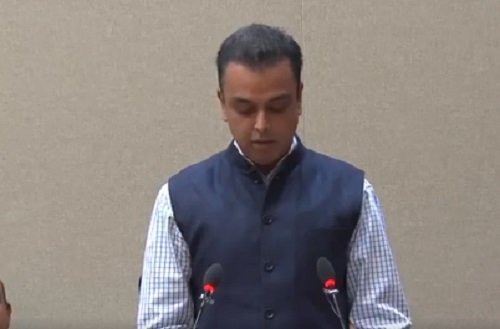
In a significant development in Indian politics, former Union Minister and prominent Shiv Sena leader, Milind Deora, took oath as a member of the Rajya Sabha. The swearing-in ceremony, held in the hallowed chambers of the Upper House of the Parliament, marked a notable stride in Deora's political journey and hinted at the evolving dynamics within the Shiv Sena party.
Milind Deora, a seasoned politician known for his astute leadership and articulate demeanor, has been a prominent figure in Indian politics for years. His entry into the Rajya Sabha under the banner of Shiv Sena comes as a surprise to many observers, considering the party's historical roots and ideological stance primarily associated with Maharashtra-centric and Hindutva politics.
The move underscores Shiv Sena's strategic realignment and its efforts to broaden its political outreach beyond its traditional strongholds. This alliance between a prominent leader like Milind Deora and Shiv Sena reflects the party's readiness to embrace a more inclusive and diverse approach, resonating with the evolving political landscape of India.
Milind Deora's induction into the Rajya Sabha also holds significant implications for Maharashtra's political dynamics. With his extensive experience and wide-ranging expertise in governance and policy matters, Deora's presence in the Upper House is likely to enhance the state's representation at the national level. His entry into the Rajya Sabha provides an additional platform for advocating Maharashtra's interests and addressing the state's pertinent issues on a broader spectrum.
Furthermore, Deora's political journey has been characterized by a progressive outlook and a commitment to constructive dialogue and consensus-building. His tenure as a Union Minister in the Congress-led government witnessed several initiatives aimed at fostering economic growth, promoting youth empowerment, and bolstering social welfare measures. His pragmatic approach to governance and emphasis on development align well with Shiv Sena's evolving narrative, which seeks to balance regional identity with a broader vision for national progress.
The decision to nominate Milind Deora to the Rajya Sabha underscores Shiv Sena's willingness to embrace a more inclusive and diverse political framework. It reflects the party's recognition of the need for expanding its ideological spectrum and engaging with a wider array of voices to address the multifaceted challenges facing the nation.
Moreover, Deora's entry into the Rajya Sabha adds another dimension to the ongoing political realignments and coalition dynamics at the national level. It underscores the fluid nature of Indian politics, where parties are increasingly open to forging new alliances and collaborations based on shared objectives and mutual interests.
As Milind Deora assumes his responsibilities as a member of the Rajya Sabha, his presence is poised to enrich the legislative discourse with his insights, experience, and progressive vision. His journey from the Congress party to Shiv Sena reflects a broader trend of political flexibility and adaptability, where leaders seek to transcend conventional boundaries and forge new pathways for meaningful engagement and governance.
In essence, Milind Deora's oath-taking as a Rajya Sabha member represents more than just a ceremonial event; it symbolizes the evolving contours of Indian politics and the potential for constructive collaboration and consensus-building across ideological lines. It is a testament to the resilience and dynamism of India's democratic framework, where diversity of thought and inclusive representation converge to shape the nation's collective destiny.






















Leave Your Comment