


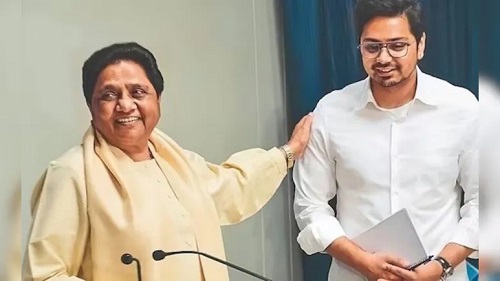
Mayawati has once again opened the door for her nephew Akash Anand, but his return to an active leadership role now comes with an unusually strict condition: his father-in-law and former BSP Rajya Sabha MP Ashok Siddharth must completely renounce politics. The latest move marks yet another reversal in the uncertain political journey of Akash Anand, who was once projected as Mayawati’s successor but has repeatedly been elevated, sidelined and restored since 2024.
In a post on X on Wednesday, Mayawati made it clear that Akash Anand’s future in the BSP is closelyng to Mayawati, only after Siddharth takes sanyas from politics would Akash Anand be able to work freely within the BSP. She also indicated that the party could then sympathetically consider restoring the responsibilities that had earlier been withdrawn from her nephew.
The wording is significant. Mayawati did not describe Siddharth’s exit merely as retirement from active politics. Instead, she called for a complete renunciation of political ambitions, suggesting that she wants a clear separation between Akash Anand’s political career and his father-in-law’s influence.
The relationship between Akash Anand and Siddharth has become a recurring issue in Mayawati’s decisions regarding her nephew. She has previously cautioned Akash against being influenced by his father-in-law and has accused Siddharth of placing personal and family interests above the BSP’s larger political mission.
Mayawati alleged that the party had given Siddharth several opportunities to correct his course, but claimed that he had failed to put the interests of Akash Anand and the BSP movement ahead of his own ambitions.
Her latest message therefore appears to be both a warning and an opportunity. Rather than permanently closing the door on Akash Anand, Mayawati has laid out a specific route through which he could potentially return to a more prominent role.
Akash Anand’s political trajectory has been particularly turbulent. Mayawati had once identified her nephew as an important figure for the BSP’s future and positioned him prominently within the party organisation.
However, that political ascent has repeatedly been interrupted. He has been elevated to key responsibilities and subsequently removed from them, with Mayawati citing concerns about his political maturity and judgment.
Last week, she announced that Akash Anand would no longer retain leadership responsibility, saying he still needed greater maturity. He was effectively left to continue as a party worker rather than as one of the BSP’s principal leaders.
The latest statement, however, suggests that the door has not been permanently shut.
Mayawati’s intervention comes at a politically crucial moment, with elections approaching in Uttar Pradesh, Uttarakhand and Punjab. She described these states as particularly important for the BSP and for the wider Dalit-Bahujan movement associated with Kanshi Ram.
She also invoked the broader political challenges confronting the Bahujan movement, particularly issues surrounding reservation. In that context, Mayawati argued that personal or family interests should not be allowed to weaken the organisation or obstruct its larger objectives.
Her message to Siddharth was therefore framed not simply as an internal BSP dispute, but as a question of political sacrifice and commitment to the movement.
The latest episode highlights the difficult balancing act facing Mayawati as she seeks to preserve control over the BSP while also dealing with questions about its future leadership.
Akash Anand’s return is no longer being presented simply as a question of political capability or maturity. Mayawati has attached it directly to the conduct and political ambitions of his father-in-law.
For Akash Anand, the message is unmistakable: the path back to the BSP’s inner circle remains open, but only if Ashok Siddharth leaves politics altogether.
That makes the latest Mayawati announcement less a final rejection of her nephew than another carefully drawn line around who can influence the BSP’s future—and on whose terms.



















Leave Your Comment